
Executive Overview
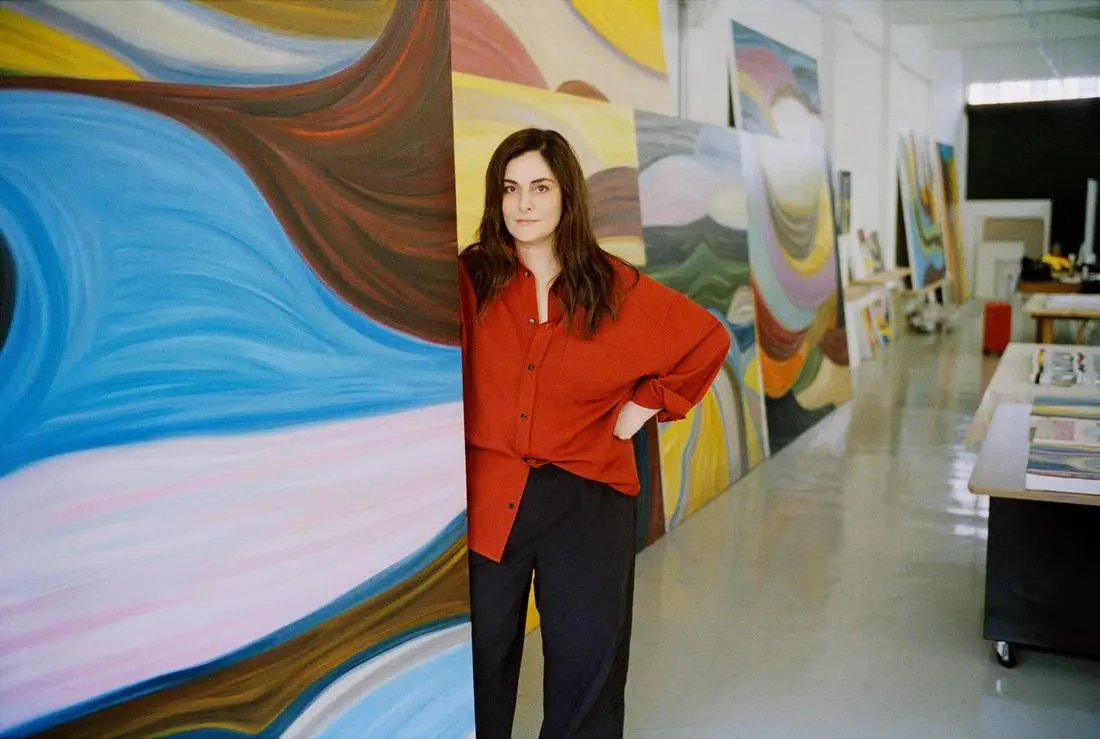
Amid the glittering chaos of Frieze London—where champagne corks perpetually pop, blue-chip gallerists orchestrate multi-million-dollar transactions, and the international art market measures its own pulse—Brazilian abstract painter Marina Perez Simão has constructed an antidote to the noise. Stepping into the architectural enclosure presented by Pace Gallery, fairgoers are invited to leave the bustling corridors behind and enter what can only be described as a meditative spaceship for contemplation.
Rather than catering to the high-octane sensory overload typical of contemporary art fairs, Simão’s presentation is a masterclass in spatial and chromatic discipline. Comprising precisely 11 newly minted canvases restricted to a rigorous triad of colors—three deep blues, three nuanced grays, and five rich magentas—the booth is laid out in a distinct cross or "X" configuration. This architectural design creates a permeable boundary. Visitors can drift inward through the central axis or peek in from the periphery, experiencing a dynamic interplay of open exposure and enclosed sanctuary.
This ambitious fair presentation marks a pivotal evolution in Simão’s career. Known historically for vibrant, high-contrast canvases where sky-blues sat brazenly atop grass-greens or fiery reds clashed with blazing oranges, the São Paulo-based artist has deliberately reined in her palette. Drawing conceptual inspiration from Pablo Picasso’s Blue and Rose Periods, as well as the ethereal pinks deployed by Fra Angelico, Simão’s newest body of work challenges the digital flattening of contemporary art. By refusing to varnish her canvases, she demands that viewers trade the distant glow of smartphone screens for a grounded, physical encounter with texture, imperfection, and depth.
Read Also
Detailed Chronology of an Evolution: From Solanaceae to the Frieze Sanctuary
To understand the intellectual rigor behind Simão’s Frieze London installation, one must trace the deliberate, step-by-step evolution of her studio practice over the past several years. Her transition toward a restrained, atmospheric palette was not an abrupt whim; it represents a calculated narrowing of focus designed to exhaust the emotional and optical capacities of specific tonal ranges.
The Groundwork: 2024 and Solanaceae
The seeds of this monochromatic and muted exploration were planted in 2024, most notably during Simão’s solo exhibition Solanaceae at Pace Gallery in Los Angeles. The exhibition title—borrowed from the scientific family name for nightshades, a botanical group containing both vital food crops and lethal toxins—signaled a turn toward darker, more mysterious psychological spaces. In these works, fragments of darkness began to punctuate her compositions, introducing silhouettes and shadows that had previously been crowded out by her exuberant use of hyper-saturated pigments.

Later that same year, this shadowy motif migrated across the Atlantic to a critically acclaimed presentation at Mendes Wood DM’s Paris gallery. Observers noted a subtle cooling of her palette, a shedding of extraneous visual noise in favor of a singular, lingering silhouette.
The Studio Lockdown: 2025–2026
When Simão began conceptualizing the works for the current cycle at the start of the year, she felt a natural, albeit inexplicable, shift taking place within her studio practice in São Paulo. Preparing for the Frieze London presentation fundamentally altered her daily rituals. In a radical gesture of creative self-discipline, Simão systematically removed anything from her studio that possessed even an ounce of unauthorized color.
She returned to her habitual working posture: standing barefoot in her socks, positioning herself far from the door beside a small terrace window, eschewing chairs entirely, and occasionally dropping directly to the floor. "These paintings required my body to be engaged," Simão reflected in an interview with ARTnews. The resulting works, produced across the first half of 2026, required an intense physical commitment that mirrored the psychological weight of working within severe self-imposed limitations.
Supporting Context & Metrics: The Physics of Color and Architecture
The spatial and material engineering of Simão’s Pace Gallery booth is as critical to its success as the paintings themselves. The layout relies on an "X" shape, establishing an intricate choreography for the viewer.
Spatial Choreography
- The Perimeter: Two blue paintings anchor either side of the structure.
- The Core: A singular, atmospheric gray painting occupies the dead center.
- The Counterbalance: Two additional paintings complete the cross-axis, creating a rhythm of discovery.
Visitors entering from different angles encounter disparate sequences of color, making the architectural journey through the booth feel akin to navigating an alien landscape. "The structure is super open and closed at the same time, but there’s also a sense of discovery depending on which side you walk through," Simão explained.

Materiality and the War on Digital Flatness
Simão’s choice of pigments and her refusal to apply surface varnish represent a direct pushback against the contemporary viewing condition mediated by Instagram and digital platforms. While acknowledging the utility of digital archives, the artist remains fiercely protective of the tactile encounter.
- The Magentas: Eschewing industrial, mass-culture associations such as "Barbie pink," bubblegum, or cotton candy, Simão turned exclusively to magenta. She manipulated this hue meticulously to replicate complex, organic tones found in nature.
- The Blues: Working predominantly straight from the tube due to the raw potency of the pigment—supplemented only by occasional dabs of white—Simão pushed the medium to its limits. By intermixing cobalt and cerulean, she coaxed unexpected greenish undertones from the blue. These canvases proved notoriously difficult to capture via photography; her team required three distinct shooting sessions simply to register how shifting light interacts with the unstable, morphing pigments.
- The Grays: Functioning as visual bridges, the gray paintings are built by layering subterranean hints of yellow and ocher beneath washes of magenta and blue. The resulting optical effect evokes the hazy, diffused glow of sunlight filtering through heavy morning fog.
In a poetic inversion of seasonal associations, Simão notes that her blue paintings radiate the heavy heat of summer, while her pink canvases evoke the chill of winter—together composing an abstract, psychological calendar.
Official Statements and Critical Perspectives
The philosophical underpinning of Simão’s work bridges the gap between abstract expression and the inscrutable complexity of the natural world. Her abstractions are never purely formal exercises; rather, they serve as emotional proxies for phenomena that defy human language.
"It’s abstract yet it has so many elements of landscape," Simão stated during her interview from São Paulo. "Nature is a big, complex, and vast organism that we don’t fully understand how it works. Art is a way to approach these things that are difficult to explain."
Describing the individual canvases as "more or less vague descriptions of strange worlds," the artist insists that each piece possesses its own distinct nature and behavioral logic. This animistic view of painting accounts for her refusal to apply a protective varnish. By exposing the raw linen and the unsealed textures of oil paint, she embraces imperfections as living proof of the artwork’s creation.

Gallery representatives at Pace have lauded the installation for providing a much-needed psychological sanctuary amid the frenzied transaction culture of Frieze Week. While neighboring booths shout for attention with high-decibel multimedia installations and aggressively commercial blue-chip inventory, Simão’s "spaceship" operates on an entirely different frequency—demanding stillness, slow-looking, and contemplative silence.
Future Outlook: The Horizon for Marina Perez Simão
As Marina Perez Simão’s market presence continues its steady, stratospheric ascent, her Frieze London presentation signals an artist entering a mature phase of deep introspection. By resisting the temptation to endlessly replicate the hyper-vibrant formulas that initially earned her international acclaim, she has demonstrated a rare curatorial and artistic courage.
The disciplined chromatic narrowing seen in the blue, gray, and magenta cycles suggests a long-term commitment to serial investigation. Art historians and market analysts alike will be watching to see how these cooler, more atmospheric tonalities influence her upcoming institutional projects and solo presentations.
For now, inside the quiet cross-shaped architecture of the Pace Gallery booth, Simão has successfully carved out a temporal and spatial void. In a week dedicated to buying, selling, and networking, she has reminded the international art world of a fundamental, immutable truth: the encounter with a painting remains an intimate, physical, and deeply mysterious communion between human bodies and raw earth pigments.

Comments
Facebook App ID not configured. Please add it in the Customizer.