
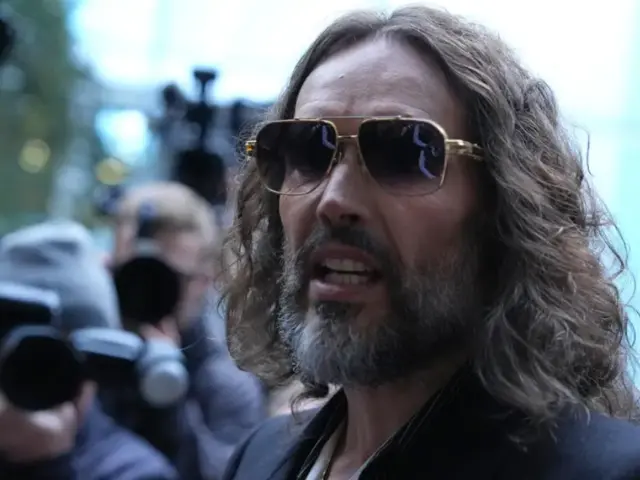
LONDON — British comedian and media personality Russell Brand stands trial at London’s Southwark Crown Court, facing a battery of serious criminal charges that threaten to irrevocably dismantle his public persona and digital empire. Prosecutors opened the high-profile legal proceedings by characterizing the 51-year-old entertainer as a "sexual predator" who leveraged his rising fame, charm, and platform to execute a calculated pattern of abuse against vulnerable women.
Brand, who has vehemently denied all wrongdoing, faces a total of seven sexual offence charges involving six distinct complainants. The alleged incidents span a decade, from 1999 to 2009—a formative era during which Brand transitioned from an underground stand-up act into a mainstream television and radio celebrity. As the courtroom doors opened to intense international media scrutiny, the trial brings into sharp focus the complex intersection of celebrity culture, historical accountability, and the legal standards governing consent.
Executive Overview
The commencement of the trial at Southwark Crown Court marks a watershed moment in the public accountability of prominent media figures. Brand, dressed distinctively in a dark suit paired with a black-and-white striped shirt and a long white tie, arrived at the courthouse accompanied by his wife, Laura. Inside, a jury composed of eight men and four women listened intently as the prosecution outlined a decade-long narrative of alleged manipulation, coercion, and non-consensual sexual violence.
Read Also
The prosecution’s case rests on the testimonies of six women whose identities have been legally protected. According to trial documentation and opening statements delivered by prosecutor Riel Karmy-Jones KC, Brand operated with a "voracious and indiscriminate" desire for sexual contact, demonstrating a profound disregard for personal boundaries. The charges against him include three counts of rape, three counts of sexual assault, and one charge of indecent assault.
In response to police inquiries, Brand maintained a uniform defense, issuing prepared statements in which he claimed he could not remember the complainants and asserting that any sexual activity that occurred was entirely consensual. Nevertheless, the prosecution argues that these encounters were underpinned by a systematic exploitation of power dynamics, where Brand’s public status and comedic talent were weaponized to disarm his targets.
Detailed Chronology and Allegations
The legal framework of the prosecution’s case constructs a chronological timeline of alleged offences dating back to the late 1990s. Spanning multiple cities, professional environments, and private residences, the charges paint a disturbing picture of opportunistic predation that scaled alongside Brand’s professional trajectory.
The 1999 Incident: Bournemouth
The earliest alleged offence dates back to 1999, a period when Brand was establishing his footing in the entertainment industry. According to the prosecution, the first complainant encountered Brand while he was performing at a Labour Party conference in Bournemouth, southern England.
The woman reportedly invited Brand back to her hotel room. Rather than engaging in a mutual encounter, the prosecution alleges that Brand aggressively pushed her onto the bed and proceeded to rape her without utilizing a condom. This incident established what prosecutors describe as an early blueprint for subsequent assaults: exploiting private or semi-private settings to overpower victims who trusted his public persona.
The 2001 MTV Incident
By 2001, Brand’s career had expanded into television, notably through his work with MTV. The prosecution detailed an incident wherein Brand allegedly attempted to physically drag a woman into a toilet cubicle at the network’s office spaces. While the woman successfully resisted his advances, prosecutors point to this event as evidence of an escalating boldness in his professional environments, where he allegedly felt emboldened by his corporate affiliation.
The 2004 London Bar and Radio Station Incidents
The year 2004 brought multiple allegations highlighting Brand’s aggressive tactics in social and professional settings. In one instance, a woman met Brand at a London bar. He allegedly grabbed her breasts and forcibly pulled her into a toilet cubicle, where he subjected her to oral rape after dismissing her resistance and telling her not to be a "spoilsport."
Later that same year or into 2005, another complainant—who worked at a radio station Brand visited professionally—reported that the comedian kissed her with extreme aggression before grabbing her breasts and bottom without her consent. These incidents underscore a recurring theme in the prosecution’s opening statements: Brand’s inability to accept rejection or respect bodily autonomy.
The 2009 Incidents: Residential and Studio Allegations
As Brand’s fame reached new heights toward the end of the decade, the alleged severity of the offenses escalated. In 2009, a woman who was 21 years old at the time visited Brand’s home. According to the prosecution, she engaged in consensual oral and vaginal sex with the comedian. However, the encounter allegedly turned non-consensual when Brand forced her into anal sex "with full force" and without a condom, despite her explicit lack of consent.
The final charge in the indictment involves a Channel 4 employee working with Brand in a recording studio later in 2009. According to the testimony, members of Brand’s own production team informed the female employee that she was required to give the comedian a massage. During this enforced interaction, Brand allegedly pressed his face directly into her groin, crossing professional and legal boundaries under the guise of production demands.
Supporting Context and Metrics
The prosecution’s narrative was heavily supported by contextual evidence concerning Brand’s lifestyle, psychological profile, and professional network during the decade in question.
The "5,000 Women" Ambition
To illustrate Brand’s mindset, prosecutor Riel Karmy-Jones referenced statements from acquaintances of the defendant from that era. Witnesses recalled Brand openly boasting about a personal life goal: to "bed 5,000 women in his lifetime." According to these testimonies, Brand explicitly remarked that achieving such a goal required a calculated approach, telling associates, "you have to tell them what they need to hear." The prosecution presented this as smoking-gun evidence of his manipulative methodology—using charm, flattery, and performance to lower the defenses of prospective targets.
The Catalyst for Investigation
The women at the center of the trial did not initially come forward to law enforcement during the period the offences allegedly occurred. Instead, the legal proceedings were set into motion following investigative media reports published in 2023, which prompted the complainants to re-evaluate their experiences and approach authorities. Formal charges were subsequently brought against Brand in 2025, culminating in the current criminal trial.

Media Scrutiny and Public Interest
The trial at Southwark Crown Court has attracted unprecedented media attention, transforming the legal proceedings into a global media event. British broadcasting networks have established dedicated investigative podcasts to follow the daily developments, while international news agencies, particularly from the United States, have stationed correspondents outside the courthouse. This level of interest reflects broader cultural conversations surrounding institutional accountability, power imbalances in the entertainment industry, and the long-term processing of historical sexual trauma.
Official Statements and Defense Posture
The Prosecution’s Position
The Crown Prosecution Service (CPS) has framed its case around the systematic nature of Brand’s actions. Prosecutor Riel Karmy-Jones emphasized to the jury that Brand’s public charm masked a darker, predatory reality:
"He was ruthless, calculated and manipulative, and the prosecution say—a sexual predator… His desire for sexual contact was indiscriminate and voracious. He was not deterred when some of the women said no."
Furthermore, the prosecution highlighted the psychological dichotomy Brand allegedly maintained: transitioning effortlessly from a charismatic, witty comedic persona to a "demanding and entitled" figure displaying a "childlike expectation that his every desire should be met."
The Defense’s Stance
Brand has maintained his innocence throughout the legal process, entering formal pleas of not guilty to all seven charges. In response to each individual allegation put forward by police during the investigative phase, Brand submitted formal written statements asserting that he had no recollection of the women in question and maintaining that any sexual encounters were entirely consensual.
His legal team is expected to challenge the credibility of the complainants, question the delayed reporting of the alleged incidents, and argue that the historical nature of the claims makes it difficult to establish objective facts beyond a reasonable doubt.
Evolution of a Public Figure: From Mainstream Icon to Digital Guru
To fully contextualize the gravity of the trial, observers must examine Brand’s extraordinary trajectory through the British and global media landscapes.
Rise to Prominence
Born to working-class parents in Essex, eastern England, Brand began his career as a stand-up comedian in his teens. He achieved household-name status in the UK during the 2000s through high-profile presenting roles on MTV, Channel 4, and the BBC. Known for his eccentric persona, rapid-fire wit, and counter-cultural posturing, Brand expanded his reach into print journalism—writing regular newspaper columns—and authored two candid autobiographies.
His crossover appeal eventually secured him roles in Hollywood blockbusters such as Forgetting Sarah Marshall and Get Him to the Greek. During this period, he also engaged in a brief, highly publicized marriage to American pop star Katy Perry.
The Digital Reinvention
In recent years, following a cooling of his mainstream television career, Brand underwent a radical ideological and professional reinvention. He positioned himself as a conservative commentator, wellness guru, and alternative media personality, broadcasting anti-establishment views to millions of followers online.
Today, despite the swirling controversies and legal challenges, Brand commands a massive digital footprint. He operates out of Florida—where he currently lives with his wife and young family—boasting approximately:
- 6 million subscribers on YouTube
- 10.1 million followers on X (formerly Twitter)
- 4.9 million followers on Instagram
This digital ecosystem has allowed Brand to maintain a loyal base of supporters who consume his daily content, creating a stark contrast between his online following and the grave legal realities playing out inside a London courtroom.
Future Outlook
The trial at Southwark Crown Court is projected to last approximately six weeks, though scheduling complexities and extensive testimonies could push proceedings well into December.
For the legal system, the case serves as a major test of prosecuting historical sexual assault allegations against wealthy and influential defendants. For the public and the media industry, the trial reinforces ongoing debates regarding accountability, the mechanics of fame, and the mechanisms available to victims seeking justice decades after alleged incidents occur.
As the jury hears further testimonies in the coming weeks, the outcome of the trial will determine not only Russell Brand’s personal and legal future but will also stand as a definitive milestone in the accountability reckoning of the modern entertainment era.



Comments
Facebook App ID not configured. Please add it in the Customizer.