
Executive Overview
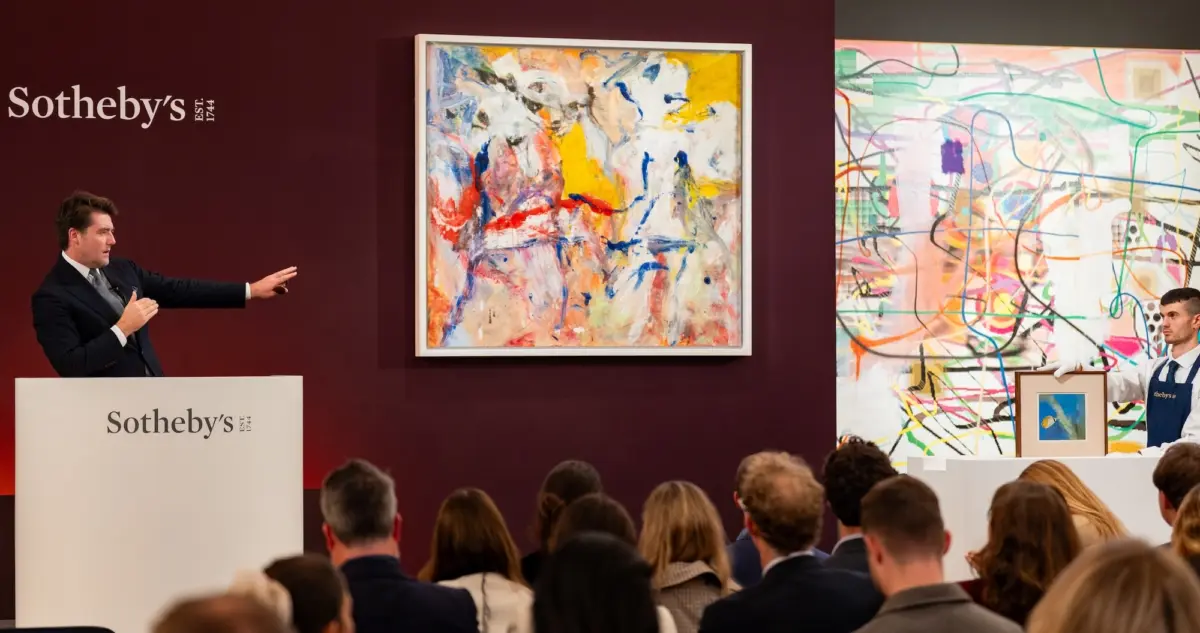
Against the backdrop of a bustling London Frieze Week, Sotheby’s hosted a closely watched, high-stakes contemporary art evening sale that ultimately yielded a steady £46.1 million ($61.1 million). Conducted within a packed saleroom that crackled with tense, silent moments, the one-hour auction unfolded under the sharp eye of auctioneer Tom Eddison. To seasoned observers, the atmosphere felt less like a celebratory commercial gala and more like a solemn courtroom proceeding, defined by anxious pauses, measured bidding, and a palpable air of market-wide calculation.
The 34-lot auction carried an overall pre-sale estimate of £41.7 million to £58.6 million ($55.3 million to $77.8 million). While the final tally landed comfortably within expectations, the hammer total of £36.9 million—calculated before the inclusion of the auction house’s buyer’s fees—fell just shy of the low end of its projected range. This nuanced performance underscored a broader narrative currently dominating the upper echelons of the fine art trade: while capital and liquidity are undeniably present, collectors and institutions are exercising unprecedented restraint, favoring selective acquisitions over speculative buying sprees.
The evening was anchored by a robust offering of blue-chip masterpieces and select regional surprises, led by Willem de Kooning’s striking 1977 abstraction. Yet, the auction also bore the scars of a cautious market climate, marked by pre-sale withdrawals, unsold lots from prominent names, and a general reluctance to push prices into unchartered territory. As the global art market continues to recalibrate in the wake of economic shifts, Sotheby’s London sale serves as a vital barometer for collector sentiment during one of the most critical weeks on the international art calendar.
Read Also
Detailed Chronology: An Hour of Measured Bidding
The tempo of the evening was established long before the first lot crossed the block. Ten of the 34 cataloged works carried third-party or house guarantees, offering a safety net in an otherwise jittery market. However, market jitters were visibly compounded by late withdrawals: works by Damien Hirst, Anselm Kiefer, and Leon Kossoff were pulled from the lineup before the auction formally commenced, signaling that consignors and auctioneers alike were unwilling to risk sub-par public showings.
As Tom Eddison took the podium, the room fell into a heavy quiet. The pacing of the sale was deliberate. Bidding unfolded with a clinical precision that lacked the euphoric momentum seen during peak market cycles in previous years.

The crown jewel of the catalog, Willem de Kooning’s untitled 1977 abstract canvas—measuring an impressive five feet wide—commanded the room’s full attention. Estimated at £8 million to £12 million ($10.6 million to $15.9 million), the painting followed a steady upward trajectory before hammering at £8.2 million. With fees included, the final price reached £9.8 million ($12.9 million), comfortably hitting its target. The work’s provenance added to its allure, having last traded at Sotheby’s New York in 2015 for $6.1 million.
Following the de Kooning, Gerhard Richter’s sweeping, eight-foot-wide Abstraktes Bild (1992) stepped into the spotlight. Estimated between £6 million and £8 million ($7.9 million to $10.6 million), the canvas ultimately hammered below expectations at £5.4 million, translating to a total of £6.7 million ($8.9 million) with buyer’s premiums. The seller, who had acquired the work at Christie’s London in 2011 for £3.6 million ($5.7 million at the time), watched as the room offered polite, rather than aggressive, competition.
The mid-tier of the top lots featured an untitled, dark-hued Mark Rothko abstract from 1969. Estimated at £3 million to £4 million ($4 million to $5.3 million), the painting hammered precisely at its low estimate to fetch £3.8 million (just shy of $5 million) with fees. This canvas also carried a lengthy tenure in private hands, having been purchased by the evening’s seller at Christie’s New York in 1992 for a modest $264,000—a testament to the long-term value retention of institutional-grade twentieth-century masters, even in a cooling market.
Despite these anchoring sales, the auction experienced notable turbulence further down the roster. Works by blue-chip and high-profile contemporary figures including Banksy, Georg Baselitz, Jadé Fadojutimi, Lucian Freud, Gerhard Richter, and Lynette Yiadom-Boakye ultimately failed to find buyers, ending up on the "unsold" list and highlighting the strict parameters within which modern collectors are currently operating.
Supporting Context & Metrics: Market Comparisons and Regional Triumphs
To properly contextualize Sotheby’s £46.1 million evening, one must view it alongside the broader ecosystem of London Art Week. The sale took place just one night after a remarkably strong, albeit safe, evening at rival auction house Christie’s. Christie’s two-part London sales totaled a staggering £218.6 million ($289.4 million)—more than double its total from the corresponding period the previous year. This capital concentration at Christie’s occurred parallel to high-attendance days at the Frieze London fair, where celebrities like Tilda Swinton and Raf Simons rubbed shoulders with international dealers who reported brisk, robust transactions across gallery booths.

When stacked against its own historical benchmark, Sotheby’s contemporary evening sale showed a slight contraction. The equivalent sale the previous year totaled £47.6 million ($63.3 million), spearheaded by a Francis Bacon masterpiece that alone fetched £13 million ($17.5 million).
Yet, within the micro-climate of Thursday’s auction, localized and regional connections proved to be powerful drivers of value. As art historian and consultant Ivana Miloradovic aptly observed during the event: "British sales on British soil are always joyous." Miloradovic pointed to the palpable enthusiasm surrounding homegrown talents, such as David Hockney’s 10th–22nd June 2021, Water Lilies in the Pond with Pots of Flowers (2021) and Michael Andrews’s captivating 1978 work on paper, Butterfly Fish. "Everybody knows the artist, the gossip, and the history," Miloradovic noted. "It was a homey atmosphere."
Indeed, Butterfly Fish emerged as one of the evening’s most electrifying surprise successes. Depicting the marine animal with exquisite technical economy, the work shattered expectations. Estimated at a modest high of £120,000, it ignited an extended bidding contest that drove the hammer price to £550,000. With fees, the total soared to £704,000 ($933,117), setting a historic high watermark for a work on paper by Andrews.
Though Andrews is sometimes historically overshadowed by School of London peers like Francis Bacon and Lucian Freud, his historical reputation among fellow practitioners remains unassailable. Fellow painter Frank Auerbach once remarked of him: "Mike is so economical. He paints only masterpieces."
The under-50 contemporary cohort experienced a mixed, yet respectable, showing. Louis Fratino’s intimate painting Kissing Couple (2019) met expectations by bringing in £320,000 ($424,144), mirroring the performance of Adrian Ghenie’s The Wall (2019), which also sold within estimate for £640,000 ($848,288). (Fratino’s market strength is currently buoyed by a sold-out solo exhibition at David Zwirner’s London gallery.) Conversely, works by younger market darlings like Jadé Fadojutimi failed to clear, proving that youth and prior market heat are no longer automatic immunities against buyer selectiveness.

Official Statements and Expert Perspectives
Industry leaders and market analysts were quick to dissect the psychological undercurrents of the sale room. The consensus among specialists pointed toward a profound maturation of the collector base—one characterized by disciplined selectivity rather than impulsive acquisition.
"I would say the market is very cautious," Ivana Miloradovic reiterated in an interview with ARTnews on the sales floor. Analyzing the distribution of results, she observed that the majority of the cataloged lots "either underperformed or were at the lower end" of their projected valuations, reflecting a buyer demographic that refuses to overextend.
Weighing in on the runaway success of Michael Andrews’s Butterfly Fish, Ottilie Windsor, head of contemporary art at Sotheby’s London, elaborated on the structural supply dynamics governing the secondary market for twentieth-century British masters.
"The paintings that he did make were often bought as they were being made by a group of collectors who followed his work really closely," Windsor explained. These core patrons have historically maintained tight ownership circles, creating a dynamic where "they’ve never really needed to sell, and so we get a very, very low supply of his work to the market. When they do come up, they really do very well."
Defending the overall health of the auction against critics who pointed to the high rate of unsold lots and the hammer total falling beneath the low estimate, Windsor offered a pragmatic defense. Pointing out that 28 out of 34 lots successfully transitioned to new owners, she argued that the conversion rate was entirely healthy given current economic headwinds. "Any dealer at the [Frieze] fair would be thrilled to sell nearly 30 secondary market lots," she asserted.

Windsor concluded with a balanced assessment of contemporary collecting trends: "There is both interest and money in the market, but the market continues to be selective and continues to surprise us with what it’s looking for."
Future Outlook: The Trajectory of the Secondary Market
As the dust settles on Frieze Week and London’s autumn auction cycle, the key takeaway from Sotheby’s contemporary sale is clear: the fine art market has entered an era of calculated consolidation. The era of unchecked enthusiasm, where virtually any blue-chip or trending name could command astronomical premiums regardless of condition, provenance, or pricing accuracy, has temporarily receded.
Moving forward into the upcoming New York and Hong Kong autumn sales cycles, consignors, auction houses, and galleries must adapt to this recalibrated reality. Success at the podium will increasingly rely on three core pillars:
- Pragmatic Estimates: Valuation models must align more closely with conservative buyer appetites to avoid the friction of unsold lots or reliance on heavy third-party guarantees.
- Impeccable Provenance: Collectors are prioritizing museum-quality works with clear, unblemished exhibition histories and long-term private retention.
- Regional Resonance: Localized enthusiasm—as demonstrated by the fervent demand for British masters like Michael Andrews and David Hockney—proves that contextual narrative and historical intimacy can successfully anchor a sale even when macroeconomic indicators flash caution.
Ultimately, Sotheby’s £46.1 million evening proves that while liquidity remains deep, the contemporary art market is no longer driven by speculative frenzy. Instead, it is guided by connoisseurship, patience, and an unwavering demand for true quality—qualities that will ultimately dictate the health and resilience of the global art trade in the seasons to come.



Comments
Facebook App ID not configured. Please add it in the Customizer.