For decades, the narrative surrounding the titan of Abstract Expressionism, Jackson Pollock, and his wife and fellow artist, Lee Krasner, has been defined by a stark imbalance. Pollock was cast as the tragic, solitary genius—a hyper-masculine pioneer of the American avant-garde whose dynamic drip paintings shattered European traditions and whose tumultuous life and tragic death cemented his mythos. Krasner, meanwhile, was routinely relegated to the footnotes of art history: the long-suffering helpmate, the protective studio manager, the dutiful widow who managed his estate long after his fatal 1956 car crash.
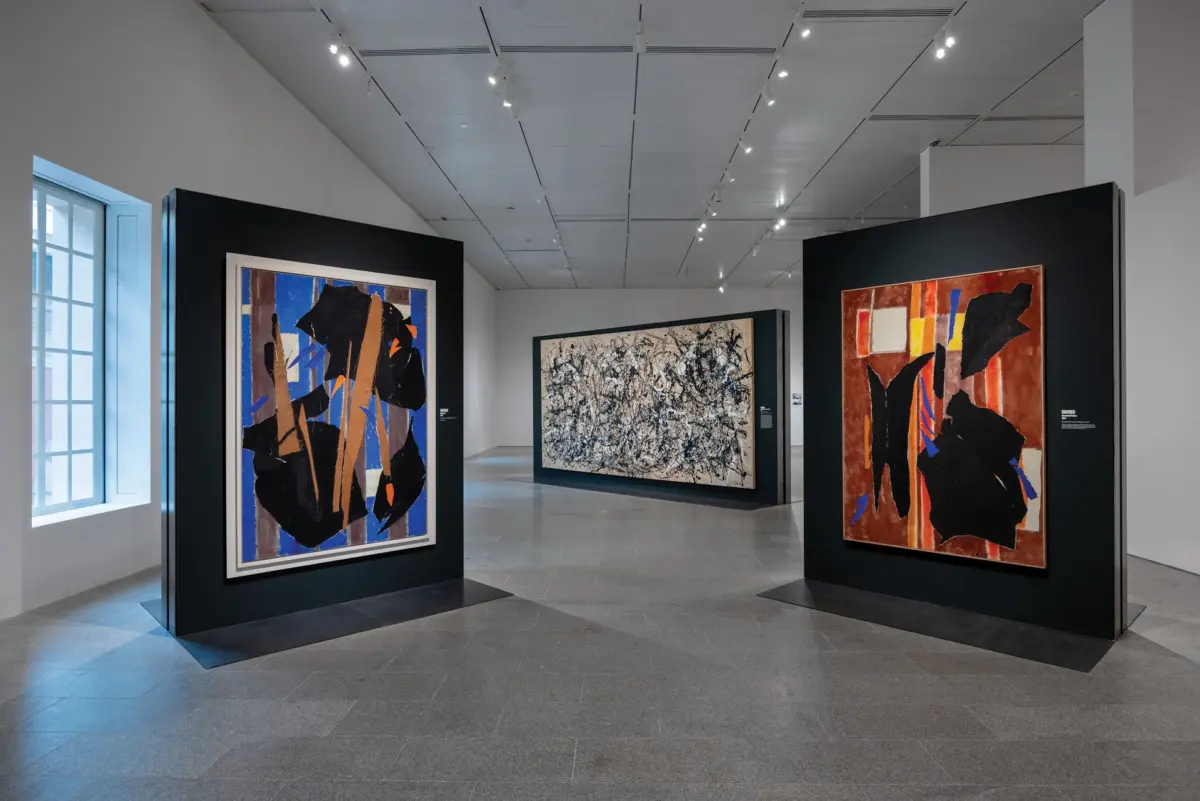
Enter "Krasner and Pollock: Past Continuous," a monumental and long-overdue exhibition at the Metropolitan Museum of Art. Bringing together more than 120 works in a once-in-a-lifetime gathering, the exhibition fundamentally disrupts the patriarchal myths that have long governed the historical assessment of mid-century American art. Rather than viewing Krasner through the prism of Pollock’s towering shadow, "Past Continuous" treats the couple as true artistic equals, examining their lives, cross-pollinations, and creative struggles through a nuanced, daring, and expansive lens.
By centering Krasner’s fierce emergence, her innovative handling of collage, and her triumphant post-Pollock career—which spanned another 28 years—the exhibition rewrites the history of Abstract Expressionism. It reveals a complex creative partnership where influence flowed both ways, and where Krasner’s resilience, intellectual rigor, and relentless self-reinvention proved that her artistic output was every bit as revolutionary as her husband’s.
Detailed Chronology: From First Encounters to Artistic Independence
To understand the scope of "Past Continuous," one must trace the trajectory of Krasner and Pollock’s relationship from its serendipitous beginnings to its tragic end and Krasner’s subsequent decades of solitary masterworks.
The Pre-War Foundations and the 1942 Convergence
The exhibition’s curators employ a biographical yet deeply analytical approach, dedicating early galleries to the artists’ respective outputs before they ever crossed paths. Visitors are greeted by contrasting self-portraits: Krasner’s sharply observed graphite-and-crayon likeness from around 1929–30, and Pollock’s moody, heavily impastoed, muddy-brown self-portrait executed between 1930 and 1933. These early works signal two distinct temperaments—Krasner’s precision and acute self-awareness paired against Pollock’s brooding, visceral intensity.
Their paths officially intersected in 1942 through a group exhibition titled "American and French Painting," curated by the Russian émigré artist and theoretician John Graham. The show placed Pollock and Krasner alongside luminaries such as Stuart Davis, Willem de Kooning, Pablo Picasso, and Henri Matisse. Upon viewing the exhibition and encountering Pollock’s work for the first time, Krasner tracked him down. The rest, as they say, is history—though history has historically chosen to remember only one half of that encounter.
The Springs, Long Island: Domesticity and the Drip Revolution
"Past Continuous" opens immersively with panoramic archival footage of the couple’s unheated, two-story shingled house and studio in Springs, East Hampton. Historic stills flicker across the screen, showing Pollock, Krasner, their dog Gyp, and a tamed crow named Caw Caw. For nearly eleven years, this remote Long Island sanctuary served as the crucible of Abstract Expressionism.
It was here, far from New York City’s bustling watering holes like the Cedar Bar, that Pollock revolutionized modern art. Inspired by the pioneering drip paintings of self-taught Ukrainian-born artist Janet Sobel—specifically her work Milky Way (1945), which Pollock viewed at Peggy Guggenheim’s Art of This Century gallery in 1946—Pollock unrolled unprimed canvas directly onto his studio floor. Working horizontally, he applied enamel and industrial house paints using sticks, hardened brushes, and basters, never physically touching the canvas surface. This breakthrough yielded masterpieces like Galaxy (1947) and the lyrically expansive Number 1, 1950 (Lavender Mist).
Yet, the media machinery of the era quickly flattened this collaborative, fertile environment into a solo act. A landmark 1954 feature in LIFE magazine famously asked, "Jackson Pollock: Is he the greatest living painter in the United States?" Illustrated with four dramatic photographs of Pollock smoking a cigarette in paint-splattered jeans, the spread celebrated him as a brooding, hyper-masculine solitary genius. Krasner was entirely omitted.
Mid-1950s Crises and Krasner’s Phoenix-Like Rebirth
The midpoint of the exhibition shifts dynamically to the mid-1950s, a period marked by profound personal and artistic crises. While Pollock spiraled out of control—grappling with severe alcoholism, creative blocks, and infidelity—Krasner reached an artistic turning point that would define her career.
Rather than succumbing to the tragedy of her husband’s decline, Krasner engineered a breathtaking emergence. In works like Bald Eagle (1955), she utilized discarded scraps of dark brown linen and unprimed canvas left over from both her own and Pollock’s studio waste. The central white shape, reminiscent of a bird’s profile, incorporates a dripped black line executed by Pollock. By recycling the rejected fragments of their shared artistic life, Krasner metaphorically tore down the old order and rebuilt herself like a phoenix from the ashes.
This period also saw Krasner’s groundbreaking 1955 solo exhibition at the Stable Gallery. The show earned high praise from critic Clement Greenberg, who proclaimed her "a major addition to the American art scene of the era." However, even Greenberg drew hierarchical boundaries, comparing her adaptation of collage to Picasso while reserving his highest, genre-defining accolades for Pollock’s drip paintings. It was precisely this glass ceiling that Krasner fought against throughout her lifetime.
The Post-Pollock Decades: Monumental Autonomy
The tragedy of August 1956—when Pollock died in a drunk-driving crash that also killed passenger Edith Metzger and injured companion Ruth Kligman—left Krasner a widow at the age of 48. At the time of the crash, Krasner had been traveling in Europe, attempting to distance herself from Pollock’s destructive behavior.
Instead of retreating into mourning, Krasner seized control of her artistic destiny with renewed vigor. The later rooms of "Past Continuous" are triumphantly dominated by her large-scale, audacious works. In The Seasons (1957), a sprawling 17-foot canvas executed just one year after Pollock’s death, Krasner returned to themes of rebirth, infusing the composition with bold, biomorphic forms resembling genitalia.
Her restless experimentation continued unabated across the subsequent decades:
Blue Level and Desert Moon (1955): Constructing a sturdy, vertical world of solid blues and reds, these works serve as aspirational self-portraits where destruction and rebirth merge.
Kufic (1965): A spare, contemplative masterpiece referencing the oldest style of Arabic calligraphy, highlighting her lifelong fascination with linear marks and writing.
Rising Green (1971): A testament to her mastery of scale, color, and emotional resonance.
Past Continuous (1976) and Future Indicative (1977): Monumental late-career collages incorporating charcoal figure drawings from her student days under Hans Hofmann, proving that her self-critical eye and inventive spirit never waned.
Supporting Context & Metrics: Challenging the Market and Historical Biases
The cultural and financial imbalances that "Past Continuous" seeks to correct are deeply embedded in the art market and publishing industries. To appreciate the Met’s intervention, one must examine the macroeconomic and cultural metrics that have historically favored Pollock over Krasner.
Metric / Milestone
Jackson Pollock
Lee Krasner
Market Valuation
Entered the exclusive "$100 million club" following a blockbuster May auction.
Steadily rising institutional and auction demand, though historically undervalued relative to male Abstract Expressionists.
Biographical Canon
Subject of the 934-page Pulitzer Prize-winning biography Jackson Pollock: An American Saga (1991).
Explored primarily in relation to Pollock, though increasingly the focus of independent monographs and scholarly re-evaluations.
Hollywood Adaptation
Inspired the feature film Pollock (2000), which earned Marcia Gay Harden an Academy Award for her portrayal of Krasner.
Her portrayal won an Oscar, yet the film’s primary focus remained centered on Pollock’s artistic trajectory.
Exhibition History
Celebrated globally as the quintessential lone genius of the New York School.
Subject of seminal corrective exhibitions, including Barbara Rose’s 1981 “Krasner/Pollock: A Working Relationship.”
Before she ever met Pollock, Krasner demonstrated a fierce intellectual independence. In her studio, she inscribed lines from Arthur Rimbaud’s harrowing poem A Season in Hell onto her wall:
To whom shall I hire myself out? What beast must I adore? What holy image is attacked? What hearts shall I break? What lie must I maintain? In what blood tread?
As a self-proclaimed "tough cookie" navigating a deeply misogynistic art world, Krasner understood the existential compromises required to maintain artistic integrity. Early curatorial attempts to address this—such as Barbara Rose’s 1981 exhibition “Krasner/Pollock: A Working Relationship”—aimed to frame their marriage as a partnership of equals, but those efforts ultimately failed to dislodge Pollock from his pedestal. "Past Continuous" succeeds where past attempts fell short because it refuses to let Pollock overshadow Krasner’s independent genius, giving her practice equal floor space, critical weight, and visual dominance in the exhibition’s final galleries.
Official Statements and Curatorial Vision
The Metropolitan Museum of Art’s curatorial team has emphasized that "Past Continuous" is not merely an exercise in revisionist history, but an essential recalibration of mid-century modernism.
In exhibition notes, museum organizers state:
“For too long, the historical framework of Abstract Expressionism has relied on a single-narrative archetype: the tortured male hero working in isolation. By examining Krasner and Pollock not as master and muse, but as two distinct, mutually influential titans working in constant dialogue, we are able to see the full complexity of their artistic outputs. Krasner was never a secondary participant in her own life; she was a pioneer whose collages and late-career paintings charted entirely new territories for American art.”
Art historians and critics reviewing the exhibition have similarly praised its bold structural choices. By placing Krasner’s mid-50s collages in direct dialogue with Pollock’s stagnation and decline, the exhibition presents a sophisticated psychological and aesthetic argument. It demonstrates that Krasner’s breakthroughs were forged in the crucible of domestic and creative friction, and that her ability to cannibalize discarded materials—including Pollock’s own rejected canvases—was an act of supreme artistic sovereignty.
Future Outlook: A New Standard for Art Historical Scholarship
"Krasner and Pollock: Past Continuous" arrives at a pivotal moment in art history, coinciding with a broader institutional reckoning regarding the systemic exclusion of women artists from the canon of Abstract Expressionism. For decades, female practitioners like Krasner, Helen Frankenthaler, Joan Mitchell, and Grace Hartigan were sidelined or viewed through familial attachments to male counterparts.
The success of the Metropolitan Museum’s exhibition establishes a new benchmark for how museums can present artist couples without collapsing one identity into another. By balancing biographical intimacy with rigorous formal analysis, "Past Continuous" ensures that future generations will no longer view Lee Krasner as a footnote in Jackson Pollock’s biography. Instead, Pollock and Krasner are restored to their rightful place as mutually dynamic forces—two distinct American masters whose intertwined lives shaped the course of modern art, but whose respective legacies demand to be evaluated on their own terms.
As institutions continue to unpack the complexities of mid-century modernism, "Past Continuous" points toward a more inclusive, accurate, and expansive future for art history—one where Lee Krasner’s powerful contributions burn as brightly as any icon of the American avant-garde.





Comments
Facebook App ID not configured. Please add it in the Customizer.