
By Michael Kozlowski
Published by Good e-Reader
Executive Overview
In the consumer electronics industry, few things evoke as much immediate frustration as unannounced omissions in product packaging. For years, tech giants have systematically stripped standard accessories from retail boxes under the banner of environmental sustainability and waste reduction. While consumers have largely grown accustomed to the absence of wall adapters in smartphone packaging, a new frontier of minimalist unboxing has arrived—and it is hitting e-reader enthusiasts directly in the wallet.
With the launch of the 13th-generation Kindle lineup, Amazon has fundamentally rewritten the unboxing experience. For the first time in the history of the world’s most popular e-reader brand, the retail box is entirely devoid of a USB-C charging cable. This sweeping policy applies uniformly across the entire hardware ecosystem: the base Kindle, the Kindle Paperwhite, the Kindle Colorsoft, various Signature Editions, and even the newly introduced aluminum-backed models. Compounding the issue, even premium accessory bundles containing wall chargers and protective covers fail to include a basic charging cord.
Read Also
This hardware omission does not occur in a vacuum. The 13th-generation devices arrive amid steep price hikes, with retail tags jumping between $30 and $60 compared to their 12th-generation predecessors. For consumers facing significant inflation on the devices themselves, being forced to separately source, purchase, or scavenge a compatible charging cable feels less like an eco-conscious crusade and more like corporate nickel-and-diming. This investigative report explores the operational context of Amazon’s decision, consumer backlash, regional pricing disparities for standalone cables, and what this shifting retail standard means for the future of digital reading hardware.
Detailed Chronology: The Evolution of the Kindle Unboxing Experience
To understand the magnitude of Amazon’s recent pivot, it is essential to trace how the contents of a Kindle box have evolved over more than a decade of market dominance.
The Golden Age of In-Box Inclusions
In the early days of dedicated e-readers, unboxing a Kindle felt like receiving a complete, self-contained toolkit. Alongside the device itself, buyers routinely found a proprietary or micro-USB charging cable and a dedicated wall power adapter. These inclusions acknowledged a fundamental truth of early e-ink adoption: not every consumer already owned a computer or a compatible USB wall brick capable of safely powering a lithium-ion battery.
As micro-USB became ubiquitous, wall adapters were quietly phased out of standard boxes—a move that mirrored broader industry trends. However, the charging cable itself remained a sacred staple of the unboxing ritual. Whether purchasing a budget-friendly base Kindle or a high-end Paperwhite Signature Edition, users knew that breaking the plastic seal meant they could immediately charge and set up their device out of the box.
The USB-C Transition and the 12th-Generation Baseline
The adoption of USB-C across the Kindle lineup represented a major usability win for consumers, unifying charging accessories across smartphones, tablets, and e-readers. Throughout the 11th and 12th generations, Amazon’s product packaging maintained a predictable standard: the e-reader, safety documentation, a quick-start guide, and a modest USB-C cable.
Even as critics noted that the included cables were often relatively short—frequently measuring under a meter in length—they served as a vital safety net for first-time buyers, gift recipients, and users migrating from older micro-USB ecosystems. The 12th-generation devices established a comfortable pricing and packaging equilibrium that consumers expected to carry forward.
The 13th-Generation Pivot: October 2026
The paradigm shifted abruptly with the rollout of the 13th-generation Kindle line in late 2026. The new hardware family—featuring vibrant new color options like Alpine Sky and Ube, rugged aluminum backplates, and advanced color e-paper displays via the Kindle Colorsoft—arrived with dramatically restructured packaging.
When early reviewers and consumers began opening their newly delivered devices, they discovered a starkly minimalist interior: just the hardware and a folded quick-start guide.
The policy was implemented universally across all form factors:
- Base Kindle Models: Stripped of the cable, despite targeting budget-conscious consumers who may be upgrading from obsolete hardware.
- Kindle Paperwhite & Colorsoft: Premium mid-tier and advanced displays missing the essential tether.
- Signature Editions: Even top-tier variants featuring massive 32GB storage capacities and premium finishes omit the cable.
- Accessory Bundles: Bundles featuring protective folio cases and wall chargers similarly omit the USB-C link.
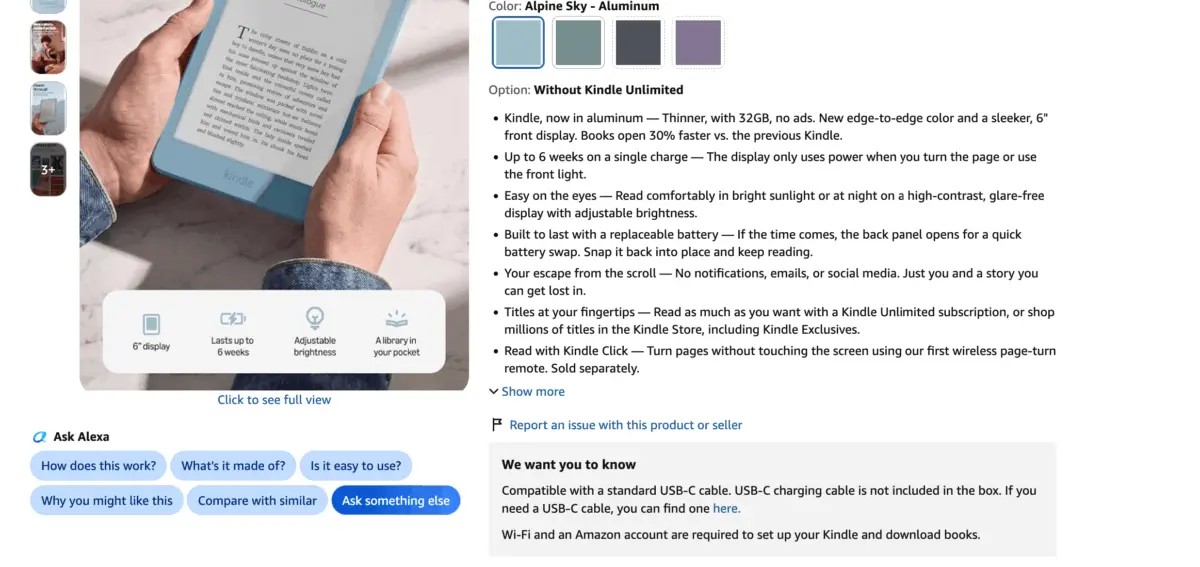
Amazon quietly updated its official product listing pages to reflect this reality, embedding customer advisories directly beneath the color selection swatches and hardware feature bullet points.
Supporting Context & Metrics: Price Hikes Meet Bare-Bones Boxes
The decision to omit the charging cable would likely have generated localized grumbling under normal circumstances. However, the timing of Amazon’s unboxing downsizing has intensified consumer ire due to parallel shifts in device pricing.
The $30 to $60 Price Jump
An analysis of launch pricing between the 12th- and 13th-generation Kindle lines reveals substantial retail increases. Across the board, base and mid-tier models have seen price bumps ranging from $30 to $60 USD. These increases are driven by rising component costs, advanced display technologies (such as the widespread integration of color e-paper in the Colorsoft series), and premium structural redesigns like the new aluminum backplates.
When consumers absorb a significant price increase, psychological expectations shift. Buyers anticipate that a higher financial outlay correlates with a more complete, frictionless out-of-box experience. Discovering that a core functional accessory has been excised simultaneously with a price hike creates an acute dissonance. Rather than interpreting the move as an eco-friendly alignment with modern electronics standards, the public has increasingly viewed the policy as a cost-cutting measure designed to protect corporate profit margins at the consumer’s expense.

The Environmental Defense vs. Economic Reality
Industry defenders frequently frame the removal of charging cables and wall bricks through the lens of e-waste reduction and carbon footprint optimization. The argument rests on the premise that households are already saturated with USB-C cables originating from smartphones, laptops, Nintendo Switches, and countless other peripherals. By shrinking box dimensions, shipping palettes can accommodate a higher density of products, theoretically lowering transportation-related carbon emissions.
While these environmental arguments hold theoretical merit, critics point out a glaring contradiction in Amazon’s execution. If sustainability were the sole driving force, one might expect the company to cease selling standalone cables entirely or to offer them at cost. Instead, Amazon simultaneously launched official branded accessories designed to monetize the gap left by the missing hardware.
Official Statements and Retail Realities
Amazon’s digital storefronts now feature explicit disclosure notices to manage consumer expectations prior to purchase. These disclosures are designed to insulate the company from customer support backlash while shifting the logistical burden onto the buyer.
The Product Page Disclosures
Navigating to any 13th-generation Kindle listing reveals a standardized notification box located prominently near the configuration options. The text explicitly states:
"We want you to know: Compatible with a standard USB-C cable. USB-C charging cable is not included in the box. If you need a USB-C cable, you can find one here. Wi-Fi and an Amazon account are required to set up your Kindle and download books."
By embedding this notice directly into the purchasing funnel, Amazon satisfies legal transparency requirements. However, online forums, Reddit communities, and review sections indicate that many casual shoppers—particularly those purchasing Kindles as gifts for older relatives or children—overlook the text entirely, leading to unpleasant surprises on unboxing day.
The Standalone Cable Market and Regional Disparities
For consumers who genuinely lack a compatible cable, or those who prefer to keep dedicated charging setups in specific rooms, Amazon began offering an official USB-C to USB-C cable starting October 1, 2026.
However, the pricing strategy for these standalone accessories has added fuel to the fire:
- United States: Priced at a modest $4.99 USD.
- Canada: Priced at an astonishing $16.99 CAD.
The steep Canadian pricing—which far exceeds direct currency conversion rates—has drawn sharp criticism from international consumer advocacy groups and Canadian tech journalists. For a consumer north of the border who just absorbed a $50+ price hike on the e-reader itself, being asked to pay nearly $17 for a basic charging cord feels punitive.
Alternative Workarounds for Signature Edition Owners
There is a minor silver lining for buyers who opt for the highest-tier hardware. Purchasers of 13th-generation Signature Editions—such as the Kindle Paperwhite Signature or the Kindle Colorsoft Signature—can bypass wired charging cables altogether. These premium models support wireless charging docks and pogo-pin dock accessories, allowing users to drop their devices onto charging pads or desk stands.
However, these docks are themselves sold separately as premium add-ons, meaning that circumventing the missing cable problem still requires an additional financial investment.
Future Outlook: Will the "Unboxed" Trend Expand or Recede?
Amazon’s gamble with the 13th-generation Kindle line serves as a bellwether for the broader e-reader and specialized consumer electronics market. As manufacturing margins tighten and regulatory pressures surrounding electronic waste mount across the European Union and North America, hardware makers are aggressively auditing every square millimeter of retail packaging.
Industry-Wide Implications
Will competitors like Kobo, Boox, and PocketBook follow Amazon’s lead and strip charging cables from their e-reader boxes?
- The Cost Pressure Argument: If consumers ultimately absorb the change without staging a widespread boycott, rival manufacturers facing identical inflationary pressures will likely view cable omission as an easy way to trim logistics costs and improve profit margins.
- The Customer Experience Advantage: Conversely, smaller competitors may weaponize the inclusion of a charging cable as a distinct marketing differentiator. In a crowded marketplace where hardware specifications are increasingly comparable, offering a "complete in-box experience" could become a powerful selling point for brands looking to woo frustrated Kindle defectors.
What This Means for Consumers
Moving forward, buyers of specialized consumer electronics must adjust their purchasing calculus. The assumption that a newly purchased electronic device includes everything required to power it up out of the box is officially a relic of the past.
For the Kindle ecosystem specifically, prospective buyers must now carefully audit their household cable inventory before clicking "Buy Now"—or factor the cost of an official or third-party USB-C cable into their total budget. Whether Amazon eventually recalibrates its policy in the face of persistent customer pushback remains to be seen. For now, the message from Seattle is unambiguous: the future of reading is wireless, unboxed, and entirely dependent on what you already have in your drawer.
What are your thoughts on this industry trend? Do you believe everyone already has a surplus of USB-C cables at home, or should Amazon include a charging cord in the box—especially given the recent price hikes? Let us know in the comments below.





Comments
Facebook App ID not configured. Please add it in the Customizer.