
Executive Overview
Throughout the summer months, a quiet ritual took place at London’s National Gallery. Week after week, art enthusiasts and casual visitors alike found themselves inexplicably drawn back to a temporary exhibition dedicated to the Spanish Golden Age painter Francisco de Zurbarán (1598–1664). While blockbuster exhibitions often rely on sensory overload and aggressive marketing, the pull of the Zurbarán collection was of an entirely different order. It was atmospheric, persistent, and deeply contemplative.
Zurbarán stands as perhaps the preeminent religious painter of the seventeenth century—a master uniquely obsessed with spiritual conflicts, internal trials, and the quiet dramas of the soul that supersede all physical phenomena. Yet, despite his profound engagement with asceticism, mysticism, and the absolute gravity of the divine, his life was anchored in the tangible world. He fathered at least nine children and possessed an acute, sensual appreciation for color, light, and the heavy textures of fabric.
This comprehensive reappraisal explores Zurbarán’s enduring artistic legacy, examining how an artist plagued by recurring anatomical flaws, questionable perspective, and architectural amateurism managed to produce works of staggering spiritual resonance. By analyzing his major works—from the haunting Saint Serapion to the tender intimacy of Christ and the Virgin in the House at Nazareth—this piece investigates the paradox at the heart of Zurbarán’s corpus: how raw, unpolished technique became the very vehicle for unmediated divine devotion.
Read Also
Detailed Chronology & Historical Context
To understand Zurbarán’s artistic evolution, one must trace the timeline of his life against the backdrop of a deeply Catholic, yet increasingly turbulent, seventeenth-century Spain. Born in Fuente de Cantos in 1598, Zurbarán came of age during a period when the Spanish Empire was beginning its slow economic and political decline, even as its cultural output reached a blinding zenith.
Early Promise and Personal Tragedies
Zurbarán was raised in a relatively prosperous household and enjoyed early professional success, securing prestigious commissions for monasteries and religious institutions across Seville and Extremadura. However, his personal life was repeatedly punctured by profound grief:
- 1623: The death of his first wife, marking the beginning of a lifelong series of personal bereavements.
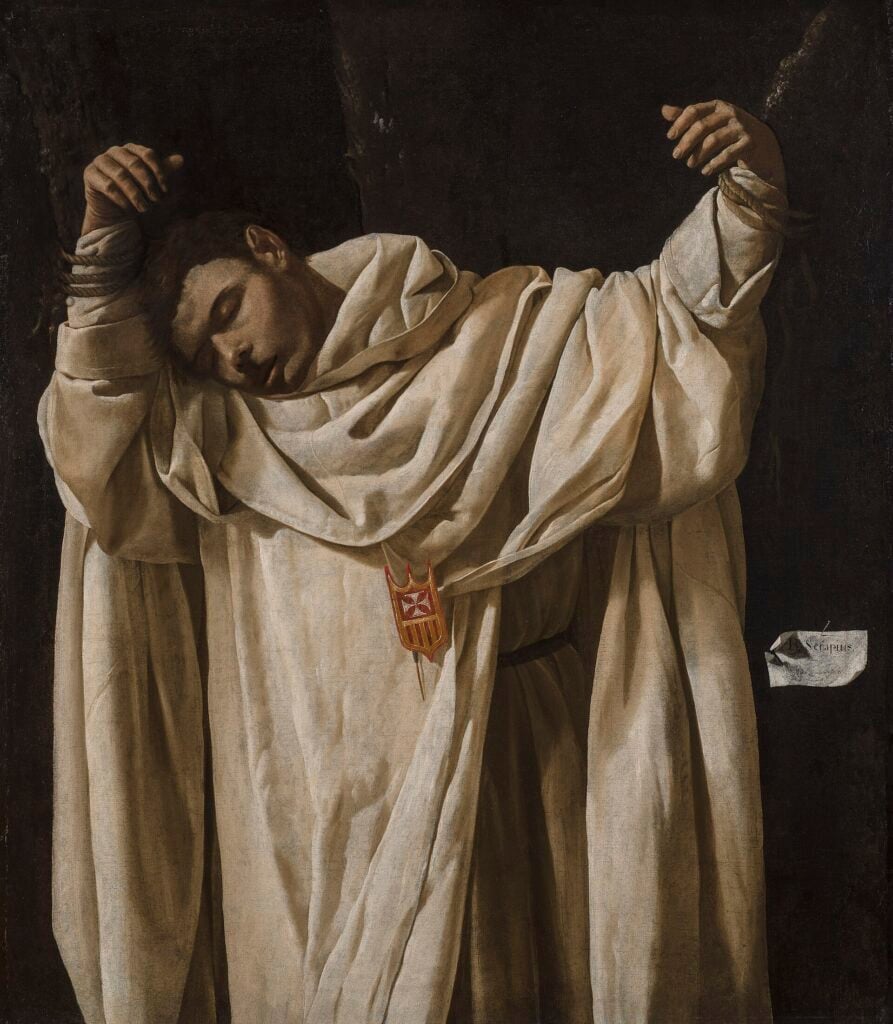
- 1628: The execution of Saint Serapion, showcasing his ability to render visceral, horrifying martyrdom with an underlying note of transcendent grace.
- 1639: The death of his second wife, plunging the artist deeper into domestic sorrow just as professional competition from younger contemporaries like Bartolomé Esteban Murillo began to mount.
- 1649: The bubonic plague sweeps through Seville, claiming the life of his beloved son, Juan de Zurbarán, a gifted still-life painter in his own right. Most of Zurbarán’s other children also predeceased him.
- 1650s: Facing severe financial distress, professional obscurity, and personal humiliation, Zurbarán’s output shifts toward introspective, deeply personal works, culminating in what is believed to be his 1650 self-portrait embedded within Saint Luke as a Painter before Christ on the Cross.
The Evolution of Sacred Realism
Unlike many of his contemporaries whose sacred scenes can be easily secularized or co-opted by nonbelievers, Zurbarán’s art resists outsider reinterpretation. Friedrich Nietzsche famously appropriated Raphael’s Transfiguration in The Birth of Tragedy to illustrate Apollonian culture, effortlessly stripping the painting of its Christian orthodoxy. Yet, it is virtually impossible to read Zurbarán’s devotional images as anything other than expressions of absolute, unvarnished religious sincerity.
Nineteenth-century critic J.-K. Huysmans, writing in The Cathedral after his own re-conversion to Catholicism, vividly captured this intensity when describing Zurbarán’s depiction of Saint Francis of Assisi in Lyons:
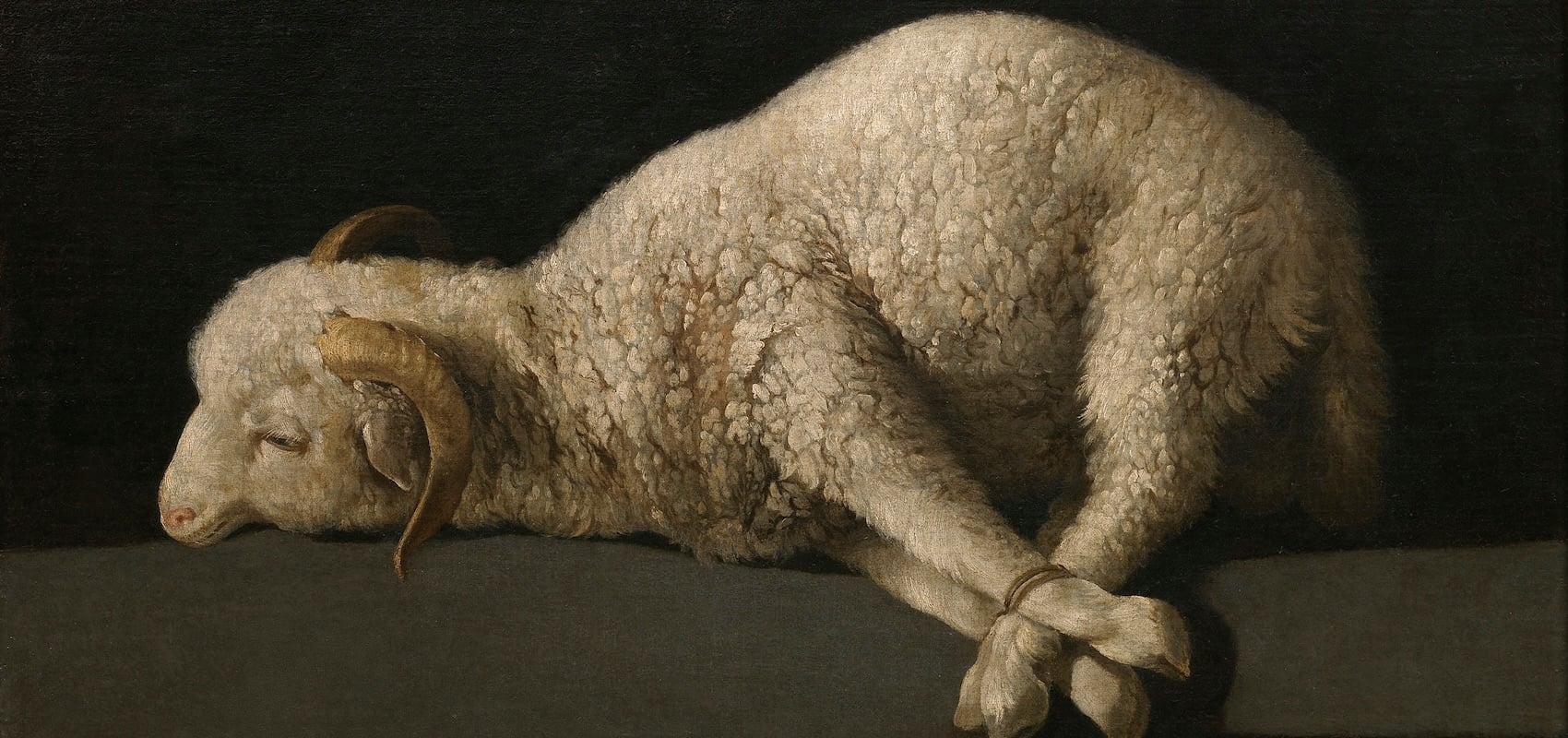
"It was a wonder how this corpse, of which nothing was left but the bones, could hold itself up, and a terror came over one at the thought of the excessive mortifications and appalling penances that had exhausted this body… the art of the torture chamber, the delirium tremens of divine intoxication here on earth; yes, but what a note of adoration, what a cry of love, stifled by anguish, sprang from this canvas."
While Huysmans misidentified the specific iconography—Zurbarán was actually depicting Pope Nicholas V’s 1449 miraculous vision of the uncorrupted body of St. Francis standing upright in his crypt—his visceral reaction underscores the psychological terror and awe that Zurbarán’s compositions routinely inspired.
Technical Paradoxes: Anatomy, Light, and Flaws
One of the most compelling aspects of Zurbarán scholarship is reconciling his towering reputation with his glaring technical deficiencies. By traditional academic standards of draughtsmanship, Zurbarán was frequently found wanting.
The Anatomy of Error
- Foreshortening and Torso Rendering: Zurbarán struggled profoundly with foreshortened limbs. In masterpieces like Saint Serapion (1628)—where the Mercedarian friar is depicted hanging lifeless by his wrists after being tortured and beaten—there is virtually no sense of a human torso beneath the stiff, heavy white folds of the habit. The arms are awkwardly articulated, yet the emotional impact is unimpeded.
- Missing Extremities: Hands and fingers were rarely rendered with anatomical precision. In his numerous depictions of kneeling saints—such as the magnificent Saint Francis in Meditation at the National Gallery—shins and feet are routinely swallowed up or omitted entirely by the cascading drapes of sackcloth.
- Architectural Naivete: His sense of perspective and architectural design often bordered on the amateurish. Backgrounds are frequently flat, and recurring motifs—such as the stacked, cannonball-like heads of cherubs—can feel jarringly repetitive.
- Light Source Ambiguity: Despite his mastery of dramatic tenebrism (light and shadow), Zurbarán frequently ignored consistent light sources. Shadows fall where they emotionally should, rather than where optical physics dictate, a flaw visible even in ambitious civic commissions like The Interment of Saint Bonaventure in the Louvre.
The Triumph of Texture
What redeems these technical shortcomings is Zurbarán’s peerless mastery over textiles and surface illumination. He possessed an uncanny ability to render the tactile weight of rough, dirty sackcloth, contrasting it with the luxurious sheen of heavy embroidery and damask silk. While he struggled with lightweight, diaphanous fabrics, his handling of coarse monastic wool creates a tangible realism that tricks the eye into accepting impossible anatomies.
As art historians note, the viewer looks past the structural errors because the emotional and textural truth of the surface is so overwhelmingly convincing.
Case Studies in Mastery
To truly grasp Zurbarán’s genius, one must examine three pivotal works that encapsulate his thematic and stylistic range.
1. Christ and the Virgin in the House at Nazareth (c. 1630s)
Housed in the Cleveland Museum of Art, this wholly original composition invented by Zurbarán depicts an eleven-year-old Jesus having accidentally pricked his finger on a crown of thorns he was plaiting in his lap. Across the table, the Virgin Mary looks on with a gaze heavy with prophetic sorrow. Despite cataloging the usual technical flaws in hand placement and spatial depth, connoisseurs universally recognize the canvas as a masterpiece of quiet domestic intimacy freighted with cosmic tragedy.
2. Saint Alonso Rodriguez (Academy of San Fernando, Madrid)
Dedicated to a Jesuit lay brother known for his intense devotion to the Sacred Heart, this painting borders on naive art. Yet, through a brilliant orchestration of color harmonies, Zurbarán directs the viewer’s gaze effortlessly upward toward Jesus and the Virgin Mary, who gaze down upon the simple-minded Rodriguez with palpable affection. It stands as a testament to the artist’s ability to visualize internal spiritual states.
3. Saint Luke as a Painter before Christ on the Cross
Arguably his most haunting canvas, this work features Saint Luke—the patron saint of artists—holding his palette and brushes while pressing his right hand to his heart. He gazes up in loving contemplation at a crucified Christ who appears to physically bow toward the painter, illuminated entirely by divine light. Given that this likely incorporates a self-portrait painted around 1650 when Zurbarán had lost nearly everything, the painting transcends mere portraiture; it is an autobiographical surrender to grace.
Future Outlook & Scholarly Reassessment
As museums increasingly pivot toward blockbusters that prioritize spectacle over substance, the enduring popularity of exhibitions dedicated to Francisco de Zurbarán suggests a profound cultural counter-current. Modern audiences, fatigued by the hyper-accelerated digital landscape and the transient noise of the attention economy, are seeking out art that demands silence, contemplation, and sustained interiority.
Art historical scholarship is moving away from a purely formalist critique—which dismisses artists based on rigid adherence to academic anatomy—toward an appreciation of expressive integrity. Zurbarán’s work challenges the modern viewer to reconsider what constitutes artistic excellence. If technique is merely a tool to communicate transcendent truth, then Zurbarán’s raw, unpolished, and deeply empathetic visions place him in the absolute pantheon of Western art.
Future exhibitions will undoubtedly continue to unpack the complexities of the Spanish Golden Age, but Zurbarán’s ultimate legacy remains secure: his canvases were never merely aids to contemplation or prayer. In their stark realism, profound sorrow, and blinding devotion, they were prayer itself.



Comments
Facebook App ID not configured. Please add it in the Customizer.