
Executive Overview
In the literary and digital landscapes, where content is frequently consumed at a frantic, superficial pace, few creators manage to bridge the gap between rigorous academic curiosity and accessible, whimsical storytelling quite like Olivia Swarthout. Best known to her growing legion of digital followers as the chronicler of the peculiar and the arcane via Weird Medieval Guys, Swarthout has carved out a unique niche at the intersection of history, philology, and internet culture.
Her linguistic lineage—with a first name rooted in the Latin oliva (olive) and a surname tracing back to the Middle Dutch for "black forest"—seems almost preordained for someone who wanders deep into the overgrown thickets of historical language. Now, following the breakout success of her debut publication, Swarthout is pivoting from the visual eccentricities of the Middle Ages to the living, breathing ecology of language itself.
Her upcoming nonfiction release, The Wordspotter’s Guide—slated for publication by Dutton (Penguin) on November 10, 2026, with literary representation managed by Tom Killingbeck of AM Heath—promises to reinvent how everyday readers interact with vocabulary. Described succinctly by its author as "a birdwatching guide, but for words," the book treats human speech not as a static collection of dictionary entries, but as a vibrant, invisible ecosystem teeming with life, mythology, and deep historical resonance.
Read Also
This comprehensive profile explores the genesis of Swarthout’s latest literary endeavor, charting her unconventional journey from full-time statistical crunching to full-time author, the grueling and transformative publishing process, and her impassioned manifesto against the sterile convenience of instant digital trivia.
Detailed Chronology: From Spreadsheets to Sentences
The path to The Wordspotter’s Guide was neither linear nor planned; rather, it was forged out of professional burnout, economic necessity, and an irrepressible compulsion to map out the hidden contours of human speech.
Phase I: The Statistical Exodus
Long before she was securing deals with major traditional publishing houses, Swarthout was navigating the grueling world of data analysis, working full-time as a statistician. The mental toll exacted by spreadsheets and numerical modeling proved formidable. Following the publication of her first heavily visual book—a venture that required sourcing hundreds of images and left her profoundly exhausted—Swarthout made the definitive choice to step away from her statistical career entirely. She sought a period of rest and recuperation, aiming to recalibrate her professional life away from the hum of corporate algorithms.
However, reality set in approximately two months into her sabbatical. As Swarthout wryly notes, the reliable monthly deposits from her former employer had "mysteriously subsided." While the financial shortfall was not immediately catastrophic, it catalyzed an urgent career pivot.
Phase II: The Zine Aesthetic and the Garage-Era Vision
Needing an income source that did not involve returning to data tables, Swarthout looked to the small diagrams and etymological breakdowns she had been casually sharing on social media platforms like Twitter and TikTok. These bite-sized linguistic explorations had already cultivated a warm, receptive audience.
Initially, she considered producing another straightforward gift book comprising purely etymological diagrams—something easily digestible where a reader could drop in at random. Yet, driven by a desire to produce something more textually substantial, she began immersing herself in historical linguistics, reconstructed prehistoric languages, the evolutionary origins of human speech, and the foundational role etymology plays in understanding human nature.
This intellectual expansion sparked a wildly experimental visual phase. Inspired by mid-century science textbooks—which she noted possessed far more character and detail than modern educational materials—Swarthout envisioned The Wordspotter’s Guide through a radically DIY, zine-inspired lens.
"The book’s voice developed in tandem with this style," Swarthout explains, "and I wound up with a short booklet that was made to look and feel almost like it had been xeroxed together by some madman in his garage in the 1970s in order to propagate theories of a possibly pseudoscientific or conspiratorial nature."
Utilizing pulpy fonts and blurry public-domain images harvested from the Internet Archive, this early prototype framed words as living organisms inhabiting a secret, parallel dimension superimposed over human reality.
Phase III: The Editorial Pivot and Proposal Development
The wild, conspiratorial zine aesthetic, though creatively fulfilling, ultimately met the realities of commercial publishing. Upon consulting with her literary agent, Tom Killingbeck, Swarthout was gently advised to close Adobe InDesign, step away from her 2,000 open browser tabs, and draft a traditional, formalized book proposal.
Recognizing the steep uphill battle of pitching an avant-garde, pseudoscientific visual gimmick to a major imprint like Dutton, Swarthout made the strategic decision to dial back the experimental formatting. She tempered her authorial voice, making it more accessible, familiar, and gently encouraging without sacrificing the esoteric core of her research.
Over an intensive eight-month period, she constructed a meticulous book proposal. Her gamble paid off: she successfully secured a deal with her first-choice publisher, proving that her transition from internet micro-historian to mainstream nonfiction author was viable.
Supporting Context & Metrics: The Mechanics of Modern Publishing
The journey from a garage-press concept to a globally coordinated release through Penguin Random House offers valuable insight into the modern mechanics of author-publisher collaboration, international market divergence, and the economics of writing.
The Publishing Timeline and Metrics
- Total Development Window: Approximately two years from initial conception to final manuscript preparation.
- Proposal Phase: 8 months of rigorous structural and thematic planning.
- Target Release Date: November 10, 2026.
- Primary Publisher: Dutton (an imprint of Penguin Books).
- Literary Representation: Tom Killingbeck, AM Heath Agency.
- Genre: Nonfiction / Cultural Linguistics / Popular Science.
The Transatlantic Cover Debate
One of the most surprising and illuminating milestones in Swarthout’s publishing journey involved the visual packaging of The Wordspotter’s Guide. Unlike many authors who are kept at arm’s length from marketing aesthetics, Swarthout was actively consulted by the Dutton team on cover design sketches for the U.S. edition.
Collaborating with cover artist Jonathan Burton, the publisher sought to capture the book’s eclectic, esoteric spirit while maintaining commercial viability. The result was two distinct covers tailored for the U.S. and U.K. markets respectively—a common industry practice that sparked an unexpected sociological experiment among Swarthout’s peers.
"To my surprise and amazement," Swarthout remarks, "Americans almost always show a clear preference for the U.S. cover, while Brits almost invariably like the U.K. version better… After seeing the two, people then usually ask me which one I prefer. To which I say: Does a mother have a favorite child?"
This transatlantic division underscores the subtle cultural variations in how visual information and academic whimsy are marketed to readers across different English-speaking territories.
The Shift from Curator to Author
Reflecting on the writing process itself, Swarthout identifies a profound operational shift between her debut project and The Wordspotter’s Guide. Her first book required sourcing hundreds of full-color archival images—a logistical marathon involving libraries, museums, and exhaustive licensing hurdles that left her creatively depleted.
By consciously pivoting toward a text-driven format backed by conceptual clarity rather than a museum-scale image hunt, Swarthout unlocked a newfound creative freedom. "When you aren’t chasing image libraries and museums for months on end," she notes, "quite a lot more of your time can actually be spent writing! This was a bit of a game changer for me."
Official Statements & Authorial Philosophy
At its core, The Wordspotter’s Guide is more than an etymological compendium; it is a philosophical argument against intellectual passivity and an invitation to re-enchant our relationship with everyday language.
The War on Instant Gratification
Swarthout makes no secret of her disdain for the reflex-like urge to pull out a smartphone to resolve trivia queries. In an era dominated by search engines and AI-generated summaries, she champions the lost art of conversational mystery and shared discovery.
"I am notoriously annoying among several of my friends for getting mad when people look up trivia on their phones," Swarthout admits. "I strongly prefer having a conversation about something or simply living in the dark over the instant gratification of looking something up on the internet, which usually turns out to be less than gratifying anyways as it tends to kill a conversation stone dead."
Through The Wordspotter’s Guide, she hopes to counteract this cultural knee-jerk reaction. By equipping readers with the tools to observe language as a naturalist observes fauna, she encourages a return to independent critical thought, imaginative speculation, and vibrant interpersonal dialogue.
Honoring Obsession: The Sebaldian Influence
When writing a book that spans an eclectic array of linguistic anomalies, historical myths, and deep-time linguistics, authors often struggle with structural cohesion. Swarthout admits to lingering anxieties during the composition process that her expansive thematic scope might render the manuscript disjointed.
Ultimately, however, those fears proved unfounded because her writing was anchored by genuine, unfeigned intellectual fixations. Drawing inspiration from literary masters such as W.G. Sebald and Roberto Bolaño—writers renowned for circling back obsessively over the same characters, landscapes, and motifs—Swarthout champions the embrace of obsession.
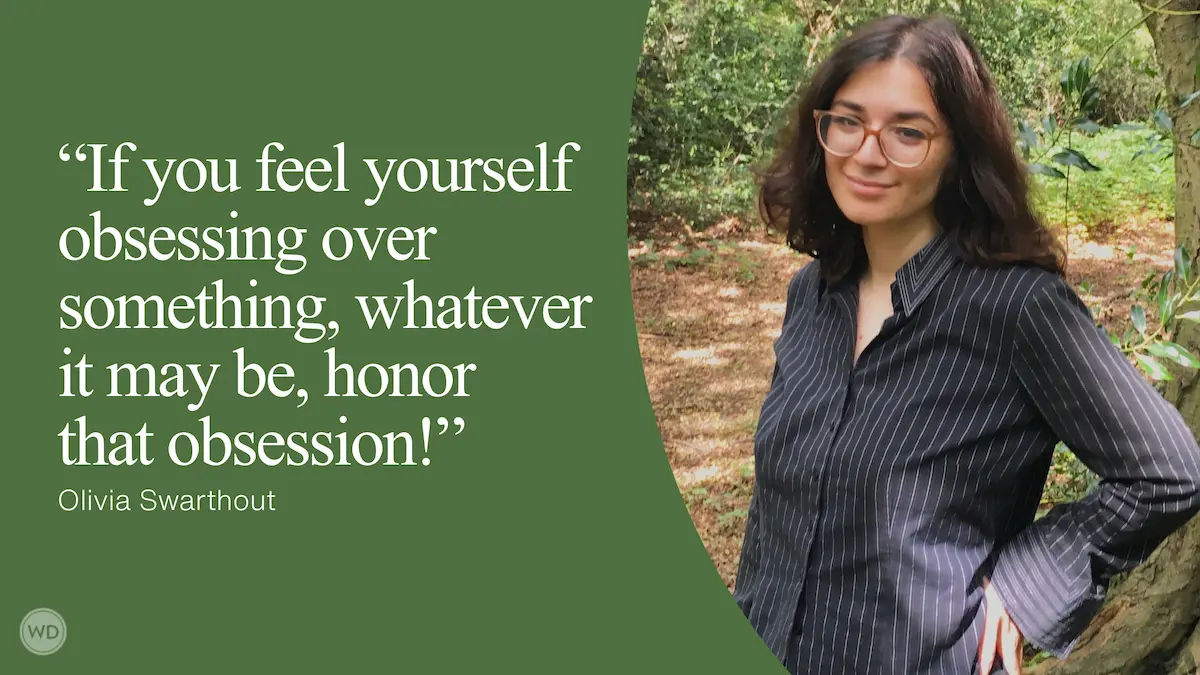
"If you feel yourself obsessing over something, whatever it may be, honor that obsession!" she advises aspiring writers. "Whether you need to write one page or 1,000 pages about it to feel satisfied, don’t walk away prematurely."
Future Outlook
As the November 2026 release date for The Wordspotter’s Guide approaches, Olivia Swarthout stands at a fascinating juncture in her career. Having successfully transitioned from data analyst to viral medievalist, and now to a premier voice in popular philology, she has proven her capacity to reinvent her artistic output without losing her distinctive voice.
The book arrives at a timely cultural moment. As generative AI threatens to homogenize written communication and flatten the linguistic landscape into predictable, automated outputs, works that celebrate the idiosyncratic, historical, and deeply human roots of language feel increasingly vital.
By treating words as wild animals worthy of careful observation, tracking, and conversation, Swarthout’s latest work invites readers to step outside the digital panopticon of instant answers and re-engage with the living history hidden plain in sight on our tongues. Whether The Wordspotter’s Guide sparks a nationwide movement of backyard philologists remains to be seen, but one thing is certain: conversation is far from dead, provided Olivia Swarthout is holding the pen.


Comments
Facebook App ID not configured. Please add it in the Customizer.