
Executive Overview
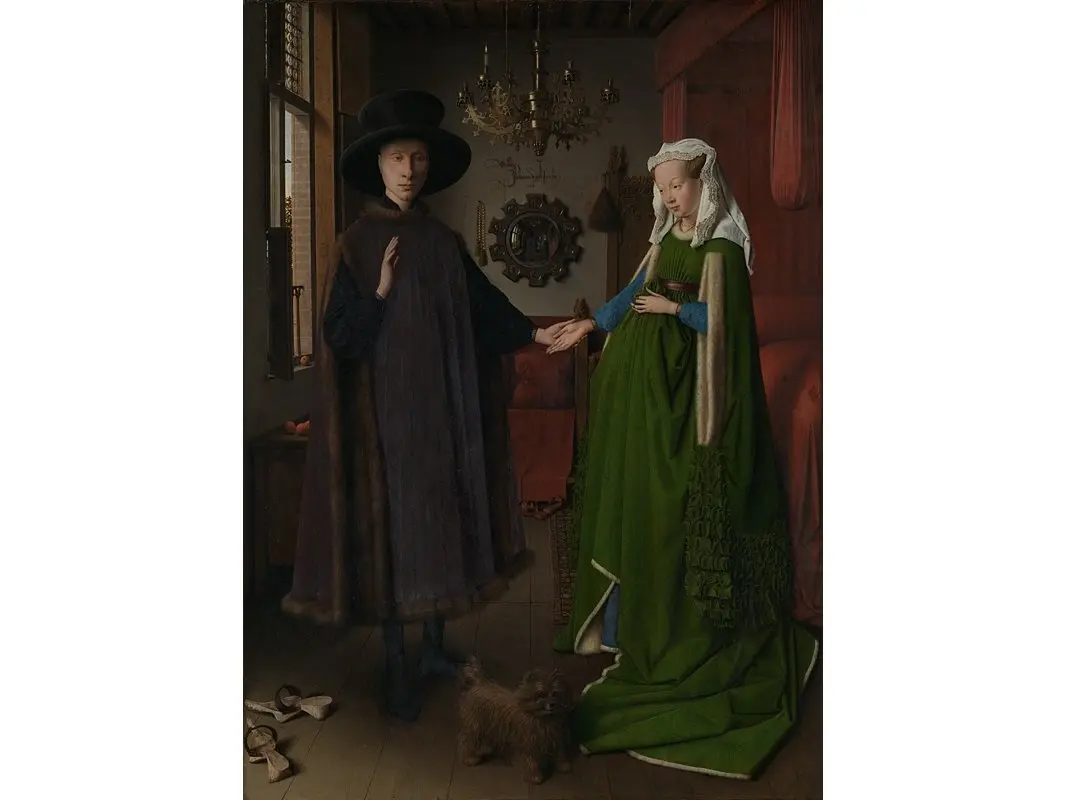
Few works in the canon of Western art history have generated as much sustained fascination, scholarly debate, and hermeneutic speculation as Jan van Eyck’s Arnolfini Portrait (1434). Housed at London’s National Gallery, this Early Netherlandish masterwork has long been celebrated for its astonishing trompe l’oeil realism, complex iconography, and the shadowy mirror that reflects the artist himself within the intimate confines of a bourgeois interior.
Now, the publication of the official exhibition catalog for Van Eyck: The Portraits—a blockbuster exhibition slated to open at the National Gallery on November 21—has detonated a bombshell in the art historical community. An essay penned by Berlin-based curator Stephan Kemperdick revives and aggressively reframes a radical hypothesis: that the man immortalized in the painting is not, as generations of scholars have believed, an Italian merchant from the wealthy Arnolfini family, but rather Jan van Eyck himself, standing alongside his wife, Margaret.
This bold reappraisal challenges centuries of established provenance, forces a reassessment of other foundational portraits in European museums, and highlights the maddening elusiveness of fifteenth-century biography. As museums prepare to unite all nine of Van Eyck’s surviving portraits under one roof, the art world is once again forced to look into the convex mirror of the Arnolfini Portrait and ask a fundamental question: Who are we actually looking at?
Read Also
Detailed Chronology: From 15th-Century Bruges to Modern Scholarship
To understand the magnitude of Kemperdick’s hypothesis, one must trace the winding documentary history of the painting—a paper trail characterized by centuries of ambiguous records, lost archival materials, and speculative deductions.
1. The Creation and Early Recording (1434–1516)
In 1434, Jan van Eyck painted the double portrait in Bruges, then the bustling economic and artistic capital of Flanders. Prominently inscribed on the rear wall above the mirror is the famous signature: "Johannes de Eyck fuit hic. 1434" ("Jan van Eyck was here. 1434"). For decades, this inscription has been interpreted as legalistic proof that the artist was present as a witness, a guest, or an official chronicler of the scene.
The earliest definitive documentary trace of the painting emerges nearly a century later, in 1516, within an inventory of the royal collections of Margaret of Austria, Habsburg Regent of the Netherlands. The inventory lists the work as depicting "Hernoul le Fin" or "Arnoult Fin"—terms that sixteenth-century and later scholars universally translated into the Italian surname "Arnolfini."
2. The Arnolfini Candidates (19th–20th Centuries)
For generations, art historians operated under the assumption that the man was Giovanni di Arrigo Arnolfini, an influential Lucchese merchant based in Bruges. However, twentieth-century archival discoveries complicated this neat biographical fit. Records indicate that Giovanni di Arrigo was likely unmarried at the time the portrait was executed in 1434.
Consequently, scholarship shifted toward his cousin, Giovanni di Nicolao Arnolfini, who would have been in his late thirties in 1434. Historical records show that Giovanni di Nicolao’s first wife, Costanza Trenta, passed away in childbirth or from illness in 1433. This temporal alignment led to the prevailing theory that the woman in the portrait is either his second wife (whose identity remains lost to history) or that the painting functions as a poignant memorial portrait commemorating the deceased Costanza—a hypothesis championed by art historian Margaret Koster, among others.
3. The Modern Revisionism (2026 and Beyond)
The release of the National Gallery’s upcoming exhibition catalog shatters this consensus. Stephan Kemperdick, a curator at Berlin’s Gemäldegalerie, argues that the historical conflation with the Arnolfini family stems from misread sixteenth-century records and a misinterpretation of the painting’s internal visual cues. By suggesting that the master painted himself and his wife Margaret, Kemperdick forces a comprehensive re-examination of how early Northern Renaissance portraiture recorded familial bonds versus artistic self-reflection.
Supporting Context & Metrics: Decoding the Masterpiece
To evaluate Kemperdick’s theory, one must examine the physical and iconographic evidence embedded within the 82.2 cm × 60 cm (32.4 in × 23.6 in) oak-panel painting.
Material Wealth and Visual Codes
The painting depicts an elegantly dressed couple standing hand in hand within a domestic interior. Every square inch of the composition radiates understated, high-value luxury:
- The Clothing: The man wears a dark, fur-lined tabard over a pleated linen shirt, while the woman is draped in an opulent ultramarine and green wool gown lined with ermine, gathering voluminous folds that signify elite status and economic prosperity.
- The Setting: An oriental carpet graces the floorboards, a brass chandelier hangs from the timber ceiling, and a single ripe orange rests on the windowsill—an exorbitant imported luxury in fifteenth-century northern Europe.
- The Mirror: The convex mirror on the back wall reflects not only the couple from behind, but also two figures entering the doorway—often interpreted as Van Eyck himself and an assistant.
The Portraiture Corpus
The stakes of Kemperdick’s argument extend far beyond a single canvas. The upcoming exhibition at the National Gallery represents a monumental art-historical milestone, bringing together all nine of Jan van Eyck’s undisputed, surviving independent portraits for the first time.
Among these are two key comparative works central to the debate:
- Portrait of a Man (1433), held by the National Gallery, depicting an older man gazing intently at the viewer. It is currently labeled tentatively as a self-portrait.
- Portrait of a Man in a Red Chaperon (c. 1390–1440/41), housed in the Gemäldegalerie in Berlin, which depicts the exact same male physiognomy as the Arnolfini Portrait, but at an advanced age. Traditionally, this Berlin portrait has also been presumed to represent Giovanni Arnolfini.
If Kemperdick is correct in asserting that the man in the Arnolfini Portrait is Jan van Eyck, the Berlin painting must likewise be reclassified as a later portrait of the artist himself, throwing the established identities of multiple museum holdings into disarray.
Official Statements and Scholarly Divide
The academic community is deeply polarized over Kemperdick’s hypothesis. While some embrace the provocative re-reading of archival gaps, others point to stubborn visual inconsistencies that undermine the self-portrait theory.
The Pro-Kemperdick Argument
Kemperdick roots his case in the specific placement of the Latin inscription ("Johannes de Eyck fuit hic. 1434"). He argues that writing this signature directly above the male subject’s head is not merely a record of geographic presence, but a psychological and biological tether. In Kemperdick’s view, the alignment signifies that the man depicted is Johannes himself, presenting his domestic partnership to posterity.
Furthermore, the Berlin Gemäldegalerie’s possession of the Portrait of a Man in a Red Chaperon provides a chronological bridge. If the man in the Arnolfini Portrait is Van Eyck in his late thirties, the Berlin panel naturally represents the aging master in subsequent years, creating a coherent pictorial biography of the artist’s own face.
The Skeptical Consensus
Museum leadership and international scholars have urged caution, labeling the theory fascinating but highly speculative.
Nicholas Flory, co-curator of Van Eyck: The Portraits alongside Emma Capron, noted in interviews with The Art Newspaper that visual evidence strongly resists Kemperdick’s conclusion. Specifically, Flory points to another undisputed work in the exhibition on loan from the Musea Brugge: a portrait of Van Eyck’s actual wife, Margaret van Eyck, verified by an internal inscription.
"The sitter in the Bruges panel definitively known to be Margaret has distinct greyish-blue eyes," Flory observed, "whereas the woman in the Arnolfini Portrait possesses warm brown eyes."
This physiological discrepancy is mirrored by German art historian Till-Holger Borchert, former director of the Musea Brugge. Borchert views the sixteenth-century inventory reference compiled by Margaret of Austria as near-conclusive proof that the sitters were indeed members of the Arnolfini merchant syndicate. Yet, Borchert acknowledges the inherent opacity of the artist’s biography, famously remarking:
"Given how little we truly know about Jan van Eyck’s life, can you tell me anything about Van Eyck that isn’t enigmatic?"
Future Outlook: The Exhibition as a Testing Ground
The debate over the Arnolfini Portrait transcends academic pedantry; it touches upon the very nature of how we interpret historical identity through visual art. As museums become increasingly reliant on definitive storytelling to engage the public, mysteries like the Arnolfini identity challenge curators to embrace ambiguity rather than tidily packaged narratives.
When Van Eyck: The Portraits opens at the National Gallery in London on November 21, visitors will have a rare, unprecedented opportunity to conduct their own visual analyses. Placed in close proximity to the Portrait of a Man (1433) and the Berlin Portrait of a Man in a Red Chaperon, the Arnolfini Portrait will invite side-by-side scrutiny from specialists and laypersons alike.
Whether Kemperdick’s theory ultimately triumphs or is relegated to the footnotes of art history, the renewed controversy has successfully achieved what great art does best: it forces us to look closer. Nearly six centuries after Jan van Eyck picked up his brush in Bruges, his painted world continues to watch us from the shadows of a convex mirror, guarding its secrets still.



Comments
Facebook App ID not configured. Please add it in the Customizer.