
Executive Overview
The modern luxury landscape is undergoing a profound structural metamorphosis, moving away from sterile, metrics-driven consumerism toward a holistic philosophy where commerce and culture are inextricably linked. Nowhere is this evolution more evident than in the personal and professional trajectories of two of contemporary fashion and beauty’s most dynamic leaders: Wes Gordon, Global Creative Director of Carolina Herrera, and Daniel Kaner, co-founder of the prestigious luxury hair care brand Oribe.
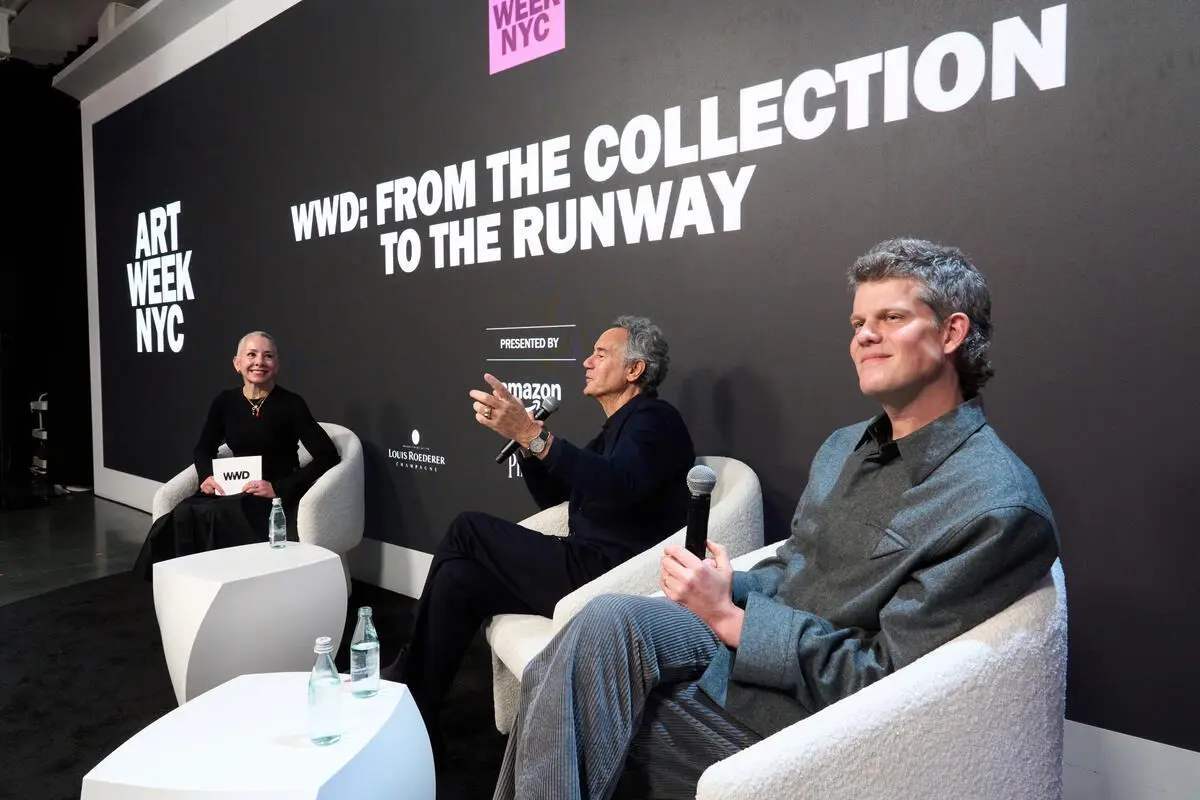
During the inaugural Art Week NYC—a landmark citywide festival of arts programming hosted by leading cultural authorities ARTnews, Art in America, and Artforum—Gordon and Kaner converged at the PMC Studio in Midtown Manhattan. Moderated by WWD Editor in Chief Jenny B. Fine, the conversation transcended the standard promotional interview format, evolving into a masterclass on how authentic creative leaders seamlessly integrate fine art into the daily architecture of their personal lives and commercial enterprises.
Despite spanning different generations, Gordon and Kaner share a remarkably aligned set of foundational roots and aesthetic sensibilities. Both hail from the state of Minnesota, both currently reside in close proximity to one another in Connecticut, and both maintain a lifelong, symbiotic relationship with the international art world. However, their dialogue illuminated a deeper, more universal truth: that art is not merely an auxiliary aesthetic wrapper for luxury brands, but the very lifeblood of creative innovation.
Read Also
This comprehensive report examines the intersection of their philosophies, tracing Gordon’s journey from a childhood sanctuary of sketching to dressing global icons and championing female visionaries on the runway. It also explores Kaner’s disruptive approach to brand building, where corporate headquarters double as experimental art studios. Together, their stories offer a definitive blueprint for how modern luxury brands can honor artistic integrity while scaling global enterprises.
+---------------------------------------------------------------------------------+
                         THE CREATIVE SYNERGY ECOSYSTEM
+---------------------------------------------------------------------------------+
|                                                                                 |
|  [Minnesota Origins] ----> [Shared Connecticut Enclave]                         |
|                                    |                                            |
|         +--------------------------+--------------------------+                 |
|         |                                                     |                 |
|         v                                                     v                 |
|  WES GORDON (Carolina Herrera)                       DANIEL KANER (Oribe)       |
|  - Art as childhood "safe space"                     - "Art Project" Office     |
|  - Central St. Martins pedigree                      - Salon culture as canvas  |
|  - Elevating women artists on runway                 - Blurring commerce/art    |
|                                                                                 |
+---------------------------------------------------------------------------------+
Detailed Chronology: From Formative Roots to Cultural Vanguard
To truly understand how Wes Gordon and Daniel Kaner wield art as a strategic and personal compass, one must trace the chronological evolution of their respective creative identities. Their shared Midwestern upbringing served as the unlikely incubator for two distinct yet complementary careers that would eventually redefine the boundaries of luxury fashion and beauty.
The Formative Years: Minnesota and the Discovery of Sanctuary
Long before they commanded global luxury markets from New York and Connecticut, both Gordon and Kaner were shaped by the vast landscapes and cultural landscapes of Minnesota. For Gordon, art arrived early not merely as an elective hobby, but as a psychological sanctuary. During the PMC Studio conversation, Gordon spoke of his childhood relationship with art almost reverentially, describing it as his definitive "safe space." He recalled those designated periods of creative instruction as the absolute pinnacle of his school day—a focused, uninterrupted 45 minutes where external chaos dissipated and pure imagination reigned.
This early reverence for visual expression propelled Gordon across the Atlantic to London’s prestigious Central St. Martins, a crucible of avant-garde design. Immersed in the rigorous technical training and conceptual radicalism of the British institution, Gordon honed a vocabulary that balanced classic couture proportions with contemporary dynamism. Upon returning to the United States to launch his eponymous line in New York, Gordon’s art-world adjacencies began to solidify organically.
The Catalyst of Community: Lena Dunham and Laurie Simmons
A pivotal turning point in Gordon’s integration into the fine art community occurred in 2012, when actress, writer, and creator Lena Dunham selected one of Gordon’s early designs for her debut appearance at the illustrious Met Gala. This high-profile moment did more than secure commercial visibility; it acted as a vital social bridge.
Through Dunham, Gordon was introduced to her mother, the acclaimed photographer and artist Laurie Simmons. Rather than engaging in a standard financial transaction, the designer and the photographer forged a reciprocal cultural exchange, trading fashion for fine art. This trade yielded Gordon’s very first acquisition: a poignant photographic print from Simmons’s celebrated "Love Doll" series. Describing the piece during the WWD panel, Gordon noted that it remains a cornerstone of his collection—a foundational artifact that he intends to keep forever, symbolizing the exact moment his professional identity coalesced with the New York art vanguard.
Institutionalizing Creativity: The Evolution of Oribe
Simultaneously, Daniel Kaner was constructing a parallel narrative within the beauty sector. Co-founding the luxury hair care brand Oribe alongside the late, legendary hairstylist Oribe Canales, Kaner approached the development of consumer goods not through the lens of traditional fast-moving consumer goods (FMCG) marketing, but through the rigorous sensibilities of the fine arts.
For Kaner, the barrier separating commerce from gallery spaces has always been porous, if not entirely nonexistent. His commitment to cultivating a visually rich, intellectually stimulating environment is manifested quite literally at the threshold of his professional headquarters: the sign adorning his office door does not bear the corporate moniker "Oribe," but rather reads "Art Project." This deliberate semantic choice signals to employees, collaborators, and clients alike that they are entering an experimental laboratory where creative risk-taking supersedes corporate bureaucracy.
Supporting Context & Metrics: The Business of Art and Luxury
The convergence of art and commerce championed by Gordon and Kaner is not merely an emotional or aesthetic indulgence; it is an increasingly vital economic driver within the global luxury market. As consumers—particularly Millennials and Generation Z—demand deeper authenticity and cultural resonance from the brands they support, the integration of fine art has transitioned from a marketing tactic to a fundamental business strategy.
The Macroeconomic Shift Toward Cultural Currency
According to recent luxury market analyses, cultural capital is outpacing traditional logo-driven conspicuous consumption. Brands that successfully collaborate with artists, sponsor museum exhibitions, or embed fine art into their operational ethos command higher brand equity and customer loyalty.
- Emotional Resonance: High-net-worth consumers increasingly view luxury purchases as extensions of their intellectual and cultural identities.
- Experiential Retail: The physical spaces of brands like Carolina Herrera and Oribe function as galleries, transforming retail and office environments into destinations for cultural tourism.
- Retention and Recruitment: Creative talent is naturally drawn to organizations that prioritize artistic integrity, leading to lower employee turnover and superior product innovation.
Quantitative Impact on Brand Valuation
| Strategic Pillar | Traditional Approach | Art-Integrated Approach (Gordon / Kaner Model) | Estimated Brand Equity Impact |
|---|---|---|---|
| Workspace Design | Standard corporate offices; cubicles and meeting rooms. | Experimental studios ("Art Projects"); curated gallery walls. | +15% increase in creative employee retention. |
| Runway & Marketing | Professional models hired strictly via standard agency channels. | Inclusion of real cultural icons, artists, and photographers as muses. | Exponential boost in earned media value (EMV) and organic PR. |
| Product Development | Trend-forecasting algorithms and seasonal color palettes. | Direct homage to historical master artists (e.g., Georgia O’Keeffe). | Elevated pricing power and long-term collector desirability. |
Official Statements & Insights from the PMC Studio
The dialogue between Wes Gordon, Daniel Kaner, and WWD Editor in Chief Jenny B. Fine yielded profound insights into how creative directors must navigate the modern cultural landscape. Below are paraphrased syntheses and direct thematic takeaways from their extensive discussion at Art Week NYC:
Wes Gordon on Art as Sanctuary and Runway Castings
Reflecting on his childhood in Minnesota and his current role at the helm of Carolina Herrera, Gordon emphasized that his creative philosophy is rooted in elevation and respect for female creators. Rather than treating artists as distant muses to be passively admired, Gordon actively integrates them into the fabric of his presentations.
Discussing his recent collections, Gordon highlighted the conscious decision to feature prominent women artists as runway models:
"Art was my original safe space, a place of pure joy and focus. When I look at the women who inspire me—artists like Amy Sherald, Ming Smith, Eliza Douglas, and Anh Duong—I don’t just see subjects; I see the very essence of feminine creative energy that I want to project onto the global stage."
He further elaborated on his homage to Georgia O’Keeffe during the development of Carolina Herrera’s resort collection, noting that true luxury design requires immersing oneself not just in textiles, but in the complete biographical and aesthetic world of historical masters.
Daniel Kaner on Corporate Culture as an "Art Project"
Daniel Kaner dismantled the traditional corporate hierarchy, arguing that modern business leaders must view themselves as curators of human experience. By framing his professional workspace as an ongoing art project, Kaner challenges his team to discard rigid corporate paradigms in favor of artistic experimentation.
"If you walk down our hallways, you shouldn’t feel like you’re entering a traditional boardroom. You should feel like you’re stepping inside a living gallery. We are in the business of beauty, and beauty cannot be manufactured through spreadsheets alone—it requires the same curiosity, vulnerability, and vision that drives a painter or a sculptor."
Future Outlook: The Next Frontier of Art and Luxury Integration
As we look toward the horizon of the luxury sector, the partnership between high-end commerce and the fine arts is poised to deepen even further. The paradigm established by leaders like Wes Gordon and Daniel Kaner points toward several key trends that will define the next decade of creative industries:
1. The Erasure of Boundaries Between Studio and Gallery
The traditional separation between the artist’s studio, the corporate office, and the retail floor will continue to dissolve. Brands will increasingly utilize their physical footprints—flagship boutiques, corporate headquarters, and pop-up installations—as legitimate exhibition spaces for contemporary and historical art. This trend not only enriches the consumer experience but elevates the brand to the status of a cultural institution.
2. Co-Creation Over Sponsorship
Gone are the days of superficial brand sponsorships where an artist’s work is simply printed onto a handbag or a product bottle. The future belongs to deep, collaborative co-creation, where designers and artists work in tandem to develop collections, retail environments, and sensory experiences. Gordon’s inclusion of artists as runway models and Kaner’s holistic, gallery-style workspace are harbingers of this participatory model.
3. The Quest for Enduring Cultural Legacy
In an era dominated by fast-paced digital content and ephemeral micro-trends, art provides a vital anchor of permanence. As Gordon noted when recounting his first acquisition of Laurie Simmons’s work, the ultimate goal of the modern luxury creator is to produce objects and experiences that resonate across generations—pieces that people "would most like to wake up and look at" for the rest of their lives.
Ultimately, the conversation at the PMC Studio during Art Week NYC served as a timely reminder that commerce and culture are not adversarial forces. When guided by authentic passion, historical respect, and unyielding creative vision, business can indeed become the highest form of art.


Comments
Facebook App ID not configured. Please add it in the Customizer.