
Executive Overview
For nearly two millennia, the global cultural memory of Pompeii has been overwhelmingly defined by cataclysm, sudden death, and eternal stillness. When Mount Vesuvius erupted in 79 C.E., it unleashed an unimaginably violent torrent of pumice, ash, and pyroclastic surges that entombed the thriving Roman towns of Pompeii and Herculaneum. For centuries, archaeological efforts have focused on the victims—the haunting plaster casts of panicked citizens frozen in their final moments, clutching jewelry, hiding in cellars, or shielding their faces from the falling debris.
However, a paradigm shift is quietly rewriting the final chapters of this ancient tragedy. Historians, classicists, and archaeologists are increasingly training their lenses not on those who perished, but on those who managed to escape.
Enter a groundbreaking, semi-fictionalized three-part documentary series, Pompeii: Out of Time With Tom Hiddleston. Hosted by British actor Tom Hiddleston—whose childhood fascination with the site inspired him to study classics at the University of Cambridge—the series bridges the gap between hard archaeological data and narrative imagination. Working alongside classicist Steven L. Tuck and a team of historical and psychological experts, Hiddleston traces the paths of specific individuals whose names appear in pre-eruption records and, remarkably, resurface in post-eruption inscriptions elsewhere in the Roman world.
Read Also
By combining cutting-edge visual effects, dramatic re-enactments, and rigorous academic research, the docuseries explores a vital, overlooked question: What happened to the survivors of Pompeii, and how did they rebuild their shattered lives?
/https://tf-cmsv2-smithsonianmag-media.s3.amazonaws.com/filer_public/18/2a/182ab01e-864b-429e-a53a-0a1b41ecc75d/pompeii.png)
Detailed Chronology: The Unfolding of a Catastrophe
To understand how anyone made it out alive, one must first dismantle the popular misconception that Pompeii was obliterated in a single, instantaneous flash. As Hiddleston emphasizes in the series, the eruption of Vesuvius was not an immediate wall of fire, but an escalating, multi-phase disaster that played out over the course of a harrowing day.
Phase One: The Deceptive Tremors
Long before the mountain blew, the region was rattled by seismic activity. In 62 or 63 C.E., a massive earthquake struck Campania, causing widespread structural damage that towns were still repairing when Vesuvius woke up in 79 C.E.
On the morning of the eruption, minor earthquakes and tremors rocked Pompeii and Herculaneum. To modern sensibilities, such violent shaking would trigger immediate evacuations. Yet, as disaster psychologist Sarita Robinson explains to Hiddleston, human behavioral patterns in life-or-death situations are complex. Just as modern urbanites routinely ignore building fire alarms because they have learned to associate them with false alerts, Pompeii’s residents—accustomed to frequent seismic disturbances in a highly active volcanic region—largely chose to ignore the tremors, assuming they were business as usual.
Phase Two: The Sky Darkens
As morning transitioned into early afternoon, Mount Vesuvius violently breached its summit, sending a towering column of ash, pumice, and gas miles into the stratosphere. This column, which Pliny the Younger famously likened to an umbrella pine tree, began raining down millions of tons of tephra onto Pompeii.
/https://tf-cmsv2-smithsonianmag-media.s3.amazonaws.com/accounts/headshot/Ellen_Wexler.png)
At this stage, the clock began ticking. The heavy accumulation of pumice started collapsing roofs, trapping families inside or forcing them out onto the choking, darkened streets. For those who possessed the foresight, the psychological readiness, and the physical mobility to act, this window offered a viable, albeit terrifying, path to flight.
Phase Three: Pyroclastic Surges and the Point of No Return
By the following morning, the eruption column collapsed multiple times, generating devastating pyroclastic surges—superheated avalanches of gas, ash, and rock traveling at hurricane speeds. These searing waves swept down the flanks of Vesuvius, instantly killing anyone still remaining in the danger zone and sealing the ruins beneath meters of volcanic material. Yet, as historical tracking proves, many thousands had already crossed regional borders to safety hours prior.
Supporting Context & Metrics: Tracing the Diaspora of the Living
The methodological backbone of this historical pivot rests on the meticulous epigraphical research of Professor Steven L. Tuck. For years, Tuck has tracked the demography of Campania by cross-referencing pre-eruption records—such as tax rolls, business contracts, loan tablets, and municipal inscriptions—with post-79 C.E. inscriptions found in neighboring towns like Nuceria, Cumae, Puteoli, and Naples.
The methodology is deceptively simple yet brilliantly effective:
:focal(750x500:751x501)/https://tf-cmsv2-smithsonianmag-media.s3.amazonaws.com/filer_public/18/2a/182ab01e-864b-429e-a53a-0a1b41ecc75d/pompeii.png)
- Identification: Isolate specific, distinct names appearing in Pompeii and Herculaneum documents dated just before the disaster.
- Tracking: Search regional archives for inscriptions, gravestones, and civic records established after 79 C.E.
- Verification: When a matching name appears in a new community alongside contextual markers of continuity, researchers can confidently identify a survivor.
Tuck’s work has successfully identified hundreds of Pompeian refugees who successfully relocated. Furthermore, these records offer profound sociological insights into how host communities absorbed the displaced populations. Many survivors banded together in exile, maintaining their local cults, commercial networks, and familial bonds. Some married into local families, while others, like young apprentices, found new guardianship when their biological parents perished in the chaos.
Case Studies: Julia Felix, Avianius Felicio, and the Praetorian Soldier
Pompeii: Out of Time With Tom Hiddleston personalizes this mass migration by anchoring the narrative in the lives of three distinct historical figures, each representing a different socioeconomic stratum of Roman society.
1. Julia Felix: The Shrewd Entrepreneur
Julia Felix was one of the wealthiest and most independent property owners in Pompeii. Archaeological excavations of her sprawling estate—uncovered as early as 1755—revealed a complex commercial operation. Facing economic opportunities after the earthquake of 62/63 C.E. damaged public amenities, Felix rented out high-end apartments, shops, and a luxurious bathhouse tailored for the city’s elite.
As archaeologist Caitie Barrett points out in the series, Felix’s independent operation of such a massive enterprise was exceptionally rare for a woman in antiquity. In the documentary, Felix is depicted as a sharp-witted businesswoman navigating demanding patrons right up until the sky turns black.
/https://tf-cmsv2-smithsonianmag-media.s3.amazonaws.com/filer_public/ee/53/ee536521-6613-4f49-acae-284942a3540d/101_tremors_pompeiioutoftimewithtomhiddleston_uhd_065.jpg)
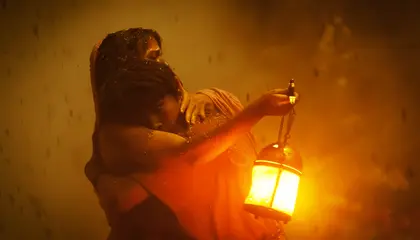
Her ultimate fate remains shrouded in mystery. In the 1950s, archaeologists discovered a body adorned with expensive jewelry near a shrine to the Egyptian goddess Isis within her estate. Whether Felix chose to stay behind—perhaps believing her piety and devotion to Isis would protect her household—or whether she was simply trapped by rapidly closing escape routes remains an open question, highlighting the frustrating limits of the archaeological record when trying to access human psychology.
2. Avianius Felicio: The Coming-of-Age Apprentice
Representing the vulnerable youth of Pompeii, Avianius Felicio was a teenager whose family, the Avianii, had experienced a stark reversal of fortune. Once part of the city’s elite, their name appears on a pre-eruption loan tablet precariously close to the signatures of the enslaved—an indicator of sinking social and financial standing.
In the series, Felicio is imagined as an apprentice to the Masuri, a local family of bronzesmiths. When Vesuvius erupts, rather than fleeing immediately, Felicio runs deeper into the hazardous city streets in a desperate attempt to find and protect his mother.
Tuck’s epigraphical research provides a poignant postscript to Felicio’s story. A gravestone discovered in the neighboring town of Nuceria bears the inscription: "To the Spirits of the Dead. The Masuri made [this] for Avianius Felicio, dearest foster son." Historians interpret this to mean that while Felicio’s biological family likely perished in the eruption, his employers took him in, adopting the traumatized orphan and integrating him into their family business. Though Felicio likely died young—still a minor when the gravestone was erected long after the disaster—his survival of the eruption itself provides a rare window into the fate of unaccompanied minors in the post-Pompeian world.

3. The Unnamed Praetorian Soldier: Duty at Herculaneum
Stationed in the coastal town of Herculaneum—situated even closer to Vesuvius than Pompeii—the third subject is a cynical Roman soldier whose military career left him detached from humanity. In the documentary, he finds a final measure of redemption by using his tactical training and authority to organize an evacuation by boat from the beaches of Herculaneum.
While the series plays with dramatic tension regarding his survival, modern archaeology delivered the definitive answer decades ago. Excavated from a Herculaneum beachfront in the 1980s alongside a belt, a sword, and a bag of coins matching a soldier’s monthly pay, his remains indicate he was an elite member of the Praetorian Guard. Whether he was part of the historical rescue mission led by the fleet commander Pliny the Elder remains a subject of ongoing academic debate, but his final moments on the ash-choked shore underscore the desperate, heroic efforts made by Roman military personnel to evacuate trapped civilians.
Official Statements and Academic Perspectives
The blending of rigorous historical scholarship with cinematic storytelling has generated significant buzz within both the archaeological and entertainment communities.
Executive producer Kevin Wright, who previously collaborated with Hiddleston on the Marvel Disney+ series Loki, noted that the production utilized big-budget visual effects techniques to serve historical storytelling. "Sometimes you need that big VFX shot, you need the big drone to sell the story, because that’s the only way you can do it justice," Wright remarked in an interview with Ars Technica. "That was where the worlds really merged."
/https://tf-cmsv2-smithsonianmag-media.s3.amazonaws.com/filer_public/f7/66/f7661576-1bd8-4601-9542-5e5d9c1121f9/102_eruption_pompeiioutoftimewithtomhiddleston_032.jpg)
For Hiddleston, the project represents a lifelong intellectual journey. Returning to his roots in classical studies at Cambridge, the actor reflects on the Latin root of history: historia, which translates dually as "history" or "story."
"That means evidence and imagination intermingled," Hiddleston observes in the series. "They’re the same thing."
By reviewing the sparse surviving epigraphical data and projecting plausible human behaviors onto the archaeological framework, the series attempts to construct what Hiddleston terms a "fuller truth"—moving past sterile museum artifacts to breathe warm life back into cold stone.
Academic collaborators like Steven L. Tuck and Caitie Barrett emphasize that while dramatization requires creative license, it firmly rests upon verifiable foundations. As Barrett notes during their examination of Julia Felix’s estate, archaeology can recover the physical spaces and material culture of the past, but it cannot get inside people’s heads. The documentary’s genius, experts argue, lies in its transparent acknowledgment of where historical evidence ends and human empathy begins.
/https://tf-cmsv2-smithsonianmag-media.s3.amazonaws.com/filer_public/ef/0d/ef0def5a-83aa-4c7c-8b55-7d0abf44ca4c/102_eruption_pompeiioutoftimewithtomhiddleston_uhd_075.jpg)
Future Outlook: The Next Wave of Pompeian Research
As archaeological excavations at Pompeii continue to expand—particularly in newly uncovered residential blocks like Regio IX—the scope of survivor studies is expected to widen significantly. Future research will likely leverage advanced digital epigraphy, chemical isotope analysis on human remains found in regional cemeteries outside Pompeii, and artificial intelligence mapping of ancient trade and migration routes.
The shift toward studying survivors marks a mature evolution in classical archaeology. Rather than viewing Pompeii merely as a static theater of death, contemporary science and media are successfully reframing it as a dynamic narrative of human resilience, community rebuilding, and adaptation in the face of unimaginable planetary upheaval. As Tom Hiddleston and his team demonstrate, the true legacy of Pompeii is not just how its people died, but how those who survived managed to reclaim their futures from the ashes.


Comments
Facebook App ID not configured. Please add it in the Customizer.