
Executive Overview
In an extraordinary political shift that has rewritten the history of the American South, Scott Colom, a 43-year-old Democratic district attorney, has won election to the United States Senate from Mississippi. Colom’s victory over two-term Republican incumbent Cindy Hyde-Smith marks a dramatic turning point in a state long considered a bedrock of conservative hegemony.
Not since 1982 had Mississippi sent a Democrat to the Senate, and an incumbent senator had not been defeated in the state since the 1940s. More significantly, Colom becomes the first African American senator ever elected by popular vote in Mississippi. While two Black senators—Hiram Revels and Blanche K. Bruce—represented the state during Reconstruction, both were chosen by the state legislature in the 1870s. Colom’s ascension represents the culmination of decades of civil rights struggles in a state historically defined by intense voter suppression and racial polarization.
+-------------------------------------------------------------------------------+
|                        KEY ELECTION METRICS & MILESTONES                      |
+-------------------------------------------------------------------------------+
|  • Final Victory Margin:         ~5,000 votes (after 8-day tally)            |
|  • Initial Election Night Lead:   28 votes                                    |
|  • Historic Precedent:            First Black MS Senator elected by popular vote|
|  • Last Dem Senate Win in MS:    1982                                         |
|  • Last Incumbent Defeated:       1940s                                       |
|  • Total Campaign Spending:      ~$4M–$5M (Dem) vs. National Super PACs       |
|  • Key Voter Purge Impact:       ~230,000 voters flagged via Experian data    |
+-------------------------------------------------------------------------------+
Colom’s victory was built on a hyper-local, populism-infused campaign strategy that capitalized on economic anxieties, rural healthcare crises, and voters’ growing frustration with federal policy outcomes. Despite being heavily outspent and largely overlooked by national Democratic committees until the final weeks of the race, Colom assembled a cross-racial coalition capable of breaking the Republican Party’s multi-decade grip on statewide office.
Read Also
Detailed Chronology
The Blocked Bench and the Decision to Run
The origin of Colom’s Senate bid can be traced to 2023, when President Joe Biden nominated Colom—then serving as the chief prosecutor for Mississippi’s 16th Judicial District—to a federal judgeship. Senator Cindy Hyde-Smith deployed the Senate’s traditional "blue slip" courtesy to block his nomination.
Rather than sidelining Colom, the blocked judicial appointment freed him to pursue elected federal office. Encouraged by veteran Mississippi Congressman Bennie Thompson, Colom launched his Senate campaign, viewing Hyde-Smith’s procedural maneuver as an unintended catalyst for a broader political challenge.
The Campaign Trail: 82 Counties and Low Visibility
Over an 18-month period, Colom embarked on an exhaustive tour across all 82 counties in Mississippi. Operating with limited financial backing, Colom focused his strategy on direct voter interaction, holding dozens of town halls in rural communities frequently bypassed by national campaigns.
By contrast, Hyde-Smith ran a low-visibility campaign. Relying on Mississippi’s reliable Republican margins—where Donald Trump won by double digits in 2016, 2020, and 2024—she declined to participate in public debates and made few unscripted campaign appearances. Colom’s team capitalized on this silence, launching a public campaign highlighting her absence.
CHRONOLOGY OF ELECTION WEEK
─────────────────────────────────────────────────────────────────────────
Nov 3 (11:30 PM) ──► Hyde-Smith leads by <1 point; GOP claims state is secure.
Nov 4 (Dawn)     ──► Colom moves ahead by a slim 28-vote margin.
Nov 5 – Nov 10   ──► Affidavit and provisional ballots processed statewide.
                     Colom's lead expands to 1,000... 2,000... 4,000 votes.
Nov 11           ──► Final lead reaches nearly 5,000 votes; Hyde-Smith concedes.
Nov 12           ──► Victory rally held at historic Tougaloo College.
─────────────────────────────────────────────────────────────────────────
Election Night and the Eight-Day Tally
On Election Night, early returns favored the incumbent. At 11:30 PM, as national outlets reported broad Democratic gains in congressional races elsewhere in the country, Mississippi Republican Party Chair Mike Hurst voiced confidence to local media, emphasizing Mississippi’s deeply entrenched GOP electorate.
By early Wednesday morning, however, as vote counts from Hinds County and the Mississippi Delta were finalized, Colom pulled ahead by a razor-thin margin of 28 votes. Over the next eight days, election workers across the state processed tens of thousands of provisional (affidavit) and absentee ballots.
As the count progressed, Colom’s lead steadily expanded:
- Day 3: Lead grows past 1,000 votes.
- Day 5: Margin expands to 2,500 votes.
- Day 8: Lead reaches nearly 5,000 votes.
With remaining uncounted ballots mathematically insufficient to alter the outcome, Hyde-Smith conceded the election eight days after polls closed.
The Tougaloo College Victory Rally
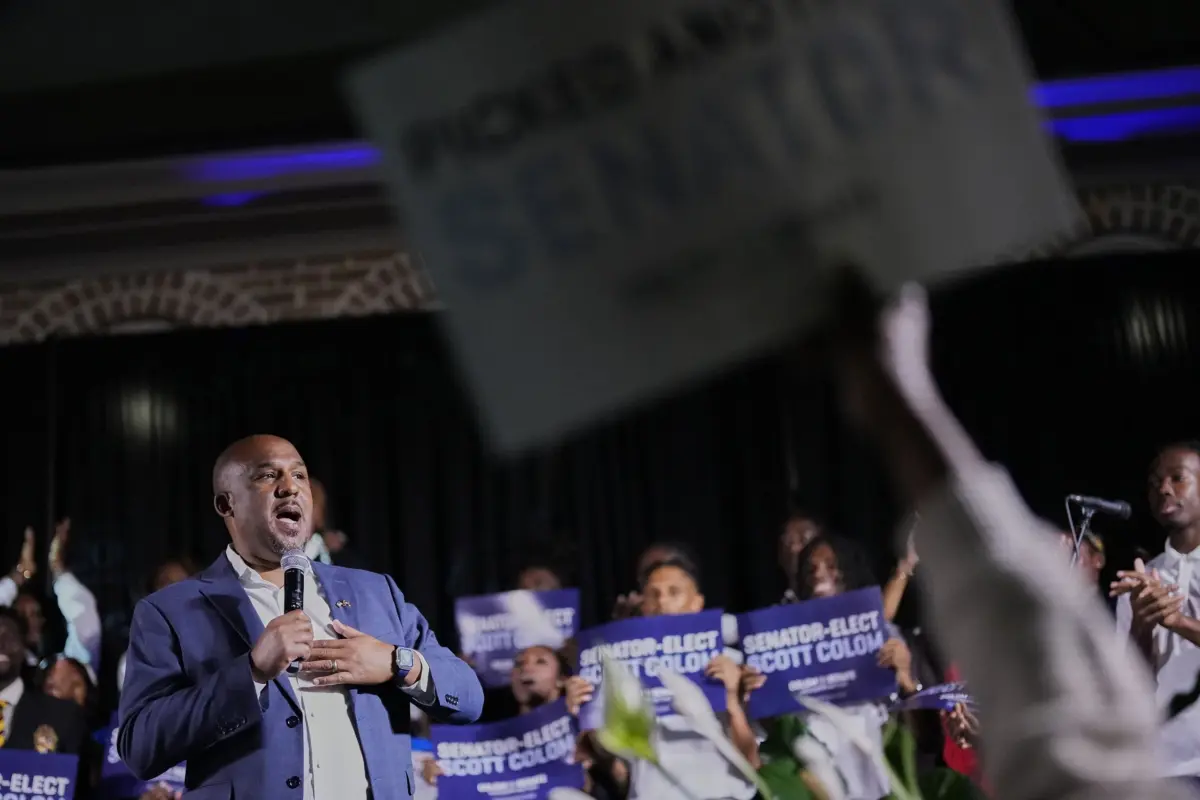
Colom celebrated his victory at Tougaloo College in Jackson, a historically Black institution founded in 1869 by Christian missionaries to educate freed slaves. Standing alongside Congressman Bennie Thompson, Colom addressed supporters, characterizing the outcome as a testament to the power of grassroots persistence.
"All I did was have the courage to imagine a night like this," Colom told the crowd. "I had the courage to believe in Mississippi."
                           SCOTT COLOM: PATH TO THE SENATE
                           ===============================

  +-----------------------+      +-----------------------+      +-----------------------+
  |  Nonprofit & Local    | ---> |   Nomination Blocked  | ---> |  "Mississippi Matters"|
  |  Judicial/Prosecutorial|      |   by Hyde-Smith       |      |   Grassroots Campaign |
  |  Experience (Lowndes) |      |   (2023 Blue Slip)    |      |   82-County Tour      |
  +-----------------------+      +-----------------------+      +-----------------------+
                                                                            |
                                                                            v
  +-----------------------+      +-----------------------+      +-----------------------+
  |  Historic Win at      | <--- |  8-Day Affidavit Tally| <--- | Election Night Margin:|
  |  Tougaloo Rally       |      |  Lead Expands to ~5k  |      |  Up by 28 Votes       |
  +-----------------------+      +-----------------------+      +-----------------------+
Supporting Context & Metrics
Demographic Realities and Electoral Math
Winning a statewide election in Mississippi as a Democrat requires overcoming stark voting patterns. Black residents make up approximately 37% of the state’s population—the highest proportion of any state in the nation—and vote overwhelmingly for Democratic candidates. Conversely, roughly 75% of white voters in Mississippi consistently align with the Republican Party.
To win, Colom needed to secure maximum turnout among Black voters while simultaneously peeling off a critical segment of working-class white voters. He targeted rural areas severely affected by hospital closures, agricultural tariffs, and rising living costs, arguing that federal policy decisions were damaging local economies regardless of party affiliation.
                  MISSISSIPPI VOTER DEMOGRAPHICS & PARTY ALIGNMENT
                  ================================================

   BLACK VOTERS (37% of Population)            WHITE VOTERS (63% of Population)
   ---------------------------------           ---------------------------------
   [█████████████████████████] 90%+            [███████████████████        ] ~75%
            Democratic                                    Republican
Campaign Strategy and Messaging: "Mississippi Matters"
Colom derived his core campaign slogan, "Mississippi Matters," from an unconventional source: the theme song of the 1990s television sitcom Family Matters. Colom reasoned that the show’s emphasis on shared family values resonated across racial and cultural divides.
His campaign focused heavily on local economic vulnerabilities:
- Healthcare: Highlighting the refusal of state leaders to expand Medicaid, contributing to rural hospital closures.
- Agriculture & Tariffs: Detailing how federal retaliatory tariffs hit Mississippi soy and cotton farmers.
- Infrastructure: Criticizing Hyde-Smith’s vote against the 2021 Bipartisan Infrastructure Law, despite her subsequent public appearance celebrating federally funded rail reopenings on the Gulf Coast.
Creative Mobilization and Viral Advertising
Faced with significant financial constraints—raising roughly $4 million to $5 million compared to multi-million-dollar national conservative ad buys—the Colom campaign utilized low-cost, high-impact outreach.
When Hyde-Smith publicly suggested that consumers struggling with rising beef prices should simply "pick another protein," the campaign responded by deploying a food truck serving "Pick Another Protein Tacos" at housing developments, industrial plants, and community events.

Colom’s brother, Andrew, produced a viral campaign ad featuring local residents reacting to the incumbent’s remarks. Produced for under $1,000, the video generated widespread social media engagement, bolstering small-dollar fundraising during the final stretch of the campaign.
+-------------------------------------------------------------------------------+
|                       FINANCIAL & CAMPAIGN CONTRASTS                          |
+-------------------------------------------------------------------------------+
|  FEATURE                | SCOTT COLOM (D)          | CINDY HYDE-SMITH (R)     |
+-------------------------+--------------------------+--------------------------+
|  Total Campaign Budget  | ~$4M – $5M               | Heavily Super PAC backed |
|  Key Messaging          | "Mississippi Matters"    | "Rock-Solid Conservative"|
|  Debates Participated   | Multiple Town Halls      | Declined Debates         |
|  Late National Support  | $2M DNC (Late Oct)       | Continuous National GOP  |
|  Ground Strategy        | 82-County Outreach       | High-level Endorsements  |
+-------------------------------------------------------------------------------+
Voting System Obstacles and the Experian Purge
Colom’s victory occurred within a state voting framework recognized as one of the most restrictive in the nation. Mississippi offers no online voter registration, no early voting, and no same-day registration.
Controversy escalated in early 2024 when an investigation revealed that the Mississippi Secretary of State’s office had utilized credit data from Experian to cross-check voter registration rolls. The process resulted in approximately 230,000 voters being flagged as "inactive," often due to minor address discrepancies identified by credit algorithms.
                           THE AFFIDAVIT BALLOT PROCESS
                           ============================

     [Voter Purged via Experian Data / Discrepancy at Precinct]
                                 │
                                 ▼
         [Casts Provisional / Affidavit Ballot on Election Day]
                                 │
                                 ▼
   [County Election Commissioners Review Electronic Records & Address Data]
                                 │
                 ┌───────────────┴───────────────┐
                 ▼                               ▼
       [ACCEPTED & SCANNED]           [REJECTED / APPEALED]
      (Lead grew by ~5,000 votes)   (Widespread observer oversight)
On Election Day, thousands of affected individuals cast provisional (affidavit) ballots. Processing these ballots caused the eight-day delay in final results, as county election commissioners reviewed individual registration records under close supervision from party monitors and legal teams.
Official Statements
Scott Colom (Senator-Elect)
Reflecting on his campaign’s victory and the national landscape, Colom pointed to voter dissatisfaction with federal economic policy and unfulfilled political promises:
"To do what it takes to actually win, everybody in politics has to have a little bit of a selfish motivation. I wanted Mississippi to get better representation, but my selfish motivation was I wanted to make my parents proud."
"He [Trump] promised lower prices on Day One, and the exact opposite happened. We had the highest increase in sales tax on Day One, through tariffs. He promised no more endless wars. We’re back at war… The people of Mississippi stood up for themselves and said, ‘We want to go in a new direction.’"
Mike Hurst (Mississippi Republican Party Chair)
On Election Night, Hurst reiterated his party’s structural advantage in the state, though that assessment was challenged by subsequent vote tallies:
"At the end of the night, though, we are a Republican state."
Congressman Bennie Thompson (U.S. Representative, MS-02)
Addressing the Tougaloo College victory rally, Thompson highlighted the historic significance of Colom’s win over Hyde-Smith:
"All my friends kept saying, ‘I don’t know if the time is right. Maybe you’re moving too fast. Maybe he’s too young.’ Well, well. Here we are, with a winner."
Charles Taylor (Executive Director, Mississippi NAACP)
Taylor underscored the decades of community organizing required to achieve a statewide breakthrough in Mississippi:
"Scott Colom’s grit and grind won this race… How you showed up before you decided to run will be foundational. In the Black community, you get elected two ways: long-term relationships or a trusted voice… Black communities have been organized since slavery."
Michael Watson (Mississippi Secretary of State)
Addressing scrutiny over the state’s voter roll maintenance procedures, Watson maintained his office’s position via public statements:
"I stand by our decision and the work we’ve done to clean up our voter rolls."
Future Outlook
Political Implications for Mississippi
Colom’s victory reshapes expectations for competitive politics in Mississippi. For decades, national Democratic organizations treated the state as non-viable, directing resources to other Southern states like Georgia and North Carolina. Colom’s success demonstrates that competitive campaigns are possible in the Deep South when built around sustained local engagement and hyper-local economic messaging.
State organizers are shifting focus to the 2027 Mississippi gubernatorial election, anticipating that Colom’s win will attract greater national investment and encourage a new generation of candidates to seek statewide office.
              HISTORICAL CONTINUUM OF BLACK MISSISSIPPI LEADERSHIP
              ====================================================

      1870                      1875                     1993               PRESENT
       │                         │                        │                    │
       ▼                         ▼                        ▼                    ▼
 Hiram Revels             Blanche K. Bruce         Bennie Thompson      Scott Colom
 (Appointed by            (Appointed by            (Elected to U.S.     (First Black U.S. Senator
 State Legislature)       State Legislature)       House of Reps)       Elected by Popular Vote)
Federal and Policy Realities
When Colom takes office, he will navigate a divided political landscape. As a Democrat representing a state that voted heavily conservative in recent presidential elections, his legislative agenda is expected to prioritize:
- Securing federal funding for rural healthcare infrastructure.
- Opposing broad agricultural tariffs that adversely impact Southern growers.
- Advocating for federal legislation to protect voting rights and modernize election administration.
Colom’s victory also carries emotional weight in a state marked by civil rights history. His campaign flipped key jurisdictions, including Forrest County—named after Ku Klux Klan founder Nathan Bedford Forrest. For voting rights advocates, Colom’s election stands as a historic milestone in the long struggle for political representation in Mississippi.




Comments
Facebook App ID not configured. Please add it in the Customizer.