
Executive Overview
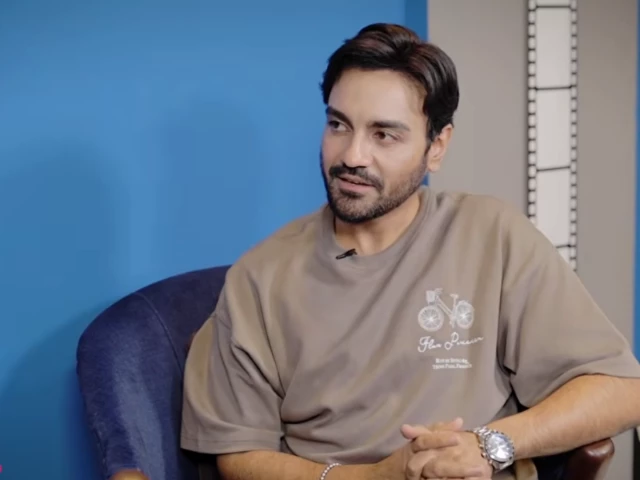
The contemporary entertainment landscape often presents a binary narrative: individuals are either destined for the creative arts from childhood, or they stumble into the limelight by sheer, uncalculated fortune. Yet, the trajectory of actor and digital content creator Arsalan Naseer defies such simplistic paradigms. In a candid, wide-ranging retrospective interview, Naseer opened up about his unconventional, winding path from a boarding school pupil sketching cartoons to a white-collar professional in Ireland, and finally, to a celebrated fixture in Pakistan’s television and digital spheres.
Best known for his breakout performances in hit projects such as Chupke Chupke and Jin Ki Shaadi Unki Shaadi, Naseer’s journey offers a profound meditation on the mechanics of success. His narrative cuts through the cultural obsession with material affluence, challenging the long-held assumption that financial security and public adoration are synonymous with inner peace. Having experienced both the rigid confines of the corporate world and the intoxicating heights of celebrity culture, Naseer’s revelations provide a rare, sobering look into the psychological toll of ambition.
Beyond his career trajectory, Naseer used the platform to deconstruct modern social constructs, ranging from the cinematic mythologies of romance to the rigid, diagnostic terminology currently dominating contemporary dating culture—specifically, the obsession with "red flags" and "green flags." By weaving together personal anecdotes with philosophical introspection, Naseer paints a picture of a man who refuses to be pigeonholed by traditional labels, whether in his professional pursuits or his personal relationships. This comprehensive report examines Naseer’s multi-faceted journey, evaluating the systemic shifts in his career, his critique of fame, and his pragmatic philosophy on human connection.
Read Also
Detailed Chronology: From Sketchbooks to Boardrooms and Studios
The Early Years: Artistic Inclinations and Institutional Upbringing
Arsalan Naseer’s life trajectory was set in motion early, characterized by displacement and a distinct divergence from conventional expectations. Sent away to boarding school at the tender age of eleven, Naseer developed an early sense of independence, though it was matched by an internal resistance to traditional scholastic disciplines. While his peers focused on standard academic markers, Naseer’s internal world was dominated by the visual arts.
"Usually every kid used to like studying, but I enjoyed arts and music more," Naseer reflected, recalling a childhood spent sketching, observing dance forms, and consuming animation. These early creative inclinations, however, did not immediately materialize into a career plan. Instead, they existed as a parallel pursuit, running counter to the expectations of a traditional upbringing that prioritized stable, high-yielding professions.
The Engineering Detour and the Corporate Mirage in Ireland
As he reached the crossroads of higher education, Naseer faced the classic dilemma confronting many creatively inclined youth in South Asia: balancing personal passion with familial and societal expectations. He initially hedged his bets, securing admission into both an engineering institution and fashion design colleges. When he broached the subject of pursuing a creative career, the response from his family was one of predictable surprise.
Yielding momentarily to convention, Naseer enrolled in an engineering program, only to abandon it three months later. Recognizing that the technical discipline was entirely misaligned with his cognitive and creative wiring, he pivoted internationally, moving to Ireland. There, he contemplated fields like business, marketing, and advertising, driven by a singular, utilitarian objective: securing a white-collar profession and building a comfortable, financially secure lifestyle.
In many ways, Naseer achieved the conventional American—or in this case, European—dream. He climbed the corporate ladder, eventually earning substantial sums and acquiring real estate, including an apartment abroad. Yet, this material culmination did not yield psychological equilibrium. "I still realised that something was missing," he admitted, highlighting a universal existential crisis where financial success fails to fill an internal void.
The Accidental Renaissance: Digital Content Creation
Relocating back to Pakistan, Naseer sought an outlet for his lingering creative energies. Having previously dabbled in comic book design, he turned to digital content creation. At its inception, this venture was modest in scope—a low-stakes side project meant to complement his daily routine rather than replace it.
"I just did it to have something on the side," Naseer noted. Little did he know, this digital foray would serve as the bridge between his corporate past and his artistic future. The satirical, sharp, and highly relatable content he produced struck a chord with internet audiences, gradually snowballing into a dominant cultural presence that eventually caught the eye of mainstream television producers.
Supporting Context & Metrics: The Anatomy of Modern Stardom
Deconstructing the Illusion of Celebrity
One of the most revealing aspects of Naseer’s interview is his disillusionment with the very industry that brought him household fame. Transitioning from a digital creator to a mainstream television actor placed him within elite cultural circles, granting him unprecedented access to the lives of fellow celebrities. This proximity dismantled any remaining illusions he held about fame.
"I started hanging around celebrities and realised they also have issues too. They are not at peace," Naseer observed. By observing individuals who possessed physical beauty, immense wealth, and societal influence yet remained tormented by internal struggles, Naseer underwent a profound shift in perspective.
| Metric / Life Stage | Corporate Life (Ireland) | Digital Content Creation | Mainstream Entertainment |
|---|---|---|---|
| Primary Driver | Financial security, white-collar status | Creative expression, hobby | Artistic challenge, audience engagement |
| Psychological State | Materially rich, existentially unfulfilled | Low-stress, exploratory | High-expectation, pressure-cooker environment |
| Perception of Success | Tied to capital accumulation and assets | Tied to autonomy and output | Tied to public validation and hit projects |
This realization forced him to re-evaluate his foundational motivations. The pursuit of wealth and fame, once viewed as the ultimate panacea for life’s uncertainties, was revealed to be a hollow pursuit. "So I was like, what inner peace am I wanting from money or fame?" he asked rhetorically, arriving at a minimalist conclusion: the conscious prioritization of inner tranquility over external accolades.
The Escalating Pressures of Mainstream Success
As Naseer cemented his status as a mainstream actor through celebrated projects like Chupke Chupke and Jin Ki Shaadi Unki Shaadi, the nature of his creative output underwent a parallel transformation. Initially, entry into the entertainment sphere was defined by gratitude and flexibility; he was content accepting any project that came his way, treating each role as a novel experiment.
However, commercial success introduced a new set of psychological parameters. Hit projects breed expectations—both from the audience and the industry at large. Naseer candidly acknowledged this shifting landscape, noting that the carefree attitude of his early days has inevitably been replaced by a rigorous drive to meet escalating demands. "At the moment, I’m trying my best," he confessed, illustrating the perpetual treadmill of validation that characterizes modern stardom.
Official Statements and Philosophical Reflections
De-romanticizing the Silver Screen: A Pragmatic View of Love
Shifting his focus from professional life to matters of the heart, Naseer offered a sharp critique of how contemporary media shapes—and often distorts—human romantic expectations. He dismissed the hyper-stylized tropes popularized by cinema as fundamentally unrealistic.
"Overrated is what is happening in films, like seeing someone in slow motion and having butterflies," Naseer pointed out, stripping away the artificial gloss of romanticized encounters. His personal romantic history mirrors this pragmatism. Rather than experiencing love at first sight, Naseer admitted that his deepest attractions have historically developed organically, often defying his initial impressions.
He recounted a specific instance where he found himself drawn to a woman who was the antithesis of traditional, passive romantic ideals. Describing her as wealthy, proud, confident, blunt, and unapologetically direct, Naseer noted that her refusal to mask her ambitions or temper her personality was precisely what commanded his respect and eventual affection.
"Some people try to hide those things, but then I grew interested in the confidence," he explained, championing authenticity over the performative modesty often expected in traditional social spheres.
Challenging the Red Flag / Green Flag Culture
In an era dominated by pop-psychology terminology and social media discourse surrounding relationship diagnostics, Naseer offered a refreshing, nuanced critique of the rigid categorization of human behavior. The modern compulsion to instantly label individuals as carrying "red flags" or "green flags" is, in his view, an exercise in premature judgment.
"You don’t know how they will be in five days versus five years," Naseer cautioned, highlighting the fluid, ever-evolving nature of human character. Drawing from his own life, he emphasized the capacity for personal transformation: "I changed a lot. The kind of person I was 10 years back, I am not the same."
His philosophy on interpersonal relationships is rooted in existential utility—the belief that every individual who crosses one’s path serves a distinct purpose in personal development. "Each person comes into your life to show you something," he asserted. Consequently, he rejects the permanence of negative labeling, posing a philosophical challenge to the digital age: "Maybe a red flag can later change to a green flag."
Future Outlook: Navigating Uncertainty with Acceptance
Arsalan Naseer’s trajectory—from a reluctant engineering student sketching cartoons in a boarding school to a corporate professional in Ireland, and finally to a leading figure in Pakistan’s entertainment ecosystem—serves as a compelling study in adaptive resilience. His story is not merely one of professional reinvention, but of philosophical maturation.
As Naseer continues to navigate the high-stakes environment of mainstream television, his overarching methodology remains anchored in surrender to circumstance rather than obsessive control. Recapping his philosophy of existence, he summarized simply: "I just go with the flow where Allah takes me."
In an industry obsessed with calculated branding, algorithmic success, and rigid career trajectories, Naseer’s willingness to question the very pillars of his own success—fame, wealth, and public adoration—marks him out as an atypical public figure. Whether he is dissecting the illusions of cinematic romance or challenging the swift judgment of modern dating culture, Naseer’s voice remains grounded in self-awareness. As he looks toward future creative projects, his journey stands as a reminder that true career longevity is not found in the relentless pursuit of external markers, but in the continuous, honest alignment of one’s work with inner peace.




Comments
Facebook App ID not configured. Please add it in the Customizer.