
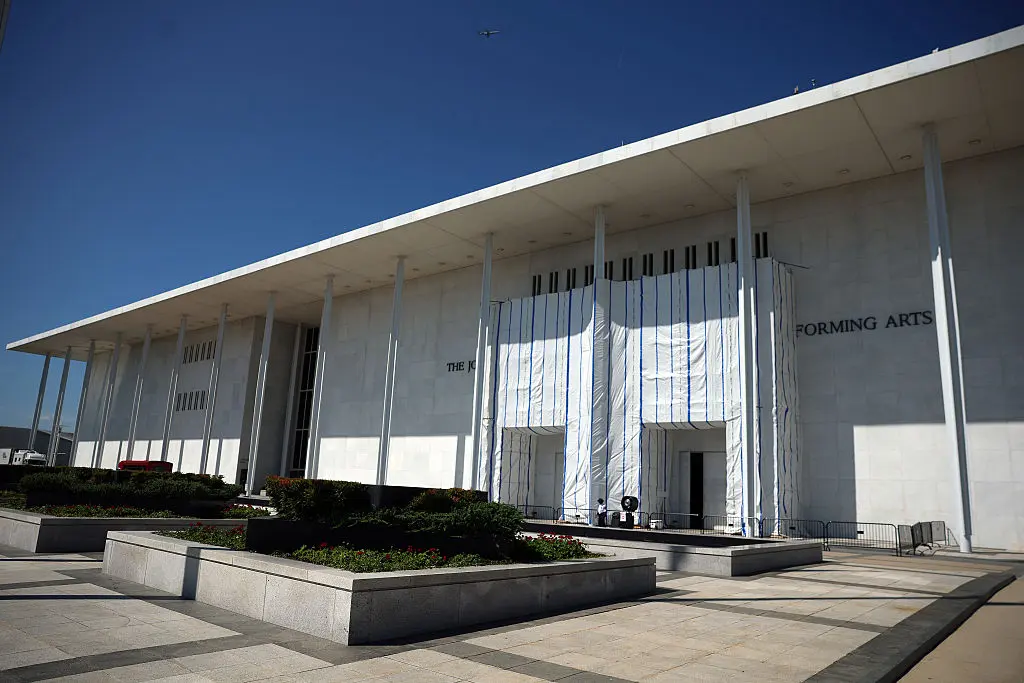
Executive Overview
The John F. Kennedy Center for the Performing Arts—long celebrated as America’s living memorial to the 35th president and a premier hub for world-class arts and culture—is currently engulfed in an unprecedented multi-layered crisis. Straddling the Potomac River in Washington, D.C., the iconic institution is grappling with a toxic confluence of rapidly declining ticket sales, staggering multi-million-dollar budget shortfalls, severe physical decay, and an intensifying political tug-of-war over its very survival.
The structural integrity of the venue itself has emerged as a flashpoint. Following severe regional storms, a section of the plaster ceiling in the landmark Grand Foyer dramatically gave way, showering debris over a space normally traversed by thousands of arts patrons. While no injuries were reported, the incident has instantly escalated from a maintenance issue into a fierce ideological battleground.
Center leadership and loyalists appointed by Chairman President Donald Trump have seized upon the collapse as definitive, long-overdue proof that the facility must immediately shutter its doors for extensive, wholesale renovations. They argue that decades of institutional neglect and deferred maintenance have rendered the building unsafe and functionally obsolete, justifying an aggressive intervention.
Read Also
Conversely, progressive arts advocates, cultural preservationists, and disgruntled former patrons view the structural failure through a deeply cynical lens. Opponents claim the crisis is being manufactured, exaggerated, or actively leveraged by political appointees to force an extended closure, rewrite the center’s institutional identity, or fundamentally alter a crown jewel of the American cultural landscape.
Compounding these physical and political battles is an alarming financial freefall. In the ten months following President Trump’s administrative takeover of the center, ticket sales have plummeted precipitously. Financial disclosures indicate the institution is barreling toward a catastrophic revenue shortfall approaching $100 million. Projections suggest this fiscal year’s operational revenue will miss its budgetary targets by an astounding 70 percent, while philanthropic and contributed revenue is expected to tumble 25 percent short.
As administrative maneuvers clash with activist resistance and financial insolvency looms large, the future of the Kennedy Center hangs precariously in the balance, leaving the nation’s premier performing arts institution fighting for its economic and cultural life.
Detailed Chronology: The Weekend Collapse and Escalating Fallout
The physical crisis at the Kennedy Center unfolded abruptly in the wake of violent storms that swept through the mid-Atlantic region. Heavy, unrelenting rainfall tested the infrastructure of the brutalist-style concrete and glass complex, designed by architect Edward Durell Stone and opened to the public in 1971.
On Friday, institution officials took to social media, publishing striking photographic evidence on X (formerly Twitter) and Instagram depicting chunks of fallen plaster, shattered acoustic material, and debris strewn across the carpeted expanse of the Grand Foyer. The accompanying captions struck an immediate tone of alarm and urgency, characterizing the disaster as a long-time-coming reckoning:
“Another warning we can’t ignore. A section of the Grand Foyer ceiling collapsed after this week’s storms. Thankfully no one was hurt. Decades of deferred maintenance made this inevitable.”
Crucially, the post explicitly aligned the physical failure with the political agenda of the institution’s leadership:
“Chairman President Trump has been right: America’s cultural center needs to close, renovate, and be restored—now.”
As mainstream outlets such as The Guardian picked up the story, reporting extensively on the rain-induced ceiling failure, the center’s vice president for public relations, Roma Daravi, doubled down on the narrative. In official statements to the press, Daravi framed the dramatic collapse as undeniable proof that the facility was no longer viable in its current state, reiterating that the emergency validated Chairman Trump’s calls for an immediate, comprehensive closure for revitalization and heavy infrastructural overhaul.
However, the narrative crafted by center leadership was met with swift, coordinated skepticism from outside advocacy groups. By Sunday, the newly formed activist collective "Hands off the Arts"—organized explicitly to resist President Trump’s sweeping modernization and operational plans for the venue—published a scathing counter-narrative via an Instagram video. The post systematically dismantled the official framing, warning followers that “Friends don’t let friends repeat @officialtkc propaganda.”
The activist group’s statement launched a direct attack on the credibility of the center’s spokesperson:
“Trump loyalist and Kennedy Center spokesperson Roma Daravi couldn’t wait to tell the media all about a ‘ceiling collapse’ in the Kennedy Center’s Grand Foyer this weekend. Awfully convenient for a person trying to legitimize a two-year renovation/renaming/bulldozing(?) on behalf of her favorite president!”
This dueling public relations blitz transformed a routine infrastructural failure into a high-stakes proxy war. To leadership, the falling debris is an objective, undeniable hazard demanding immediate administrative action and site closure. To critics, it is a staged or deliberately sensationalized crisis engineered to manufacture consent for a politically motivated takeover of a beloved national institution.
Supporting Context & Metrics: The Financial Freefall
While the physical collapse of the Grand Foyer ceiling captured immediate media attention, the quiet bleeding behind closed administrative doors presents an even graver existential threat to the Kennedy Center. The institution is currently enduring a historic financial collapse, driven by a combination of macroeconomic headwinds, shifting public patron behaviors, and intense ideological alienation among its traditional subscriber base.
In the ten months following President Donald Trump’s assumption of direct control over the center’s governance structure, ticket sales have entered a prolonged, uninterrupted tailspin. Data obtained from financial disclosures and insider reports indicate that the performing arts venue is tracking toward a mind-numbing operational deficit, currently positioned to fall nearly $100 million short of its projected revenue targets for the cycle.
A granular breakdown of the budgetary distress reveals an institution in critical condition:
- Operational Revenue Deficit: Center financial officers are formally projecting that this fiscal year’s earned revenue will miss established budget targets by an unprecedented 70 percent.
- Philanthropic Shortfall: Contributed revenue—traditionally driven by high-net-worth individual donors, corporate sponsorships, and foundation grants—is forecasted to fall 25 percent short of expectations.
- Subscriber Alienation: Subscriptions for major resident companies, including the National Symphony Orchestra and Washington National Opera, as well as touring Broadway productions, have experienced historic cancellations.
Industry analysts and arts management experts point out that performing arts centers across the United States have faced post-pandemic recovery challenges, but none have matched the localized, politically driven attrition experienced by the Kennedy Center. The fusion of partisan politics with arts administration has alienated core demographic segments—particularly progressive metropolitan audiences in the Washington, D.C., area who historically form the backbone of the center’s single-ticket buyers and annual donors.
As box office receipts dwindle and corporate sponsors pull back to avoid entanglement in partisan controversies, the center’s cash reserves are being rapidly depleted just to handle basic day-to-day facility operations, leaving virtually no capital to address the very infrastructural decay that leadership claims requires a total shutdown.
Official Statements and Competing Perspectives
The chasm between the Kennedy Center’s executive leadership and its diverse body of stakeholders, artists, and patrons has never been wider. The public discourse surrounding the venue has devolved into an ideological war of words, characterized by mutual distrust, competing motivations, and starkly divergent visions for the future of the national memorial.
The Administration’s Stance: Necessity, Safety, and Renewal
From the perspective of Chairman President Donald Trump and his appointed lieutenants, including PR Vice President Roma Daravi, the Kennedy Center is an asset that has been chronically mismanaged and structurally neglected by previous establishments.
Administration loyalists argue that sweeping action is not merely desirable, but morally imperative. They point to aging mechanical systems, outdated acoustics in secondary theaters, and now, photographic evidence of compromised roofing and fallen plaster in the Grand Foyer as definitive proof that the building is failing the public.
In the administration’s view, calls to "close, renovate, and be restored now" are rooted in public safety and national pride. They contend that America’s premier cultural showcase should reflect architectural excellence and modern operational standards, free from the bureaucratic inertia that they argue allowed the facility to deteriorate to the point of structural hazard. Leadership maintains that a temporary, aggressive intervention—even one requiring a multi-year shutdown or restructuring—is the only responsible path forward to salvage a decaying monument.
The Critics’ Stance: Manufactured Crisis and Institutional Capture
Conversely, the opposition—anchored by grassroots organizations like Hands off the Arts, progressive lawmakers, cultural historians, and many prominent artists—views the administration’s rhetoric with profound alarm.
Critics argue that the physical decay of the Kennedy Center is being weaponized. By amplifying maintenance issues like the rain-damaged Grand Foyer ceiling, administration loyalists are accused of manufacturing a false sense of emergency to justify a hostile takeover. Opponents fear that a prolonged closure would not simply be used for neutral plumbing and plaster repairs, but rather as a smokescreen to purge independent artistic programming, marginalize diverse creative voices, and potentially rebrand the institution to align with a specific partisan ideology.
Furthermore, critics emphasize that the severe financial crisis crippling the center is entirely self-inflicted. They argue that the 70 percent operational revenue shortfall and the staggering $100 million deficit are direct consequences of the political polarization introduced by the Trump administration’s takeover. In this view, loyalist management drove away the very patrons, donors, and artists who sustained the institution, creating a financial death spiral that leadership now cynically blames on physical infrastructure.
Future Outlook: What Lies Ahead for the National Cultural Center?
As the dust settles from the fallen plaster in the Grand Foyer and the war of words intensifies online, the immediate and long-term future of the John F. Kennedy Center for the Performing Arts remains dangerously uncertain.
The convergence of three major crises—physical decay, financial insolvency, and severe political polarization—has pushed the institution into uncharted territory. Several critical questions now define the road ahead:
- Will the Facility Close? The administration’s push to shutter the center for extensive renovations faces fierce legal, political, and public relations hurdles. While the physical evidence of water damage and falling ceiling tiles provides a tangible argument for safety closures, opponents are mobilizing to demand independent engineering audits to verify the true extent of the structural threat, ensuring that closures cannot be arbitrarily extended for political reengineering.
- Can the Financial Bleeding Be Stopped? With a projected $100 million shortfall and a 70 percent drop in operational revenue, the Kennedy Center faces imminent insolvency unless immediate financial stabilization measures are enacted. Securing emergency federal appropriations will prove exceptionally difficult given the deep congressional divisions over the center’s governance, while rebuilding trust with alienated donors and ticket buyers will require a monumental shift in administrative outreach.
- The Battle Over Institutional Identity: At its core, the fight over the Kennedy Center is a battle over who speaks for American culture. As President Trump’s appointees seek to reshape the institution, and as cultural activists fight to preserve its traditional mandate as an inclusive, politically independent national stage, the outcome will set a monumental precedent for how federal cultural institutions are governed, funded, and protected in times of intense political division.
For now, the grand halls along the Potomac sit in a state of uneasy suspense. Patrons arriving for performances navigate not only the standard rituals of high culture, but the shadow of falling debris overhead and the heavy political crosswinds swirling through the administration offices. Whether the Kennedy Center emerges from this multi-front crisis revitalized or fundamentally transformed remains one of the most pressing and contentious cultural questions of the modern era.





Comments
Facebook App ID not configured. Please add it in the Customizer.