In an era defined by compounding ecological anxieties, climate volatility, and an ever-expanding global population, the question of how humanity feeds itself sustainably has transitioned from an academic thought experiment to an existential imperative. While industrial agriculture dominates modern food supply chains—characterized by massive monocultures, chemical inputs, and heavy fossil-fuel reliance—a quieter, more innovative agricultural revolution is taking root across the globe.
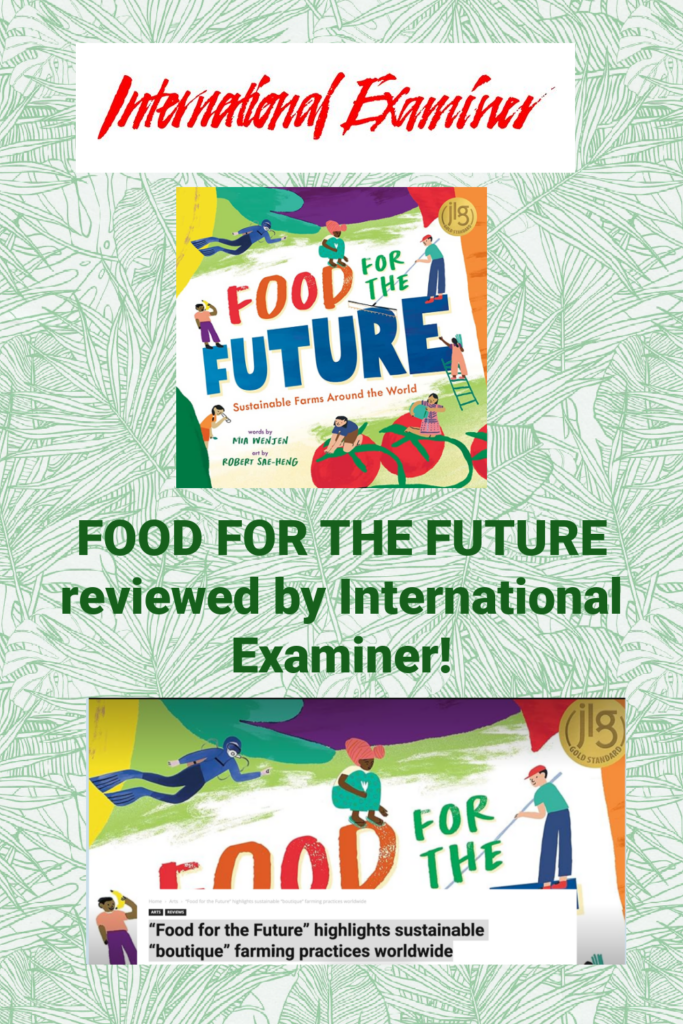
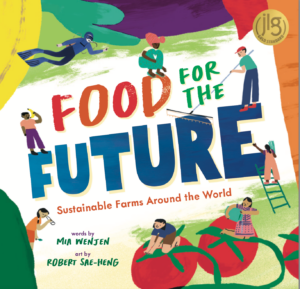
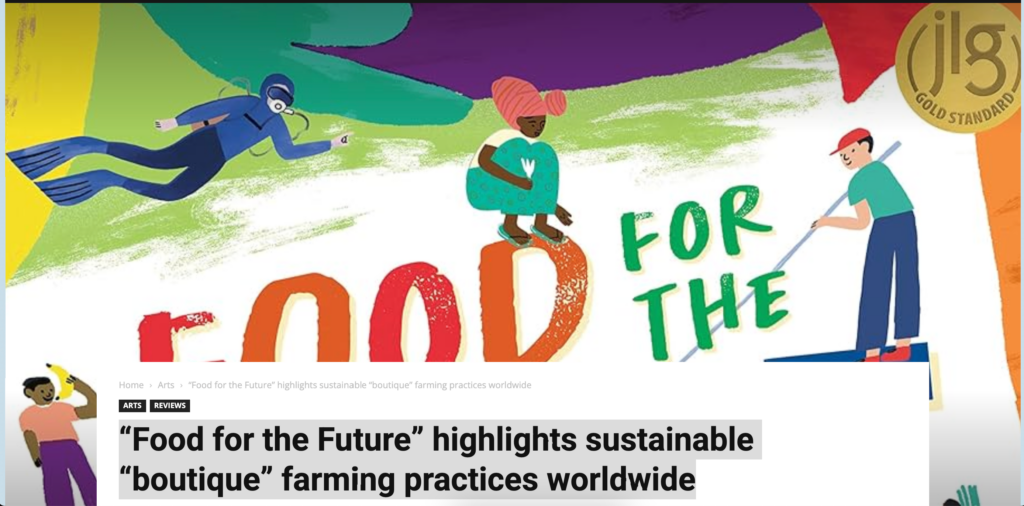
This alternative paradigm is masterfully captured for younger audiences in Mia Wenjen’s critically acclaimed children’s book, Food for the Future: Sustainable Farms Around the World, illustrated by Robert Sae-Heng. Recently the subject of a thoughtful review by Shalin Hai-Hai in the International Examiner, Wenjen’s work steps outside the traditional boundaries of agrarian storytelling. Instead of focusing exclusively on conventional family farms or industrial complexes, the book adopts a "big tent" definition of farming. It explores a diverse array of global, sustainable, and "boutique" agricultural practices—ranging from seawater salt evaporation and ocean biospheres to indigenous hunting-gathering traditions like the log-dam fish traps of the Enawenê-Nawê people.
This investigative report examines the core themes of Wenjen’s work, analyzes the real-world agricultural and environmental philosophies it champions, contextualizes its commercial and critical success through an impressive array of literary accolades, and explores how narrative nonfiction is shaping the next generation of ecological stewards.
The journey of Food for the Future: Sustainable Farms Around the World reflects a steady, deliberate accumulation of critical validation and educational adoption. Since its publication by Barefoot Books, the title has charted an extraordinary path through the landscape of children’s literature, accruing honors that highlight both its aesthetic appeal and its rigorous educational utility.
From Concept to Critical Reception
January 2023 – Publication & Launch: Released to critical acclaim, the book immediately established itself as a visually arresting entry into children’s nonfiction. Illustrated by Robert Sae-Heng, the two-page, double-spread layouts transformed diverse geographical and agricultural landscapes into immersive visual learning environments.
Early Recognition (2023–2024): The book’s unique framing of global sustainability resonated immediately with educators, librarians, and reviewers. It was named one of Bank Street College’s Best Children’s Books of the Year, signaling its foundational importance in school and library curricula.
The Awards Circuit (2024–2025): The title’s momentum accelerated as it garnered a series of prestigious long-listings and finalist nods. Notably, it was named a finalist for the 2023 INDIES Book of the Year Awards and earned a Nautilus Silver Book Award—an honor celebrating books that advocate for a better world, social and environmental justice, and conscious living. Further cementing its classroom relevance, the book secured spots on the Green Earth Book Award long list, the Mass Book Award long list, and the Sunshine State Young Readers Award Orange Blossom List for Nonfiction.
Ongoing Academic and Public Engagement (2024–Present): Through targeted digital features and educational deep-dives—such as explorations of Hawaiian salt-making traditions, shiitake mushroom cultivation, and the "Half Moon Miracle" agroforestry techniques in the Sahel region—the book has transcended its physical binding to become an active pedagogical tool.
Supporting Context & Metrics: Redefining "Farming" for a Changing Planet
To fully appreciate the cultural footprint of Wenjen’s work, one must examine the agricultural philosophies embedded within its pages. Modern food production systems face severe vulnerabilities, including topsoil erosion, freshwater depletion, chemical runoff, and carbon emissions. Food for the Future directly confronts these environmental stressors by showcasing decentralized, resilient agricultural models from across all inhabited continents.
The Anatomy of Boutique and Indigenous Agriculture
Traditional Western discourse often equates "farming" with large-scale tractor-tilled acreage growing wheat, corn, or soy. Wenjen intentionally shatters this narrow paradigm. The text maps an array of alternative food-production systems:
Aquaculture and Ocean Biospheres: Highlighting oyster farming and underwater biosphere pods, the book demonstrates how maritime spaces can be cultivated without depleting wild fish stocks or land resources.
Arid and Terraced Innovations: By showcasing terrace farming in South America (where crops like quinoa and sweet potatoes thrive on steep mountain gradients) and soil-restoration techniques in Africa’s Sahel region, the book underscores human ingenuity in challenging topographies.
Indigenous Stewardship: The inclusion of indigenous practices, such as the Enawenê-Nawê people constructing log jams and handwoven fish traps, bridges the gap between ancient wisdom and contemporary sustainability. These methods highlight a reciprocal relationship with ecosystems rather than an extractive one.
Urban and Vertical Integration: Incorporating vertical farms that harness solar power and capture rainwater demonstrates how high-tech solutions can merge with sustainable principles in urban settings.
Critical Perspectives and Industrial Omissions
In her review for the International Examiner, Shalin Hai-Hai notes both the profound strengths and the deliberate omissions of the text. While the book succeeds brilliantly in introducing children to diverse ecological practices and fostering an appreciation for the labor behind food production, it omits certain modern innovations. For instance, the text does not deeply explore industrial-scale production—which remains crucial for feeding billions—nor does it delve into emerging trends like insect protein farming or lab-grown artificial meats.
However, these omissions do not diminish the book’s value; rather, they frame it accurately as an inspirational starting point. By focusing on localized, sustainable models, the book sparks children’s curiosity, encouraging them to investigate the back-of-the-book notes that explain the science and mechanics behind each agricultural practice.
Official Statements and Educational Impact
The resonance of Food for the Future extends far beyond literary circles, tapping into a broader cultural conversation about climate education, food literacy, and systemic waste reduction.
Educational psychologists and literacy advocates frequently emphasize that children cannot care for ecosystems they do not understand. By humanizing the agricultural process—showing real people engaged in the physical labor of planting, tending, harvesting, and gathering—the book fosters deep-seated empathy and environmental consciousness.
"Readers come away with a deeper understanding of just where common foodstuffs come from, and perhaps a sense of how much labor goes into the growing, harvesting, making, and delivery of food… There is a sense of the need to feed people sustainably [and] a sense of the need to avoid food wastage given the costs to making food."
— Shalin Hai-Hai, International Examiner
Furthermore, the integration of back-matter notes provides educators with a reliable bridge from narrative engagement to scientific inquiry. Children are not merely entertained by Robert Sae-Heng’s vibrant illustrations; they are invited to interrogate why rainwater catchment systems work, how soil erosion is prevented by terracing, and what makes a salt farm ecologically distinct from a chemical processing plant.
Future Outlook: The Evolution of Eco-Lit and Sustainable Food Systems
As we look toward the mid-21st century, the intersection of children’s literature and environmental science will play an indispensable role in shaping planetary consciousness. Books like Food for the Future are the vanguard of a new literary movement that treats young readers not as passive consumers of simplistic fables, but as active, intellectually curious stakeholders in Earth’s future.
The Path Ahead for Agricultural Literacy
Curriculum Integration: As school districts face mounting pressure to incorporate climate education into core subjects, titles that blend geography, biology, and social studies—such as Wenjen’s catalog—will serve as foundational texts.
Expanding the Narrative: Future literary works in this genre will likely bridge the gap identified by critics, building upon the foundation of "boutique" and indigenous practices to introduce older students to complex industrial adaptations, cellular agriculture, and circular urban food systems.
Empowering the Next Generation: Ultimately, the greatest metric of success for books like Food for the Future cannot be measured in awards or long lists alone. It is measured in the behavioral shifts of the next generation—children who grow up with an innate understanding that food is precious, labor is intensive, and the earth’s ecosystems are fragile systems worthy of our utmost respect and protection.
Through meticulous research, evocative storytelling, and breathtaking illustration, Mia Wenjen and Robert Sae-Heng have provided an enduring blueprint for how we can teach our children to nourish both themselves and the world they will inherit.








Comments
Facebook App ID not configured. Please add it in the Customizer.