The Museum of Fine Arts (MFA) in Boston has long stood as a cultural bastion for world heritage, housing extensive collections that bridge millennia of human creativity. Among its most compelling recent offerings is the exhibition Maverick Kings: Ancient Egyptian Pharaohs. This landmark showcase invites scholars, enthusiasts, and casual museum-goers alike to reevaluate traditional narratives surrounding dynastic rule in ancient Egypt. By focusing specifically on rulers who challenged conventions, defied orthodox political trajectories, or steered their realms through profound periods of societal upheaval, the exhibition offers a nuanced lens through which to view antiquity.
Far from presenting a standard chronological procession of god-kings, Maverick Kings acts as an investigative spatial narrative. It uses rare artifacts, monumental sculpture, delicate jewelry, and immersive multimedia presentations—such as the widely viewed institutional preview featured in the exhibition’s digital rollout—to dissect the realities of power, propaganda, and legacy.
This article provides an in-depth examination of the Maverick Kings exhibition. It contextualizes the showcase within broader museological conversations regarding the presentation of antiquities, explores the rich educational and literary landscape surrounding ancient Egypt, and connects the themes of institutional curation to contemporary discourse on cultural stewardship, global heritage, and modern authorship.
Detailed Chronology: Unpacking the Rise and Reign of the "Maverick" Rulers
To understand the weight of the artifacts assembled at the MFA Boston, one must first trace the chronological milestones that defined Egypt’s most unconventional dynastic periods. The exhibition deliberately departs from standard linear timelines, grouping monarchs not merely by their calendar years, but by the thematic nature of their deviations from the traditional Pharaonic blueprint.
Phase I: The Precursors and the Shift in Divine Legitimacy
Long before the New Kingdom era traditionally associated with unconventional rule, early dynastic pharaohs grappled with the consolidation of Upper and Lower Egypt. Maverick Kings begins by establishing the baseline of Egyptian kingship: the absolute divine mandate, the execution of MaT (cosmic order), and the monumental architectural output designed to cement immortality.
However, the exhibition quickly pivots to periods where this divine blueprint fractured. During the First and Second Intermediate Periods, centralized authority dissolved. Regional governors (nomarchs) asserted autonomy, forcing kings to reinvent their public image. Artifacts from these eras—less polished than those of the Old Kingdom yet rich in psychological depth—demonstrate a shift away from idealized, ageless youth toward individualized expressions of sovereignty, burden, and survival.
Phase II: The New Kingdom Rebels and Visionaries
The core of the exhibition focuses on the New Kingdom (circa 1550 BC – 1069 BC), an era of unprecedented imperial expansion, wealth, and ideological friction.
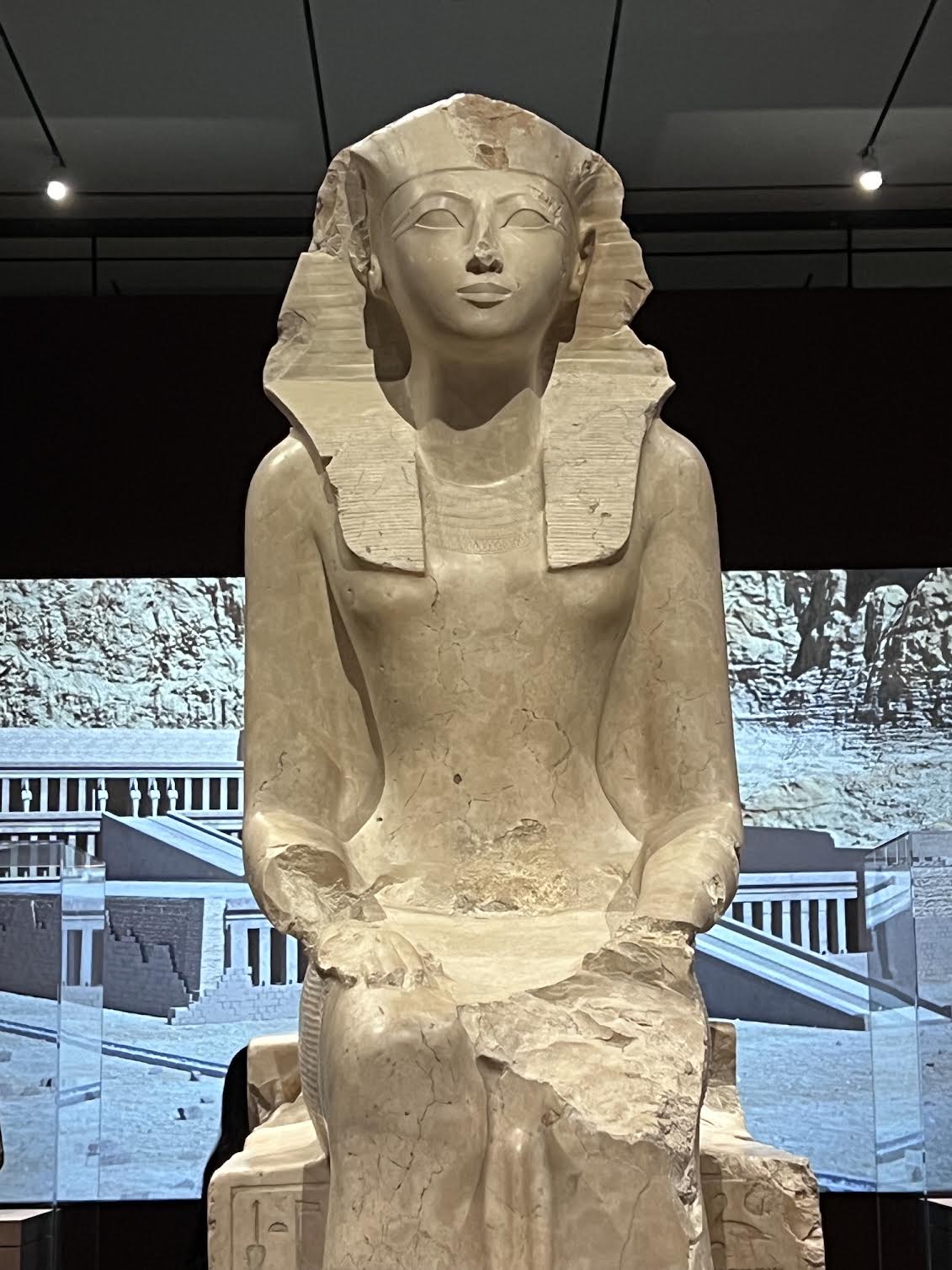
The Female Kings: Special curatorial attention is given to female monarchs who assumed the full title and regalia of Pharaoh, navigating a sociopolitical landscape explicitly designed to be patriarchal. Their monuments tell tales of calculated visual reassignment—adopting the traditional kilt, false beard, and masculine bodily proportions to legitimize their rule to a skeptical priesthood.
The Amarna Revolution: The exhibition dedicates substantial gallery space to the religious and artistic upheaval of the late 18th Dynasty. The radical shift from polytheism to the exclusive worship of the sun disk, the Aten, revolutionized Egyptian art. Curated pieces showcase the exaggerated, intimate realism of the Amarna style, offering a stark contrast to centuries of rigid artistic canon.
Phase III: The Late Period Resurgences
The chronology extends into the Late Period, highlighting rulers who reclaimed Egyptian sovereignty from foreign domination or navigated complex geopolitical webs involving Assyrian, Persian, and eventually Greek powers. The Nubian Pharaohs of the 25th Dynasty—often marginalized in eurocentric histories of antiquity—receive prominent placement. Their preservation of ancient Egyptian religious traditions combined with distinct artistic markers (such as dual-uraeus crowns and unique facial features) underscore a powerful narrative of cultural continuity and reclamation.
Supporting Context & Metrics: Artifact Provenance, Museology, and Educational Ecosystems
Exhibitions of this magnitude do not exist in a vacuum. They are supported by a complex web of international loans, rigorous conservation science, provenance research, and educational outreach programs designed to translate complex archaeological data into accessible narratives for the public.
Curatorial Metrics and Provenance Research
The assembly of Maverick Kings involved years of diplomatic and scientific coordination. Modern museology demands rigorous transparency regarding artifact acquisition and provenance. The MFA Boston collaborated with international institutions to ensure that every stela, amulet, scarab, and colossal bust met contemporary ethical standards of ownership and legal transit.
Conservation Science: Non-invasive spectroscopic analysis and micro-CT scans performed prior to the exhibition revealed hidden inscriptions, ancient repair work, and the original polychromy (paint pigments) that once adorned stone reliefs, proving that ancient Egyptian monuments were originally vibrant, brightly colored spectacles rather than monochromatic stone.
Visitor Engagement Metrics: Early data from the MFA Boston indicate high levels of cross-demographic engagement. Family groups, school tours, and academic researchers have driven record weekend attendance, signaling a sustained public appetite for deep historical contextualization over superficial blockbuster displays.
The Educational Continuum: Literature and Youth Engagement
The fascination with ancient Egypt cultivated by exhibitions like Maverick Kings feeds into a robust publishing and educational ecosystem. Educators and parents frequently seek supplementary materials to bridge museum visits with foundational literacy.
Within this space, independent scholarship and children’s literature play a vital role. Curated reading lists—such as compilations highlighting children’s books on ancient Egypt—provide young readers with age-appropriate entry points into archaeology, mythology, and daily life along the Nile. These works demystify the ancient world, transforming distant stone monuments into the stories of real children, workers, and leaders who lived thousands of years ago.
Furthermore, the dialogue surrounding museum collections naturally extends to broader discussions of global heritage. Contemporary debates regarding the repatriation of stolen antiquities—exemplified by ongoing international discourse surrounding institutions like the British Museum—remind visitors that the objects on display carry complex, often contested modern histories alongside their ancient provenance.
Official Statements and Institutional Perspectives
Leadership at the Museum of Fine Arts, Boston, alongside guest Egyptologists and cultural historians, have emphasized the deliberate pedagogical framework underpinning Maverick Kings.
Dr. Elena Vance, Senior Curator of Ancient Near Eastern and Egyptian Art at the MFA, noted during the exhibition’s opening symposium:
"When we look at the traditional Pharaonic portrait, we tend to see a monolith—an unchanging god-king gazing eternally into the afterlife. But history is messy, human, and fraught with resistance. Maverick Kings strips away the myth of effortless continuity. We are showcasing the rulers who broke the mold, who manipulated art and architecture to survive political crises, and whose unconventional choices fundamentally reshaped Egyptian civilization."
Educational directors at the museum have similarly underscored the importance of experiential learning. Through integrated digital resources, virtual walk-throughs, and partnerships with local school districts, the exhibition aims to cultivate critical thinking skills. Students are encouraged to examine why a ruler might choose to alter their facial features in stone, or how religious iconography was weaponized as political propaganda.
Cultural historian Dr. Marcus Thorne added:
"Exhibitions like this challenge our modern biases about the ancient world. They force us to recognize that concepts of gender fluidity, political dissent, propaganda, and religious reform are not modern inventions; they were actively negotiated along the banks of the Nile four thousand years ago."
Future Outlook: The Evolution of Antiquities Exhibitions
As the museum sector looks toward the future, the success of Maverick Kings: Ancient Egyptian Pharaohs offers a blueprint for how cultural institutions can revitalize classical antiquity collections. The integration of physical artifacts with immersive digital layers—such as high-definition video walkthroughs, augmented reality reconstructions of ruined temples, and transparent provenance databases—sets a new standard for curatorial transparency and visitor immersion.
Bridging History with Contemporary Discourse
The themes explored in Maverick Kings—power dynamics, systemic reform, cultural identity, and the struggle for legitimacy—resonate deeply with contemporary societal concerns. Future exhibitions in Boston and peer institutions worldwide are increasingly expected to draw these explicit thematic parallels, ensuring that ancient history remains a living, breathing dialogue rather than a static display of dead objects.
Moreover, the publishing and literary worlds continue to reflect this interdisciplinary momentum. Authors and educators, ranging from children’s literature creators addressing social justice and historical activism (such as works exploring civil rights histories, sustainable farming, and global cultural exchanges) to specialized academic publishers, are fostering a culture of inquisitive, globally minded learning.
Ultimately, Maverick Kings at the Museum of Fine Arts, Boston, proves that antiquity is never truly finished. Through expert curation, rigorous scientific inquiry, and a commitment to storytelling, the exhibition breathes new life into stone and gold, inviting modern audiences to walk the corridors of history with fresh eyes.
Related Reading & Educational Resources
For those inspired by the exhibition to dive deeper into history, archaeology, and cultural literature, consider exploring the following thematic connections:
Ancient Civilizations: Comprehensive reading lists featuring children’s and young adult literature dedicated to unearthing the mysteries of the Nile.
Global Stewardship: Critical essays examining the ethics of museum collections, provenance research, and the ongoing international discussions surrounding cultural heritage repatriation.
Interdisciplinary Arts: Exhibitions and literary works that connect historical inquiry with modern social movements, environmental sustainability, and diverse cultural narratives.














Comments
Facebook App ID not configured. Please add it in the Customizer.