
Executive Overview
When the 2026 FIFA World Cup kicked off with an identical opening-match fixture to the tournament of sixteen years prior—co-host Mexico facing South Africa—the emotional resonance should have been one of triumphant historical continuity. Instead, the match in Brooklyn, New York, watched by a motley diaspora of a Dane, a Singaporean, an Eritrean, three South Africans, and a Peruvian-American, exposed deep fractures. On the pitch, South Africa’s tactical setup crumbled under a barrage of red cards, resulting in a 2–0 defeat to Mexico and an eventual Round of 32 exit against Canada.
Off the pitch, the tournament laid bare a far more disturbing reality. Unlike previous global spectacles where African nations rallied around their continental neighbors in rare displays of Pan-African solidarity, South Africa’s opening match was marked by a conspicuous absence of support from across the continent and its diaspora. Many chose to back Mexico.
This alienation was not accidental. It was the direct fallout of a dark domestic spring: a wave of virulent, xenophobic civil unrest led by native citizen groups demanding the mass deportation of undocumented African migrants. Thirty-one years after the fall of Apartheid, South Africa finds itself trapped in a cycle of historical repetition, where the magnificent promises of "Rainbow Nationalism" have been hollowed out by economic desperation, state failure, and a resurgence of native scapegoating that mirrors the very segregationist logic the country fought so hard to overcome.
Read Also
Detailed Chronology: From Johannesburg 2010 to the North American Stage 2026
The 2010 Genesis and the Dream of Rainbow Nationalism
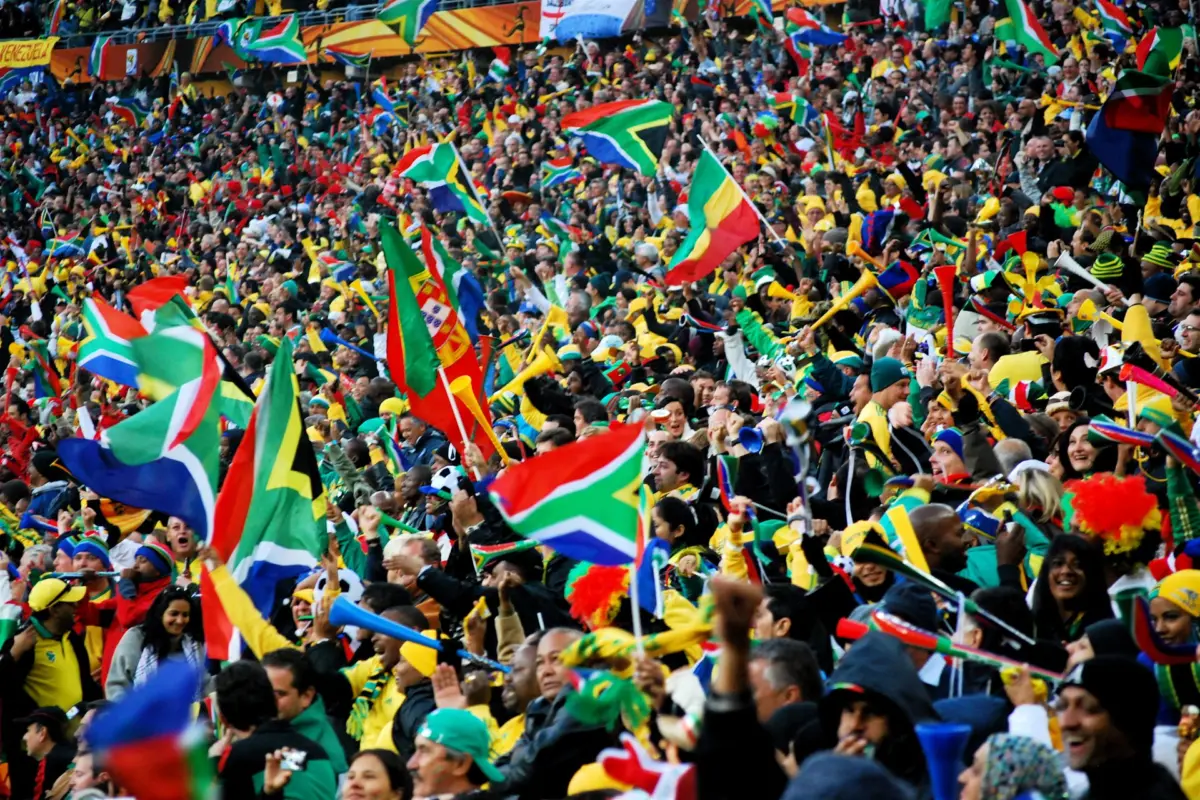
To understand the psychic weight of South Africa’s 2026 campaign, one must return to June 11, 2010. As the first nation on the African continent to host the World Cup, South Africa presented itself to the world as a modern, unified, and hospitable democracy. Downtown Cape Town and Johannesburg’s fan parks thrummed with energy. When Siphiwe Tshabalala rocketed his opening goal past Mexican keeper Guillermo Ochoa, legendary commentator Peter Drury immortalized the moment: "Goal Bafana Bafana! Goal for South Africa! Goal for all Africa! Jabulile! Rejoice!"
That moment was the apex of "Rainbow Nationalism"—a concept coined by Desmond Tutu to celebrate South Africa’s kaleidoscopic diversity of languages, cultures, and ethnicities. It was an ethos built on the foundational imagery of 1995, when Nelson Mandela donned a green "Springbok" rugby jersey bearing the number six of white Afrikaner captain Francois Pienaar. It was an article of faith that sport could forge a nation out of eleven named players on a pitch.
The Domestic Boiling Point: Spring 2026
By the spring of 2026, however, the rainbow had faded. A self-described citizen-led group operating outside traditional political parties, March and March, organized massive, disruptive protests against undocumented African migrants in Pretoria, Johannesburg, and Durban. Spearheaded by figures demanding strict immigration enforcement, the movement pledged weekly demonstrations until every undocumented immigrant was expelled.
The African National Congress (ANC)—Nelson Mandela’s historic liberation party—came to power in 1994 on the promise of "A Better Life for All." Yet, with unemployment stubbornly lingering at 32.7 percent, movements like March and March successfully weaponized public frustration, casting the African migrant as the primary obstacle to prosperity. While white expatriates working remotely and earning in foreign currencies were welcomed as foreign direct investment, African immigrants from Zimbabwe, Malawi, Nigeria, and Mozambique were blamed for drug trafficking, elevated crime rates, and drained public resources.
The June 30 Deadline and the Atmosphere of Fear
In December 2025, March and March and allied factions issued a hard deadline: June 30, 2026. All undocumented foreign nationals were ordered to leave the country under veiled threats of violence. The rhetoric echoed slogans popularized by populist politicians like Sports and Culture Minister Gayton McKenzie, whose 2023 campaign popularized the exclusionary cry "Abahambe" ("They must go").
In the weeks leading up to the deadline, African embassies chartered emergency flights and buses to repatriate their citizens. WhatsApp groups circulated frantic warnings for people to carry their identification papers—an eerie, chilling echo of the passbooks enforced by the Apartheid-era state. Though the June 30 protest ultimately ended largely peacefully, sporadic violence, arrests, and at least one death underscored a grim truth: the architecture of exclusion had survived the transition to democracy.

Supporting Context & Metrics: The Anatomy of Crisis
The socio-economic landscape of contemporary South Africa provides fertile ground for reactionary nationalism. The persistence of deep historical inequalities, compounded by systemic state delivery failures, has created a volatile vacuum.
- Unemployment Rate: Official figures place South Africa’s unemployment rate at 32.7 percent, disproportionately impacting young Black South Africans who came of age decades after the end of Apartheid.
- Historical Precedents of Violence: The 2026 xenophobic mobilization is part of a recurring historical loop. Destructive pogroms targeting African foreign nationals erupted in 2008 and 2009, resurfaced in 2015, and have now re-emerged under the sanitized, legalistic guise of "national sovereignty" in 2026.
- Diaspora Isolation: Historically, African football fans across the continent and abroad united behind whichever African nation qualified for the World Cup—memorably rallying behind Ghana’s run to the quarterfinals in 2010 and Morocco’s historic semifinal berth in 2022. In 2026, however, that solidarity fractured. Disgusted by South Africa’s domestic anti-immigrant campaigns, many Pan-African supporters actively rooted against Bafana Bafana.
Official Statements and Public Reactions
The dissonance between South Africa’s socio-political realities and its representation on the global sporting stage was laid bare during press conferences in North America.
When South African captain Ronwen Williams was asked about the widespread absence of Pan-African support and why neutral African fans were backing Mexico ahead of their group-stage match against Czechia, his response revealed a defensive detachment:
"We’ve all got our own politics, our own problems, and our own fights that we deal with back home. Every country has that. I don’t know where that stems from. It does hurt. I have been attacked . . . my country as well, for things that are going on back home."
Williams’s comments stood in stark contrast to the historical tradition of politically engaged African athletes. In 2006, Ivorian striker Didier Drogba dropped to his knees on live television to plead with rival factions in his country’s civil war, an act widely credited with helping broker peace. Similarly, global superstars like Kylian Mbappé have repeatedly used their platforms to condemn far-right extremism and xenophobia in France.
Domestically, populist leaders attempted to distance themselves from the physical fallout of their rhetoric. As the June 30 deadline approached, Minister of Sports and Culture Gayton McKenzie urged supporters of his Patriotic Alliance party to stand down from planned actions, seeking to insulate his political standing from anticipated bloodshed. Meanwhile, March and March founder Jacinta Ngobese-Zuma remained defiant, telling supporters: "Every Thursday for the next six months, we are marching until they are gone."
Future Outlook: The Inertia of the Rainbow Nation
On the pitch, South Africa’s 2026 World Cup campaign was a microcosm of its political inertia. Following their opening 2–0 defeat to Mexico—marred by red cards issued to Yaya Sithole and Themba Zwane—the team managed a draw against Czechia and a dramatic win over South Korea. Yet, when confronted by an unyielding Canadian side in the Round of 32, the team shrank under the weight of the moment, bowing out of the tournament.
Tactical missteps by coach Hugo Broos were ultimately secondary to a deeper ailment. As the tournament demonstrated, South Africa’s greatest vulnerability is not defensive fragility on the football pitch, but a pervasive political paralysis.
Thirty-one years after Nelson Mandela walked out of Victor Verster Prison, the country remains haunted by the specters of colonization and Apartheid. Movements like March and March prove that when a state fails to deliver equitable material conditions for its citizens, the vacuum is readily filled by the toxic politics of division. Until South Africa confronts the structural inequalities that breed native scapegoating, the dream of the Rainbow Nation will remain just that—a fading memory of a summer in 2010, decoupled from the turbulent, unforgiving reality of the present.


Comments
Facebook App ID not configured. Please add it in the Customizer.