
Executive Overview
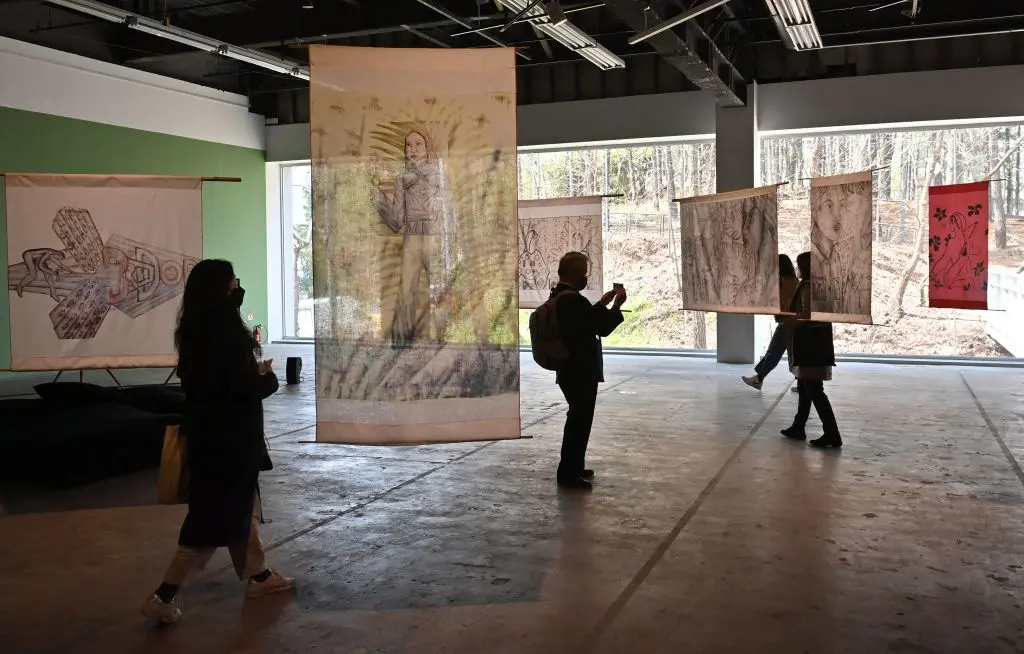
The prestigious Gwangju Biennale found itself thrust into the center of a high-stakes geopolitical storm today, just hours before the grand opening of its highly anticipated 16th edition. A contingent of Chinese artists and curators officially pulled out of the exhibition, enacting a total boycott directed by the Chinese embassy in Seoul. This drastic move comes as a direct protest against the Gwangju Biennale Foundation’s handling of the Taiwanese exhibition space, unravelling months of curatorial collaboration and casting a long shadow over one of Asia’s premier contemporary art events.
At the heart of the dispute is a contentious rebranding of the Taiwanese presentation. Initially organized as the "Taiwan Pavilion," the exhibition space was reportedly altered by organizers to "The NTMoFA Pavilion"—named after its commissioning body, the National Taiwan Museum of Fine Arts. While the nomenclature shift appears on the surface to be a bureaucratic compromise, it has ignited a fierce multi-sided backlash. Taiwanese artists and cultural officials have fiercely denounced the change as an act of unwarranted political censorship, a capitulation to external pressure, and a betrayal of the Biennale’s historical legacy, which is deeply rooted in the pro-democracy Gwangju Uprising of 1980.
Conversely, Beijing and its diplomatic representatives view the affair through an entirely different lens. To the Chinese government, any official or semi-official recognition of Taiwan as an independent political entity constitutes a direct challenge to the "One China" principle. The Chinese curatorial team and embassy officials argued that the initial inclusion under the moniker "Taiwan" violated diplomatic norms, yet they simultaneously condemned the organizers for what they perceived as political interference.
Read Also
As the Gwangju Biennale Foundation scrambles to issue apologies and distance itself from the administrative quagmire, the incident serves as a stark reminder of how contemporary international art exhibitions remain intensely vulnerable to deeply entrenched geopolitical fault lines. This article provides an in-depth exploration of the timeline, political pressures, institutional statements, and broader implications of a crisis threatening to permanently alter the landscape of international cultural diplomacy.
Detailed Chronology: How a Naming Dispute Escalated into a Full Boycott
To understand the sudden unraveling of the China Pavilion at the 16th Gwangju Biennale, one must trace a rapid succession of administrative friction, diplomatic ultimatums, and mounting pressures that culminated in a complete institutional walkout.
The Buildup and the Pivot
Planning for the 16th Gwangju Biennale had proceeded for months with the usual complex logistics inherent to international art mega-exhibitions. As part of its expansive Pavilion Project, the Biennale was slated to feature national and regional presentations from across the globe, designed to foster cross-cultural dialogue. Among these was a showcase organized by Taiwan’s National Taiwan Museum of Fine Arts (NTMoFA).
However, behind closed doors, pressure appears to have mounted regarding the branding of the Taiwanese footprint. Sensitive to cross-strait political dynamics and potential diplomatic fallout, Biennale administrators allegedly intervened prior to the public opening. Without the explicit consent or consultation of the participating Taiwanese artists and curators, organizers altered the exhibition’s title from the "Taiwan Pavilion" to "The NTMoFA Pavilion."
The Outcry from Taipei
The adjustment did not go unnoticed. In late August, on the eve of the exhibition’s global press preview, the participating Taiwanese artists, backed by Taiwan’s Ministry of Culture, launched a scathing public critique. They asserted that the last-minute retitling stripped them of their rightful identity and amounted to covert political censorship.
Furthermore, the Taiwanese contingent framed the decision as a profound insult to the foundational ethos of the Gwangju Biennale. Born out of the trauma and resilience of the May 18 Democratic Uprising—in which citizens of Gwangju fought against military dictatorship—the Biennale has long positioned itself as a bastion of artistic freedom, human rights, and resistance against authoritarian overreach. For the Taiwanese artists, altering a pavilion’s name to appease foreign sensitivities represented a betrayal of these sacred institutional values.
Beijing Steps In
As news of the naming controversy circulated internationally, it caught the attention of the People’s Republic of China’s diplomatic apparatus in South Korea. Beijing maintains a rigid diplomatic stance, demanding that international bodies, corporations, and cultural institutions adhere strictly to the "One China" policy, which treats Taiwan as an inalienable province of the PRC.
Last week, the Chinese embassy in Seoul issued a direct directive to the Chinese artistic and curatorial team participating in the Biennale. The order was unambiguous: halt all exhibition-related activities immediately. The embassy viewed the initial (and reportedly intended) use of the "Taiwan" designation as an intolerable breach of diplomatic protocol, signaling tacit international recognition of Taiwanese sovereignty.
The Official Withdrawal
Following the embassy’s mandate, the Chinese curatorial team held a formal news conference on opening day to announce their definitive departure. Ruan Yuelai, a lead curator for the China Pavilion, delivered a stern statement captured by South Korean media outlets.
"Because the biennale organizers used an incorrect designation for the participation of China’s Taiwan region," Yuelai stated, "and by allowing political factors to interfere with art, the Chinese curatorial team finds this unacceptable and has unanimously decided to withdraw from the exhibition in strong protest."
With these words, months of artistic labor were dismantled, leaving empty display spaces where the China Pavilion once stood and transforming a celebration of global contemporary art into a diplomatic battleground.
Supporting Context & Metrics: The Geopolitics of Cultural Mega-Exhibitions
The clash at the Gwangju Biennale is far from an isolated incident; rather, it reflects a growing trend of geopolitical friction infiltrating the global art world. As contemporary art biennials and triennials grow in scale, funding, and international visibility, they increasingly function as soft-power arenas where states vie for prestige, legitimacy, and ideological dominance.
The Gwangju Biennale’s Legacy
Established in 1995 to commemorate the spirits of the 1980 Gwangju Democratization Movement, the Gwangju Biennale holds a revered status in the international art community. It was conceived not merely as a commercial showcase, but as a socio-political platform dedicated to civil liberties, historical memory, and artistic autonomy.
Because of its heroic democratic lineage, the Biennale has historically prided itself on providing a safe harbor for marginalized voices, politically charged works, and international dialogues that might be suppressed elsewhere. This makes the current controversy particularly stinging for its organizers; the accusation of self-censorship strikes directly at the moral core upon which the institution was built.
The "One China" Policy in the Cultural Sector
Beijing’s aggressive defense of its territorial claims has increasingly extended into international cultural institutions, museums, and film festivals. Over the past decade, Chinese authorities and state-backed entities have frequently pressured global organizations to alter geographical designations, remove references to Taiwan, Tibet, or Hong Kong, or cancel exhibitions featuring dissident artists.
For international institutions—particularly those in East Asia, whose economies and diplomatic ties are deeply intertwined with Beijing—navigating these demands creates an agonizing dilemma. Capitulating to Chinese pressure risks alienating democratic allies, outraging participating artists, and destroying institutional credibility. Conversely, resisting Chinese pressure often leads to immediate boycotts, financial repercussions, and severe diplomatic friction with the world’s second-largest economy.
The Role of South Korea’s Government
Amid the escalating crisis, the government of South Korea has sought to distance itself from the fallout, emphasizing the separation of powers and the autonomy of private cultural entities. A spokesperson for the South Korean Foreign Ministry addressed the New York Times, clarifying that Seoul’s official diplomatic policy toward Taiwan remained unchanged and asserting that the current disagreement had its "roots in the private sector."
This diplomatic tightrope walk highlights the delicate position of the South Korean government. While Seoul must maintain stable strategic and economic relations with Beijing, it also operates within a vibrant democratic society that fiercely protects freedom of expression and values international solidarity with other democracies.
Official Statements and Institutional Responses
As the dust settles on the opening day of the 16th Gwangju Biennale, the primary stakeholders involved have released statements attempting to clarify their positions, assign accountability, and manage the ensuing public relations fallout.
The Gwangju Biennale Foundation’s Apology
Faced with universal criticism—from the departing Chinese artists angry over naming inconsistencies, to Taiwanese creators decrying censorship, to international observers dismayed by the institutional disarray—the Gwangju Biennale Foundation issued a formal apology.
"The Gwangju Biennale Foundation sincerely apologizes for the concern, confusion and disappointment caused to artists, participating institutions, audiences and stakeholders in Korea and abroad in connection with the operation of the Pavilion Project for the 16th Gwangju Biennale."
However, the foundation’s statement also sought to defend its historical operating principles, attempting to deflect direct blame for the administrative decision that sparked the crisis:
"The foundation has consistently upheld the principle that it does not intervene in or censor the planning, content or expression of exhibitions presented by participating institutions and artists."
Critics, however, have pointed out the contradiction within this defense: if the foundation truly maintained a hands-off policy regarding exhibition content and curation, the unilateral decision to rebrand the "Taiwan Pavilion" to "The NTMoFA Pavilion" directly violates that very principle of non-intervention.
The Chinese Consulate-General’s Stance
Reinforcing the curator’s walkout, the Chinese consulate-general in Gwangju issued a sharp rebuke of the Biennale organizers. The diplomatic office accused the foundation of having "openly allowed the Taiwan region of China to participate in the exhibition using a name that is completely inconsistent with its status."
The consulate’s statement underscores Beijing’s zero-tolerance policy toward any international platform utilizing nomenclature that implies Taiwanese statehood or independent administrative recognition outside of PRC oversight.
The Taiwanese Ministry of Culture
Prior to the embassy-ordered boycott, Taiwan’s Ministry of Culture stood firmly behind its artists, echoing their denunciations of the name change. Taipei characterized the alteration as an unacceptable submission to external political coercion. For Taiwan’s cultural sector, participation in international exhibitions under appropriate branding is a vital assertion of cultural visibility and democratic identity, making the compromise engineered by Biennale administrators a deeply painful concession.
Future Outlook: The Repercussions for International Art Fairs
The dramatic withdrawal of the Chinese delegation from the 16th Gwangju Biennale marks a watershed moment with profound implications for the future of global contemporary art exhibitions.
A Chilling Effect on Global Curation
Curators, museum directors, and Biennale organizers worldwide are watching the Gwangju situation closely. The incident demonstrates that no international exhibition—regardless of its historical prestige or artistic integrity—is immune to the gravitational pull of geopolitical rivalries.
As geopolitical tensions between major superpowers and contested territories continue to intensify, art institutions will increasingly find themselves caught in the crossfire. Organizers may become overly cautious, self-censoring, or entirely avoiding controversial regional partnerships to prevent administrative meltdowns. Conversely, institutions that stand firm on artistic freedom risk losing access to crucial funding, state-sponsored delegations, and major international markets.
Long-Term Damage to the Biennale’s Brand
For the Gwangju Biennale, the immediate challenge lies in salvaging the current edition. With major display spaces left empty by the departed Chinese artists and lingering bitterness from the Taiwanese contingent, the focus of the art world has regrettably shifted away from the artworks themselves and onto administrative dysfunction and political capitulation.
Restoring trust will require profound institutional transparency and a recommitment to the democratic ideals of the Gwangju Uprising. Moving forward, the Gwangju Biennale Foundation must establish clear, transparent, and unwavering guidelines regarding pavilion designations and curatorial autonomy. Without such structural reforms, future iterations of the exhibition risk alienating both artists and the global public, diminishing its hard-earned reputation as a beacon of progressive contemporary art.
Ultimately, the Gwangju Biennale crisis serves as a sobering lesson for the global art community: art cannot exist in an insulated vacuum, separate from the turbulent realities of international politics. As long as national identities, sovereignty, and geopolitical ambitions remain contested on the world stage, the canvas of contemporary art will continue to reflect those deep, unresolved fractures.


Comments
Facebook App ID not configured. Please add it in the Customizer.