
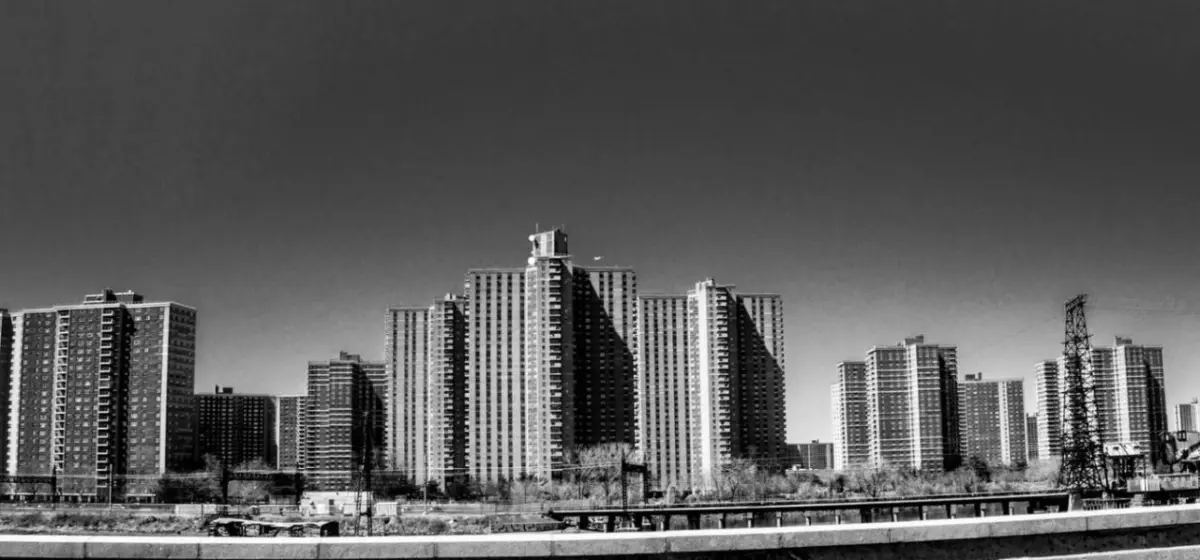
The crisis of housing affordability across the United States has reached a critical inflection point, rendering the fundamental need for shelter a speculative luxury. At the epicenter of this metropolitan stress test is New York City—a municipality where the severe tension between market-driven real estate development and human survival is played out daily. In his forthcoming book, A Right to Housing?, urban scholar and author Samuel Stein explores the deep structural histories, systemic failures, and latent potentials of social housing in America’s largest city. Stein’s work serves as both a post-mortem on decades of policy abandonment and a roadmap for a renewed housing left.
While contemporary political discourse often treats public housing as a uniquely American failure, Stein demonstrates that the current dilapidated state of public and social housing is not an inherent flaw of public ownership, but rather the calculated result of chronic underfunding, ideological sabotage, and regressive budgeting. From the pioneering municipal efforts of the early 20th century to the robust labor-backed cooperatives of the postwar era, and finally to modern study missions comparing New York to Vienna’s celebrated model, the struggle for housing justice is fundamentally a political one. As grassroots coalitions mobilize for legislative overhauls like the proposed Social Housing Development Authority, the question facing urban centers is no longer whether public intervention is possible, but whether society can afford not to decommodify housing.
Detailed Chronology: A Century of Social Housing in New York
To understand New York City’s current housing landscape, one must trace the historical trajectory of public intervention—a timeline characterized by early municipal ambition, federal redirection, labor-movement innovation, and eventual rollback.
Read Also
The Pre-Federal Era and "First Houses"
Long before the federal government assumed any structural role in public housing, New York City initiated its own municipal social housing programs. Recognizing the abysmal living conditions in tenement districts, the city bypassed federal bureaucracy by purchasing a stretch of Lower East Side tenements directly from the Astor family. When initial renovation estimates proved too costly, the city took the radical step of tearing the structures down and rebuilding them with identical proportions. Known as "First Houses," this project marked the city’s inaugural commitment to publicly provided, affordable shelter.
The New Deal and the "Urban Renewal" Pivot
The municipal model was quickly subsumed by the federal expansions of the New Deal era. Guided by federal mandates, cities across the United States shifted toward an "urban renewal" model. This approach paired the construction of low-income housing with the large-scale demolition of existing residential and industrial districts—neighborhoods predominantly populated by low-income Black and immigrant households.
Left-leaning mayors like Fiorella LaGuardia, alongside radical legislators like Vito Marcantonio, Ben Davis, Pete Cacchione, and Baruch Vladeck, often envisioned a different path: one where public housing could outpace private development and encompass a much broader cross-section of the populace. Instead, the federalized system locked cities into a relentless tear-down-and-build-up cycle. While this created waves of internal displacement that continually overwhelmed municipal resettlement agencies, it simultaneously laid down an enduring bulkhead of working-class communities. Today, these developments span four-fifths of the city’s community districts and comprise up to a third of the rental housing stock in neighborhoods like East Harlem.
The Postwar Cooperative Boom and Mitchell-Lama
Concurrently, non-governmental and worker-centric models were flourishing. The first major wave of alternative social housing emerged through limited-equity cooperatives sponsored by working-class institutions in the central Bronx, the Lower East Side, and Sunset Park, Brooklyn. This coalesced into a powerful union cooperative movement, spearheaded by garment workers and their United Housing Foundation—which built the home of civil rights leader Bayard Rustin in Penn South—and joined by electrical workers, butchers, typesetters, furriers, and healthcare workers. This movement ultimately produced roughly 50,000 homes designed to be perpetually affordable for working-class families.
Building on this momentum, the state’s Mitchell-Lama program (operating from the mid-1950s to the early 1980s) provided public support in the form of tax breaks, bond financing, and low-interest loans to union developers, nonprofits, and profit-limited corporations. This initiative yielded 69,000 cooperative apartments and 66,000 rental homes. However, the program contained a structural flaw: a "sunset" clause (which tenant advocate John Leyva aptly renames a "doomsday" clause) allowing owners to exit the program and convert units to market-rate housing once mortgages were paid off. Before subsequent reforms stabilized the process, more than half of Mitchell-Lama rentals and roughly 10 percent of co-ops abandoned their affordability mandates.
Supporting Context & Metrics: The Scale of the Crisis vs. The Promise of Social Infrastructure
The numbers surrounding New York City’s housing ecosystem reveal a stark dichotomy between the scope of human need and the infrastructural buffers currently holding the city together.
- 300,000: The official count—widely understood to be a significant undercount—of New Yorkers living within the public housing system managed by the New York City Housing Authority (NYCHA). To contextualize this population, it is roughly equivalent to the entire population of Pittsburgh, Pennsylvania.
- 13 Percent: The proportion of NYCHA’s housing stock that has been brought under private management via local adaptations of the federal Rental Assistance Demonstration (RAD) program. Despite this shift, New York remains unique among American cities for refusing to completely demolish or privatize its public housing inventory.
- 43 Percent vs. 9 Percent: The stark disparity between the social housing stock of Vienna, Austria (where 43 percent of residents live in heavily subsidized, high-quality municipal or cooperative housing), and New York City (where various forms of social housing hover around 9 percent).
- The Cost of Inaction: New York City’s shelter and street homelessness population currently matches the entire population of Boulder, Colorado. Yet, chronic underfunding has fostered a self-fulfilling prophecy of decay, where deferred maintenance in public housing developments is routinely weaponized by mainstream pundits and politicians as proof that public ownership is inherently dysfunctional.
Official Statements and Grassroots Perspectives
The ideological battle over housing draws sharp lines between defenders of market supremacy and advocates of radical public stewardship.
Mainstream critics, operating within what urban theorist Owen Hatherley diagnoses as "the New York ideology," frequently point to aging public infrastructure to argue that large-scale state planning is fundamentally doomed. This perspective masks the reality of intentional underinvestment. As Stein notes, chronic federal underfunding has engineered dangerous and deteriorating conditions, which politicians then cite as justification for privatization.
Conversely, grassroots organizers and tenant associations are shifting the paradigm by looking internationally. Reflecting on a 2022 delegation visit to Vienna organized by New York housing activists, Stein contrasts the city’s holistic approach to human shelter with New York’s profit-driven subsidy systems. In Vienna, municipal authorities actively suppress land and property values, acquiring parcels to build stunning, energy-efficient social housing developments that require less public subsidy per resident than New York’s models because they are entirely divorced from the imperative of generating private profit.
Reflecting on the limitations of the local status quo, Stein summarizes the American compromise:
"We have public housing, but it has never been as well designed, built, or maintained. We have limited-equity co-ops… but we built far fewer of them, and we allowed some to go private… We spend city capital on housing, but we get less for our money because we refuse to decommodify most of the homes we invest in."
Future Outlook: Rebuilding the Social Housing Apparatus
As the housing affordability crisis metastasizes, the New York housing left has moved beyond defensive maneuvers, offering a proactive, systemic alternative.
The centerpiece of this renewed vision is proposed state legislation designed to establish a Social Housing Development Authority for New York State. Operating in the democratic spirit of the historic Labor Housing Conference, this public entity would possess the sweeping authority to build new social housing, acquire distressed or speculative properties, and oversee large-scale conversions. By cutting out the cycle of disinvestment and gentrification that views homes primarily as instruments for racialized wealth redistribution, the authority offers a tangible path toward housing justice.
Similar grassroots momentum is bubbling across the United States. In Rhode Island, advocacy groups like Reclaim RI are fighting to transform the state’s Department of Housing into an active public developer capable of building mixed-income public housing. In Seattle, Washington, voters successfully mobilized to fund and establish a municipal social housing developer.
These initiatives point to a fundamental political truth articulated by British sociologist Ralph Miliband: the capitalist state will not voluntarily surrender its commitment to real estate speculation out of moral obligation. Rather, transformative change requires a mobilized, organized working class capable of exerting unrelenting pressure on government institutions. As Stein concludes, if the current apparatus refuses to enshrine housing as a non-negotiable human right, organizers must build the political power necessary to forge a state that will.





Comments
Facebook App ID not configured. Please add it in the Customizer.