The intersection of history, art, and civil rights activism finds a powerful modern expression in the upcoming picture book biography, Postcards from Malcolm X: How Yuri Kochiyama Became a Human Rights Activist. Authored by Mia Wenjen and illustrated by acclaimed artist Keith Henry Brown, this forthcoming publication—scheduled for release on October 13, 2026—examines the profound, cross-racial alliance between legendary civil rights leader Malcolm X and prolific activist Yuri Kochiyama.
Spanning a relationship that lasted a mere 16 months yet catalyzed a lifelong political awakening, the narrative explores the mechanics of intersectional activism. It highlights how Malcolm X served as a mentor, teacher, and intellectual guide to Kochiyama, expanding her worldview from community-level civil rights organizing to global human rights advocacy.
This journalistic feature profiles illustrator Keith Henry Brown, detailing his journey from commercial graphic design and jazz album art direction to award-winning children’s book illustration. Through an exclusive Q&A session, Brown discusses the meticulous historical research required to bring Kochiyama and Malcolm X’s world to life, his personal ties to cross-cultural movements, and his upcoming projects, including Pullman Porters Deliver.
Detailed Chronology: The Partnership of Malcolm X and Yuri Kochiyama
To understand the core narrative of Postcards from Malcolm X, one must examine the historical architecture of the relationship between Yuri Kochiyama and Malcolm X during the early 1960s.
Pre-Existing Community Leadership: Long before her fateful meeting with Malcolm X, Yuri Kochiyama was already an established community organizer. Rooted heavily in grassroots mobilization, she possessed an innate ability to rally communities toward localized change. However, her understanding of systemic power structures was deepened significantly upon entering Malcolm X’s political orbit.
The 16-Month Catalyst: Though their documented formal friendship lasted only 16 months before Malcolm X’s assassination in 1965, the mentorship fundamentally reoriented Kochiyama’s life. She consistently credited this brief period with her ultimate political awakening, shifting her focus from strictly domestic civil rights issues to a broader, global human rights framework.
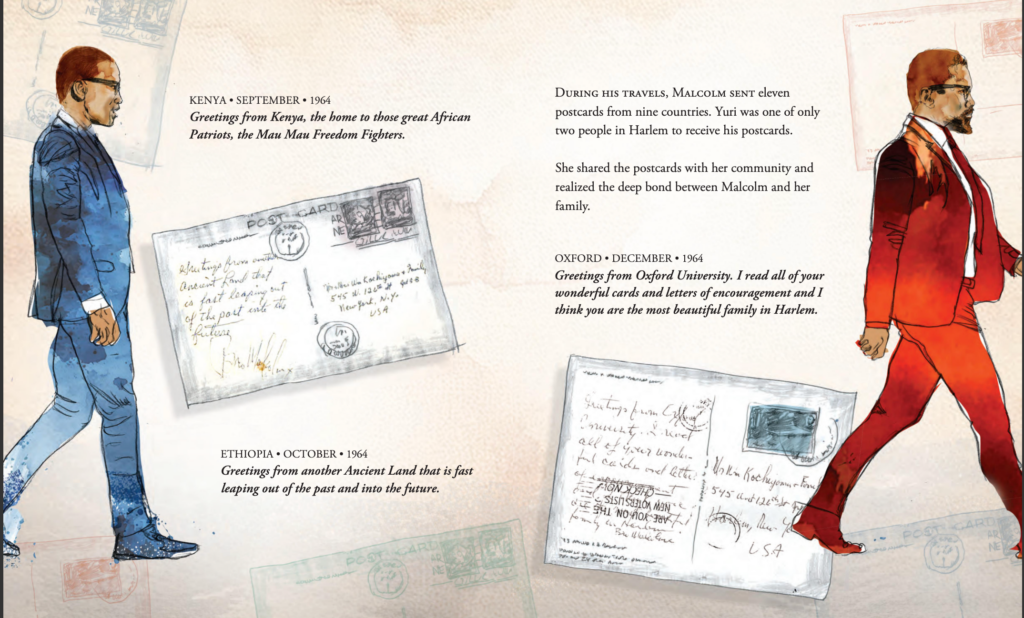
The Transnational Correspondence: During his second major trip abroad, Malcolm X maintained correspondence with Kochiyama, sending her a series of 11 postcards. These artifacts serve as both intimate testaments to their intellectual camaraderie and historical documents detailing his evolving global perspective.
The Harlem Foundation: Kochiyama’s relocation to Harlem was a deliberate choice. Rather than observing from a distance, she immersed herself directly in the neighborhood, choosing to live in a local housing project. This physical and ideological grounding allowed her to build authentic, enduring relationships with her Black neighbors, cementing a legacy of Black and Asian American solidarity.
Supporting Context & Metrics: The Evolution of Keith Henry Brown
Keith Henry Brown’s trajectory toward illustrating Postcards from Malcolm X is a masterclass in multidisciplinary artistic evolution. His work reflects a deep-seated connection to historical preservation, musical heritage, and visual storytelling.
Career Milestones and Artistic Transition
Brown’s professional path began immediately after high school with a brief stint as a comic book artist. He subsequently cultivated a robust career spanning graphic design, advertising art direction (including award-winning work for Grey Advertising), and fine art illustration.
A pivotal turning point occurred while Brown was designing jazz album covers for Christian McBride, the 11-time Grammy Award-winning bassist and composer. Impressed by his visual style, a publisher approached Brown to illustrate his first children’s book, Birth of the Cool: How Miles Davis Found His Sound, written by Kathleen Cornell Berman. The book earned a coveted starred Kirkus review, instantly establishing Brown as a premier voice in children’s literature biography.
Personal Resonance and Historical Precedents
Brown’s affinity for Postcards from Malcolm X is rooted in his own upbringing in New York. Growing up, his brother was actively involved with the Basement Workshop, established in 1969 as the first Asian-American political and arts organization in New York City’s Chinatown. Witnessing these early cross-cultural artistic and political collaborations left an indelible mark on Brown’s worldview, predisposing him to champion narratives of intersectional solidarity.
Official Statements and Insights: An Exclusive Q&A with Keith Henry Brown
In an in-depth discussion regarding his artistic process, research methodology, and philosophical approach to Postcards from Malcolm X, Keith Henry Brown shares behind-the-scenes insights into the creation of the book.
Q1: What made you decide to become a children’s book illustrator?
"It wasn’t really the plan. Right out of high school, I worked briefly as a comic book artist, but I ended up building a career as a graphic designer, art director, and illustrator. The turning point came when I was designing jazz album covers for Christian McBride… A publisher asked if [I] could illustrate an entire children’s book in that same style—Birth of the Cool: How Miles Davis Found His Sound. The book received a starred Kirkus review, and after that, publishers started reaching out with more projects."
Q2: You are in high demand! We had to wait three years until you were available to illustrate Postcards From Malcolm X. What made you decide to take this project?
"What drew me to the project was the story itself. Even before I read the manuscript, I was fascinated by the friendship between Malcolm X and Yuri Kochiyama. I hadn’t seen that story told before, and I loved the idea of these two activists from different communities finding common purpose. It also resonated with me personally. My brother was involved with the Basement Workshop in the 1970s… Seeing those kinds of cross-cultural connections made a lasting impression on me."
Q3: What is your favorite spread in Postcards From Malcolm X and why?
"One of my favorite spreads is the one where Malcolm appears to be walking across time. On the left, he’s younger, clean-shaven, and wearing a blue suit. On the right, he’s older, bearded, and dressed in red, as if he’s been walking and evolving over the years. Surrounding him are reproductions of the actual postcards. I love that spread because it came very close to what I had envisioned. The watercolor effects worked the way I hoped, and the symbolism feels strong."
Q4: What do you want readers to take away from Postcards From Malcolm X as the illustrator? Any Easter eggs?
"For me, the heart of the book is the connection between different communities. I love that Yuri Kochiyama chose to move to Harlem because she believed it was an important place for her activism and became such a genuine part of the community… If there’s an Easter egg, it’s that many of the settings are based on real places I visited while researching the book. More than anything, I hope readers come away with a sense that people from different backgrounds can find common purpose."
Q5: What’s next for you (that you can reveal)?
"The book I’m working on now is Pullman Porters Deliver, written by Lea Lyon. It tells the story of the Pullman porters and their fight to organize a union. I actually had a relative who was a Pullman porter, so the project has a personal connection for me. It’s a fascinating and important part of American history that many people don’t know about."
Future Outlook
As cultural discourse increasingly searches for historical blueprints to navigate modern sociopolitical divisions, works like Postcards from Malcolm X offer a vital educational framework. Targeted toward readers ages 7 and up, the picture book bridges generational and cultural gaps, demonstrating that historical alliances between Black and Asian American communities are deeply rooted, enduring, and essential for modern equity movements.
Keith Henry Brown’s upcoming slate—highlighted by Pullman Porters Deliver—indicates a continued dedication to unearthing overlooked historical narratives of labor, civil rights, and cultural resilience. With Postcards from Malcolm X hitting shelves on October 13, 2026, educators, parents, and young readers alike will be provided with a visually stunning and textually rich resource for fostering intersectional empathy and historical awareness.


















Comments
Facebook App ID not configured. Please add it in the Customizer.