
The 2026 FIFA World Cup, jointly hosted across the vast geopolitical expanses of North America—Canada, Mexico, and the United States—has fundamentally transformed soccer into an exhaustive exercise in bureaucratic transparency, linguistic standardization, and hyper-exposure. Beyond the tactical chess matches unfolding on manicured pitches, this expanded forty-eight-team tournament has inaugurated a rigorous semiotic experiment. For the first time, world football’s governing body has mandated on-field microphones for referees to broadcast the outcomes of video-assisted reviews (VAR) directly to stadium audiences and global television viewers. Simultaneously, a sweeping regulatory innovation has turned speech into a matter of absolute governance: any player who covers his mouth during a confrontational mid-match exchange with an opponent is automatically shown a red card.
Together, these twin mandates elevate verbal clarity into an iron law of international play, effectively criminalizing concealment—whether of words, intentions, or tactical interpretations. While the rationales behind these reforms are clear—curbing the persistent scourge of racist abuse masked behind cupped hands and clarifying opaque refereeing decisions—their implementation has birthed a surreal theatricality. This is a tournament where the administrative impulse of global bureaucracy collides violently with the chaotic, polyglot realities of the world’s most popular sport.
As the competition unfolds across a continent dominated by English-language hegemony, the 2026 World Cup has become a crucible for questions of translation, diaspora, and national identity. From the bureaucratic renaming of the legendary Estadio Azteca to simple "Mexico City Stadium," to the phonetic contortions of American play-by-play announcers attempting to navigate a nominal Babel of global surnames, this tournament forces a confrontation between institutional monolingualism and the irrepressible linguistic diversity of the modern game.
Read Also
Detailed Chronology: The Enforcement of Transparency on the Pitch
The kinetic reality of these new regulations was brought into sharp focus during the group-stage encounter between Paraguay and Türkiye in Santa Clara. Under the scorching Northern California sun, Salvadoran referee Iván Barton—a figure whose imposing demeanor carries the bureaucratic self-importance of a minor general pulled straight from the pages of a Gabriel García Márquez novel—became the protagonist of a new era of football jurisprudence.
Acting on instructions relayed from the centralized video-review operation housed in Dallas, Barton halted play to scrutinize a suspected instance of mouth-covering by Paraguayan forward Miguel Almirón. Following a cursory examination of the pitch-side monitor and a brief consultation with his video assistants, Barton strode back onto the turf. Producing a red card from his pocket, he delivered his verdict with the theatrical gravity of a summary executioner. Amplified by the stadium’s powerful sound system, his voice reverberated with totalitarian resonance:
"Number ten, Paraguay—cover his mouth! The decision is rrrrred card!"
This moment epitomized the tournament’s underlying philosophical shift. Players, referees, administrators, and pundits can no longer operate in the shadows of private communication. The compulsion for absolute exposure has bridged the gap between thought, intention, utterance, and action. While few match officials possess Barton’s martial grandeur, the booming delivery of on-field sentences has emerged as an unexpected and compelling feature of the tournament. The various accented Englishes spoken by officials hailing from Poland, Colombia, Jordan, and Mauritania inject a much-needed textural friction into a sport that had drifted dangerously toward homogeneous sanitization.
Furthermore, the ban on the defensive hand-to-mouth barrier has inadvertently exposed the sophisticated multilingual repertoires of elite competitors. During a tense Round of 16 clash, as Paraguay attempted to provoke a fiercely composed French side into a brawl, French talisman Kylian Mbappé was caught on camera complimenting opposing defender Júnior Alonso with the classic Argentine colloquialism, "la concha de tu madre." The walls of private tactical chatter have effectively been torn down, leaving athletes exposed to the merciless scrutiny of ultra-high-definition cameras and lip-readers alike.
Supporting Context & Metrics: The Monolingual Hegemony and Diasporic Realities
On the tactical level, every World Cup is an architectural clash of idioms—the Spanish-influenced juego de position versus German-derived Gegenpressing, structural set-piece engineering versus the untamed improvisations of South American football. Yet, at the institutional and administrative level, this cacophony of styles is superseded by a rigid, party-pooping monolingualism.
Although FIFA formally recognizes multiple official languages, and the three host nations encompass a broad array of state languages, English reigns supreme as the undisputed lingua franca of the tournament. All official match reports, regulatory edicts, and major on-field verdicts are funneled through the language of Shakespeare. Even venues rich in footballing heritage have been forced to bend the knee: Mexico City’s hallowed Estadio Azteca was scrubbed of its historic moniker for the duration of the tournament, replaced on halfway-line placards by the stark, administrative blandness of "Mexico City Stadium."
This linguistic homogenization creates a profound irony. At its core, the World Cup is a celebration of difference breaking through the seams of bureaucratic uniformity—a manifestation of the hyper-migratory and diasporic reality of modern labor. National squads are increasingly assembled from complex webs of naturalization, displacement, and heritage.
- The United States Men’s National Team (USMNT) features players operating with Dutch, German, and English accents. Star striker Folarin Balogun, raised in East London, was born in New York simply because his mother’s pregnancy prevented her from boarding a return flight to the UK.
- Cape Verde’s defensive stalwart, Roberto “Pico” Lopes, born and raised in Ireland, initially dismissed an inquiry from the Cape Verdean football association because the initial outreach arrived via LinkedIn—written in Portuguese. It was only when administrators followed up in English that Lopes engaged, highlighting a darkly comic maxim of modern sports administration: if a resource-strapped national association isn’t cold-messaging prospective central defenders in English, they are failing to maximize their competitive edge.
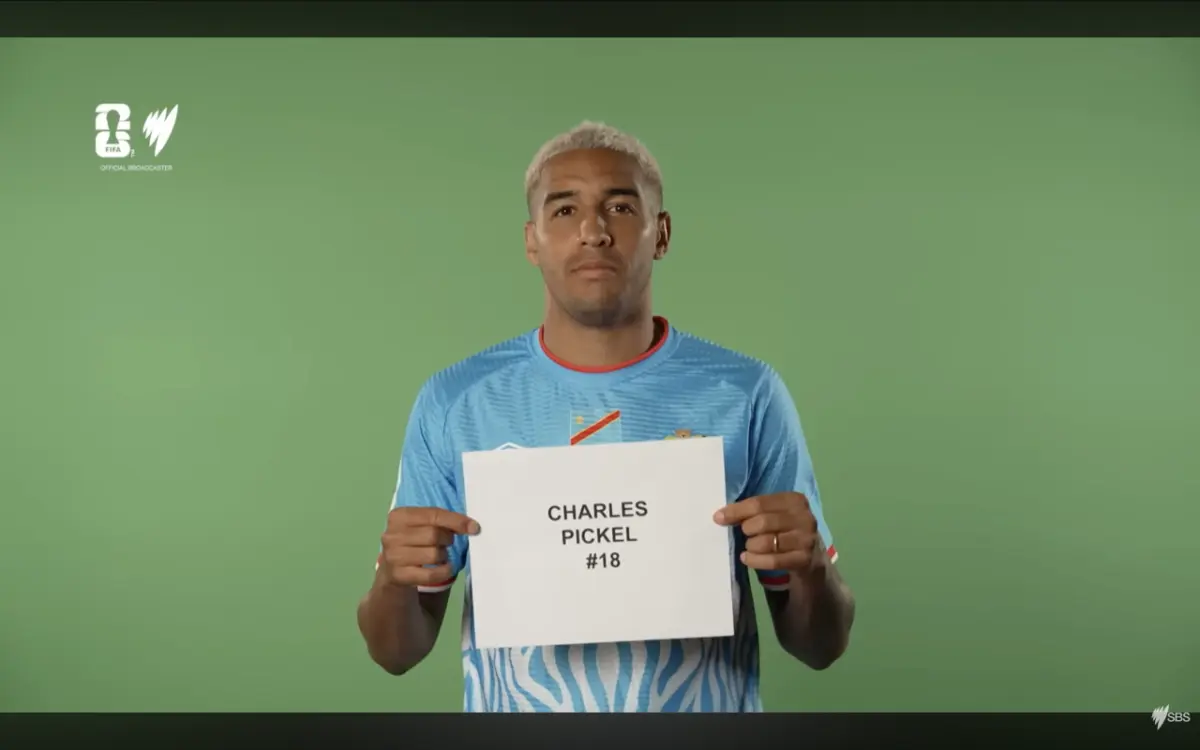
To assist commentators navigating this nominal Babel, FIFA distributed pronunciation guides featuring players holding up A4 name cards. Predictably, this exercise invited athletes—such as Marcus Thuram, Rayan Cherki, and Charles Pickel—to playfully "Americanize" their identities, offering a glimpse into an alternate reality where elite European-born professionals hailed from generic Middle American exurbs. Yet, when live action resumes, Anglophone broadcasters remain deeply divided over how to treat phonetic complexities. Portugal’s Nuno Mendes, for instance, oscillates between a Hispanicized "Noo-noh Men-dez" and the full, whispered Iberian sibilant "Noon Mensshhhhhh," exposing the fundamental limits of imposing a single phonetic standard onto a beautifully unruly global lexicon.
Official Statements & Structural Adaptations: Managing the Super-Tournament
The expansion of the World Cup from thirty-two to forty-eight teams has reshaped the logistical and linguistic contours of the competition. Skeptics prior to the tournament questioned how soccer’s institutional languages would cope with the expanded knockout infrastructure. While English struggled with the inelegant nomenclature of the "Round of 32," Romance languages integrated the expansion with characteristic fluidity, moving effortlessly from the seizièmes de finale to the huitièmes de finale in French, and through the sibilant cadence of dieciseisavos de final in Spanish.
Managers, too, have been forced to innovate in response to profound internal diversity. Iraq, making its first World Cup appearance since 1986, arrived in North America with a squad comprising Arabs, Kurds, Assyrians, and European-born expatriates. Facing severe communication barriers, Iraqi manager Graham Arnold implemented a radical linguistic segregation strategy on the pitch:
"When I started, I played the best players to their positions and strengths, but then I realized some couldn’t speak the language so there was no communication; what I’ve done lately is pretty much English-speaking players on the left side of the field and Arabic on the right."
While this strategic partitioning ultimately failed to prevent a difficult group-stage exit—yielding three defeats and a 12-to-1 goal differential—it underscores the granular, unexpected problems forced upon modern managers operating in an era of hyper-globalized player movement.
Future Outlook: The Silence of Icons and the Inevitability of English
As the tournament reaches its climax, the tension between linguistic exposure and athletic performance remains unresolved. At one end of the spectrum stand players like England’s record-breaking striker Harry Kane, whose inarticulate, monosyllabic media appearances ("absholutely buzhing") stand in stark, efficient contrast to his ruthless execution on the pitch. At the other lies France’s transcendent playmaker Michael Olise, whose supreme economy of movement is mirrored by a delightful, deadpan reticence in both English and French. When asked by journalists to describe himself, Olise offered the ultimate anti-media deflection: "Normale. Je suis une personne normale."
At the summit of the sport, success grants absolute immunity from the exhausting machinery of sports broadcasting. Lionel Messi, leading Argentina on adopted North American soil after three seasons with Inter Miami, famously refuses to speak English in public. Holding an unchallenged status as the greatest player in history, Messi has weaponized his linguistic autonomy. He has smiled, grunted, and shrugged his way into American pop culture across an avalanche of commercial partnerships—appearing in a quarter of all World Cup-themed advertisements on US television, alongside teaser appearances for Hollywood blockbusters where his verbal contributions are limited to "Spider-Man," "Si," "Como," and an iconic scream.
Can the World Cup ever truly escape the gravitational pull of English? Assuredly not. Yet, for all its institutional ubiquity, the English language cannot completely erase the linguistic "other" that haunts the margins of the tournament. Even as FIFA marches toward total bureaucratization and Anglicization, the event remains vibrantly disrupted by the ghosts of paths not taken, the echoes of regional dialects, and the profound, wordless poetry of a game that ultimately speaks for itself.




Comments
Facebook App ID not configured. Please add it in the Customizer.