
Executive Overview
In a watershed moment for the global fine art market, Sotheby’s London achieved a historic milestone on Tuesday during its marquee sale of Modern and Contemporary South Asian art. The auction raked in a phenomenal £19.8 million ($26.2 million), shattering the previous high-water mark for the category set precisely one year prior at £18.9 million ($25.5 million).
The auction was characterized by staggering buyer enthusiasm and institutional-grade demand. The 73-lot catalog achieved a near-unprecedented 99% sell-through rate, with an astonishing 89% of the offered works outperforming their pre-sale high estimates. More impressive than the top-line revenue, however, was the breadth of the market’s growth: nine individual artist auction records were pulverized over the course of the evening.
Industry leaders and market analysts are viewing this high-stakes evening not as an isolated anomaly, but as a definitive structural shift. South Asian modernism and contemporary creation—long viewed as a niche sector within Western-dominated auction houses—is rapidly cementing its status as an elite, high-performing global asset class. Driven by a blend of deep-pocketed institutional buyers, visionary private collectors, and widening international appreciation, the sector is experiencing a cultural and financial renaissance that shows no signs of slowing down.
Read Also
Detailed Chronology & Bidding Highlights: A Night of Broken Records
The energy inside the Sotheby’s London saleroom on Tuesday was palpable from the opening hammer. Bidders spanning North America, Europe, the Middle East, and Asia competed fiercely across physical and digital rooms, fueling an electric atmosphere that propelled multiple lots far past conservative expectations.
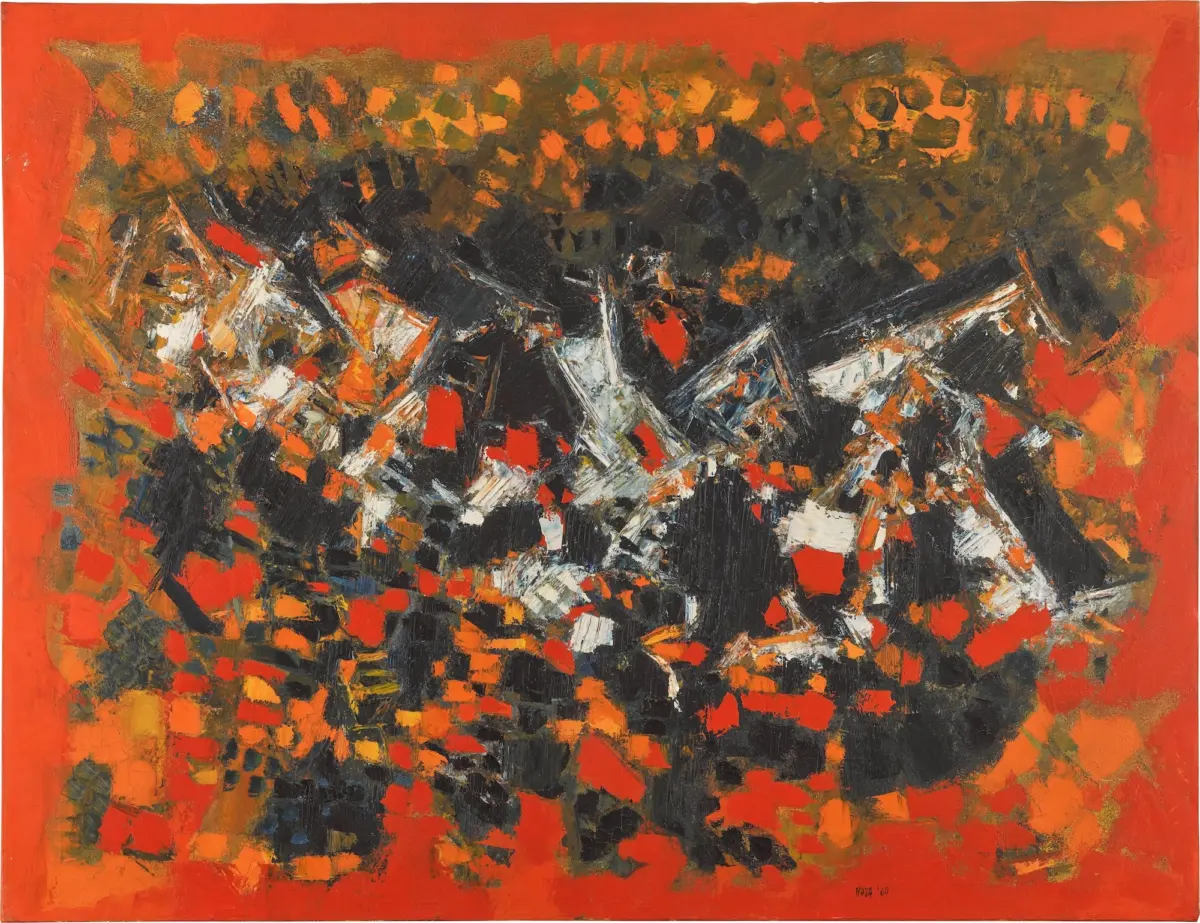
S.H. Raza’s Paysage Rouge: An Abstract Triumph
The undisputed centerpiece of the evening was Sayed Haider (S.H.) Raza’s luminous 1960 abstract landscape, Paysage Rouge. Estimated conservatively before the sale, the canvas defied expectations by fetching a remarkable £3.8 million (just shy of $5 million)—a staggering 10 times its high estimate.
This result marks the third-highest price ever paid at auction for the trailblazing Indian modernist, whose ultimate auction record stands at $5.6 million, set at Sotheby’s New York in 2024. Raza’s enduring appeal underscores the market’s appetite for his mid-century compositional mastery. As noted by critics reviewing his landmark 2023 retrospective at the Centre Pompidou, Raza’s oeuvre reflects “a fascinating life of artistic question and response, battled out on canvas.” Tuesday’s performance proves that collectors are eager to wage similar battles in the auction room to secure his premier works.
Bhupen Khakhar’s Old Men Playing Chess: A Dramatic Ascent
Securing the second-highest price of the night was Bhupen Khakhar’s undated masterpiece, Old Men Playing Chess. Entering the auction with the highest pre-sale estimate of the night at £700,000 (roughly $926,000), the painting easily eclipsed that mark, soaring to a breathtaking £3.1 million ($4.2 million).
The composition features a vast, striking orange landscape that visually dwarfs two elderly men quietly engrossed in a game of chess in a bottom corner. The sale shattered Khakhar’s previous personal best, comfortably surpassing the $3.2 million fetched by his legendary 1962/1982 painting Two Men in Benares at Sotheby’s London in 2019. The result signals robust demand for Khakhar’s narrative-driven, deeply empathetic portrayals of ordinary life and queer identity.
M.F. Husain’s Mithuna Crimson: A Phenomenal ROI
Among the most remarkable financial trajectories of the evening was Maqbool Fida (M.F.) Husain’s undated monumental canvas, Mithuna Crimson. Smashing its £600,000 high estimate, the work brought in a stellar £2.7 million ($3.5 million) to claim third place in the auction’s top lots.
The transaction tells a compelling story of long-term investment viability. The seller had originally acquired the sprawling, six-foot-wide painting for a modest $28,350 at Sotheby’s New York back in 2000. Tuesday’s sale translates to an astronomical 123,000-fold value increase over two decades, highlighting the compounding prestige associated with the "Picasso of India."
Rabindranath Tagore’s Untitled (Head of a Woman): Crossing the Million-Dollar Threshold
Rounding out the night’s milestone achievements, Rabindranath Tagore’s evocative Untitled (Head of a Woman) became the only other lot to decisively cross the coveted $1 million threshold. Estimated at a maximum of £350,000 ($463,000), the haunting and deeply expressive portrait realized £1 million ($1.4 million), establishing a fresh auction benchmark for the polymath and Nobel laureate. For context, this exact work had traded hands at Sotheby’s New York in 2008 for a comparatively humble $104,500, marking a phenomenal appreciation over a 16-year holding period.

Supporting Context & Market Metrics
To fully comprehend the seismic nature of Tuesday’s auction, one must examine the broader macroeconomic and cultural ecosystem currently supporting the South Asian art market.
The Nine Artists Who Rewrote the History Books
Beyond the marquee names, the foundational strength of the sale was demonstrated by the sheer volume of new benchmarks set. The evening witnessed the fall of nine separate artist auction records, encompassing a diverse array of historic and modern practitioners:
- Antonio Piedade da Cruz
- Sunayani Devi
- Olinto Ghilardi
- Gopal Ghose
- Bhupen Khakhar
- Dhruva Mistry
- Hugo Vilfred Pedersen
- Mohan Sharma
- Rabindranath Tagore
The inclusion of historic figures alongside mid-century modernists demonstrates that collectors are digging deeper into art history, actively seeking out regional pioneers who were previously overlooked by Western-centric institutions.
Contextualizing the Husain Phenomenon
The stellar performance of M.F. Husain’s Mithuna Crimson arrives on the heels of a historic year for the artist’s market. In 2023, Husain’s Untitled (Gram Yatra) shattered the all-time auction record for modern Indian art at Christie’s New York, commanding a monumental $13.8 million. That transaction was famously spearheaded by Kiran Nadar, one of South Asia’s most influential private collectors and museum founders.
Furthermore, the global institutional footprint for Husain expanded significantly with the inauguration of a dedicated museum in Doha, Qatar. These institutional tailwinds—combined with aggressive private collecting—have created an environment where works by foundational Indian masters routinely defy broader economic uncertainties.
Official Statements
Industry leaders were quick to highlight the historic nature of the evening, emphasizing that the results signal a permanent maturation of the global art market.
In an official post-sale press announcement, Manjari Sihare-Sution, Sotheby’s Worldwide Head of Modern and Contemporary South Asian Art, expressed her elation:
"This has been an extraordinary sale for the department—our highest total in history, surpassing the record we set in London only last year. With nine new artist records, the results reflect both the depth of the market and the increasingly international appreciation for South Asian art."
Sihare-Sution’s remarks hit upon a vital structural change: the buyer base for South Asian masterpieces is no longer confined to the South Asian diaspora or regional collectors based in Mumbai and New Delhi. Instead, blue-chip institutions, European wealth funds, and American contemporary collectors are fiercely competing for these inventories, viewing them as essential components of a truly global art history narrative.
Future Outlook
As the dust settles on Sotheby’s London saleroom, market participants are already looking ahead to the remainder of the 2026 auction calendar with heightened optimism. Several key trends are expected to dictate the trajectory of the South Asian art market in the coming years:
- Geographic Diversification of Buyers: While collectors from India and the broader diaspora remain the foundational bedrock of the market, European and North American institutional acquisitions are accelerating. Museums are actively working to correct historical blind spots by acquiring canonical works by artists like Bhupen Khakhar, S.H. Raza, and Rabindranath Tagore.
- Institutional Validation: The opening of dedicated institutional spaces—such as the Husain museum in Doha and the continuous expansion of private philanthropic museums in New Delhi—provides long-term price stabilization and cultural validation. When public institutions validate an artist’s historical importance, private market confidence invariably surges.
- Supply-Side Dynamics: With a 99% sell-through rate and 89% of lots exceeding high estimates, auction houses are facing a severe supply shortage of top-tier museum-quality works. Owners of blue-chip South Asian art are increasingly aware of the market’s explosive growth, which may encourage more consignments of previously unseen masterpieces in upcoming seasons.
Tuesday’s £19.8 million triumph was not merely a commercial victory for Sotheby’s; it was a definitive cultural statement. South Asian modern and contemporary art has decisively shaken off its historical under-appraisal, stepping into the glaring international spotlight as a powerhouse sector capable of matching—and frequently outpacing—its Western counterparts.



Comments
Facebook App ID not configured. Please add it in the Customizer.