
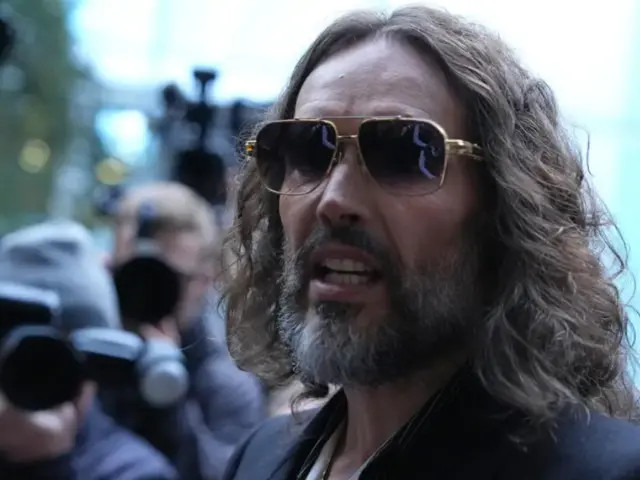
LONDON — British comedian, media personality, and digital influencer Russell Brand stands trial at London’s Southwark Crown Court, facing a series of severe criminal charges spanning a decade of his career. Prosecutors opened the high-profile legal proceedings by characterizing the 51-year-old defendant as a "sexual predator" who leveraged his rising celebrity status, considerable charm, and calculated manipulation to target vulnerable women.
Brand, who has entered a plea of not guilty to all allegations, faces seven distinct criminal counts involving six female complainants. The alleged offenses reportedly took place between 1999 and 2009—a formative period during which Brand ascended from a counter-cultural stand-up comic to a ubiquitous mainstream fixture across British television, radio, and international cinema.
The trial, which is drawing intense global media scrutiny and extensive public interest, is anticipated to last approximately six weeks, with potential extensions running through December. As the judicial proceedings unfold, the case sheds light not only on the mechanics of celebrity accountability but also on the enduring legacy of a cultural landscape that allowed prominent media figures unchecked latitude during the height of the 2000s entertainment boom.
Read Also
Executive Overview
The commencement of Russell Brand’s trial at Southwark Crown Court marks a critical juncture in the ongoing societal and legal reckoning regarding power dynamics within the entertainment industry. The prosecution, led by barrister Riel Karmy-Jones, laid out a stark narrative during opening statements, alleging that Brand operated with a "voracious and indiscriminate" desire for sexual contact, ignoring clear expressions of refusal from his targets.
The charges against Brand comprise:
- Three counts of rape
- Three counts of sexual assault
- One count of indecent assault
The complainants, whose legal anonymity is protected throughout the proceedings, allege that Brand utilized his public persona, quick wit, and a paradoxical blend of ingratiating charm and petulant entitlement to orchestrate encounters that frequently escalated into non-consensual sexual acts. According to the Crown, Brand’s actions were neither impulsive nor misunderstood romantic overtures, but rather the calculated maneuvers of a predatory individual who believed his fame shielded him from consequence.
Brand arrived at the central London courthouse dressed in a dark suit, a black-and-white striped shirt, and a long white tie, accompanied by his wife, Laura. In response to police inquiries regarding each specific complainant, Brand previously issued prepared statements maintaining that he had no recollection of the women and asserting that any sexual activity that did occur was entirely consensual.
Detailed Chronology of Allegations
The prosecution’s case traces a ten-year timeline from 1999 to 2009, detailing incidents allegedly occurring across various locations, including political conferences, broadcasting studios, and private residences.
1. The 1999 Labour Party Conference (Bournemouth)
The earliest allegation dates back to 1999, when Brand was performing stand-up comedy at the Labour Party conference in Bournemouth, southern England. According to the prosecution, the complainant invited Brand back to her hotel room. Once inside, Brand allegedly pushed her onto the bed and proceeded to rape her without utilizing a condom. In response to police questioning regarding this incident, Brand maintained a lack of memory concerning the complainant and insisted on consensual interaction.
2. The 2001 MTV Office Incident
In 2001, as Brand’s television career was gaining traction, a second woman alleged that Brand attempted to forcibly drag her into a toilet cubicle at the offices of MTV. While the woman successfully resisted his advances and prevented the escalation of the assault, the prosecution presented this incident as part of a persistent pattern of aggressive boundary violations.
3. The 2004 London Bar Encounter
According to testimony outlined by Karmy-Jones, a third complainant met Brand at a London bar in 2004. Brand allegedly grabbed her breasts and pulled her toward a toilet cubicle. When she expressed reluctance, he reportedly told her not to be a "spoilsport" before subjecting her to non-consensual oral rape.
4. The 2004–2005 Radio Station Incident
A fourth woman alleged that Brand visited the radio station where she was employed during late 2004 or early 2005. Upon entering the premises, Brand allegedly kissed her "very aggressively" before reaching out to grab her breasts and bottom without her consent.
5. The 2009 Residence Assault
The most severe physical allegations include an incident in 2009, where a woman—who was 21 years old at the time—met Brand and engaged in initially consensual oral and vaginal sex at his home. The prosecution alleges that Brand subsequently forced her into anal sex "with full force," without her consent and without a condom, disregarding her physical resistance and verbal objections.

6. The 2009 Channel 4 Recording Studio Incident
The final charge involves a female employee of Channel 4 television who was working alongside Brand in a recording studio in 2009. According to the prosecution, members of Brand’s production team instructed the woman that her duties included giving Brand a massage. While complying with this directive, Brand allegedly pressed his face into her groin without warning or consent.
Supporting Context & Metrics
The unfolding legal battle occurs against the backdrop of Brand’s dramatic personal and professional metamorphosis over the past quarter-century.
Career Trajectory and Public Persona
- Rise to Prominence: Born to working-class parents in Essex, England, Brand began performing stand-up comedy as a teenager. He achieved household-name status in the UK during the early 2000s as a presenter for MTV, Channel 4, and the BBC.
- International Expansion: Brand briefly crossed over into Hollywood, securing roles in major feature films such as Forgetting Sarah Marshall and Get Him to the Greek, and experienced a high-profile, short-lived marriage to American pop star Katy Perry.
- Digital Reinvention: Following a period of relative mainstream absence, Brand reinvented himself as a digital commentator, conspiracy theorist, and conservative-leaning "faith-based guru."
Digital Footprint and Influence
Brand’s pivot to alternative media platforms has yielded a massive digital following, providing him with a direct pipeline to millions of global supporters independent of traditional broadcasting networks:
- YouTube: Approximately 6 million subscribers.
- X (formerly Twitter): Approximately 10.1 million followers.
- Instagram: Approximately 4.9 million followers.
The juxtaposition between Brand’s current persona as a spiritual and political iconoclast and the historic allegations of predatory behavior has fueled intense public debate across political and cultural divides. Many of his digital followers view the prosecution as part of an establishment backlash against his anti-establishment commentary, whereas victim advocacy groups emphasize the courage required for multiple women to step forward across a decade-long timeline.
Official Statements and Legal Arguments
The courtroom battle hinges on contrasting interpretations of Brand’s character, behavior, and intent during the decade in question.
Prosecution Arguments
Riel Karmy-Jones portrayed Brand as an individual who operated with absolute impunity during the height of his fame. The prosecution highlighted statements from former acquaintances who recalled Brand openly bragging about an ambition to "bed 5,000 women in his lifetime," allegedly remarking to associates that "you have to tell them what they need to hear."
"He was ruthless, calculated, and manipulative, and the prosecution say — a sexual predator," Karmy-Jones stated to the jury of eight men and four women. The Crown argued that Brand utilized charm and comedic talent when seeking compliance, but transformed into a "demanding and entitled" figure—exhibiting a "childlike in his expectation that his every desire should be met"—when faced with rejection.
Furthermore, the prosecution noted that the complainants only came forward to law enforcement after observing investigative media coverage regarding Brand in 2023, which prompted additional victims to report historic abuse following his formal charging in 2025.
Defense Strategy
While Brand’s formal defense arguments will be articulated fully as the trial progresses, his initial responses to police interviews established the core of his legal posture. In response to each allegation, Brand filed prepared statements denying any recollection of the complainants and maintaining that all sexual interactions he engaged in throughout his career were strictly consensual.
Legal analysts anticipate that the defense will challenge the credibility, consistency, and motivations of the complainants, pointing to the passage of time—ranging from 15 to 27 years—since the alleged incidents occurred. Historic sexual assault trials frequently navigate complex evidentiary challenges, relying heavily on contemporaneous accounts, circumstantial corroboration, and the behavioral patterns of both the accused and the accusers.
Future Outlook
The trial at Southwark Crown Court is projected to run for approximately six weeks, with proceedings potentially extending into December depending on the pace of testimony and cross-examination.
Broader Implications
The outcome of the trial carries profound implications for all parties involved:
- Legal Accountability: For the judicial system, the case serves as another test of its capacity to adjudicate historic sexual offenses involving public figures, balancing the rights of the accused to a fair trial with the imperative to provide a credible platform for accusers.
- Media and Cultural Impact: The intense global media coverage—featuring dedicated podcasts from British news outlets and live reporting by international networks outside Southwark Crown Court—underscores the ongoing public fascination with the fall of media icons.
- The Digital Sphere: For Brand’s vast digital audience, the verdict will likely solidify or shatter their perception of his authenticity and moral authority. A conviction would permanently alter his standing as an alternative media leader, whereas an acquittal would likely be weaponized by his supporters to validate narratives of institutional persecution.
As testimonies continue, the court remains the central arena where these competing narratives of fame, power, consent, and accountability will ultimately be resolved.


Comments
Facebook App ID not configured. Please add it in the Customizer.