In an era defined by ubiquitous screen time, digital distractions, and the perpetual struggle of bedtime routines, parents are constantly searching for innovative ways to engage their children. From short-lived activity kits that lose their novelty within days to board games that quickly collect dust in cupboards, the market is saturated with products that promise development but often deliver fleeting entertainment. Yet, a quiet revolution is taking place in households around the world—one that relies not on high-tech algorithms or flashing pixels, but on something remarkably old-fashioned: the spoken word.
This article examines House of Heroes, a guided family storytelling adventure platform tailored for children aged 4 to 11. By merging the intimacy of parent-led read-aloud sessions with the dynamic agency of choose-your-own-path narratives, the platform has struck a chord with modern families. Operating entirely screen-free, House of Heroes turns the traditional bedtime story into an immersive, collaborative experience where the child is not merely a passive listener, but the definitive architect of the adventure.
Through an investigative lens, this report explores the mechanics of this platform, the psychology of interactive family storytelling, the broader trends of screen-free child development, and the future outlook of interactive literacy products in the digital age.
Detailed Chronology: The Evolution of Modern Bedtime Engagement
To understand the current paradigm shift in parenting technology, one must examine the progression of how families spend their post-dinner hours over the past two decades.
Phase 1: The Analogue Baseline (Pre-2010s)
For generations, the evening routine was a straightforward affair: dinner, bath, pajamas, and a traditional book. Parents read statically from page one to the end, while children absorbed the plot passively. While effective for fostering early literacy, this format occasionally struggled to compete with the rising tide of evening television and early handheld devices.
Phase 2: The Digital Inundation (2010–2020)
As tablets and smartphones permeated households, evening routines shifted dramatically. Screen time became the default babysitter and de-escalation tool. Educational apps promised cognitive gains, but frequently resulted in overstimulation, behavioral friction during device confiscation, and fragmented attention spans. Parents found themselves locked in nightly power struggles to pry glowing rectangles from tired hands.
Phase 3: The Quest for Frictionless Engagement (2020–Present)
Wearied by digital fatigue, parents began seeking low-friction, high-connection alternatives. The market responded with subscription-based activity boxes, science kits, and complex board games. However, these solutions often introduced new friction points: they required extensive setup, cleanup, rule memorization, or active creative writing from exhausted parents at the end of a long workday.
It was within this context that the concept of guided, word-for-word collaborative storytelling emerged as a viable bridge between passive reading and heavy-prep activities.
The Mechanics of House of Heroes: How It Works
Designed specifically to eliminate parental prep work while maximizing child agency, House of Heroes operates on a remarkably simple framework.
Zero-Prep, Word-for-Word Narratives
Unlike traditional role-playing games (RPGs) that require rulebooks, dice rolls, or master storytelling skills from the adult, House of Heroes scripts every adventure word-for-word.
The Role of the Parent: The adult opens the adventure, reads the scripted text aloud, and simply pauses to ask a question. No creative writing or improvisational acting is required.
The Role of the Child: The child is cast as the central Hero—always themselves—and is given absolute decision-making power over the plot’s trajectory. Every choice alters the immediate outcome and shapes the narrative path.
The World of Eternia
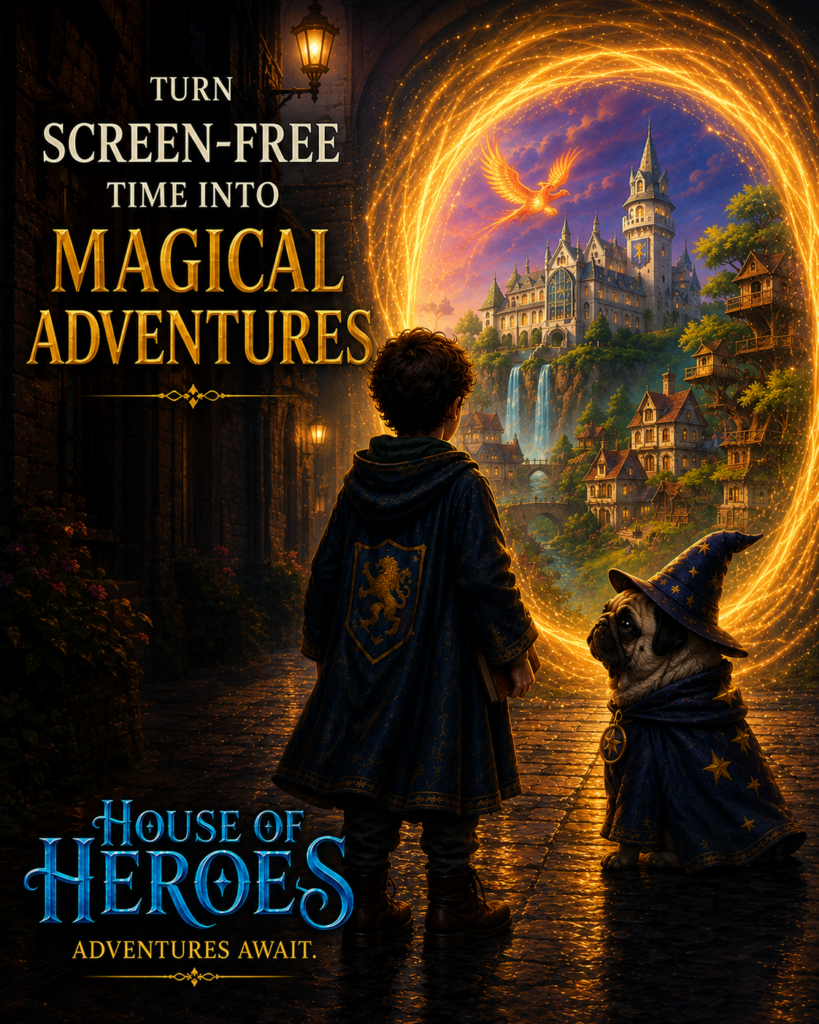
The stories unfold within a whimsical, richly detailed universe known as Eternia. At its center is the House of Heroes school, populated by a recurring cast of eccentric characters that evolve across sequential adventures:
A pug wizard who serves as headmaster.
A half-human, half-owl roommate.
A strict yet deeply supportive guardian teacher.
A specialized seamster responsible for crafting unique magical cloaks for each student.
Lasting precisely 20 to 25 minutes, each adventure is strategically paced. It is long enough to feel like a momentous evening event, yet concise enough to be successfully completed prior to lights-out without dragging out the bedtime routine.
Supporting Context & Metrics: The Case for Screen-Free Interaction
Cognitive and Emotional Development
While the adventures feel purely recreational, they are meticulously structured to cultivate essential social-emotional learning (SEL) competencies. Every narrative arc places the young protagonist in scenarios that quietly practice:
Courage: Confronting the unknown without hesitation.
Empathy and Kindness: Making compassionate choices even when they incur personal costs.
Persistence: Overcoming systemic obstacles and narrative setbacks.
To reinforce these principles, the platform incorporates interludes featuring a recurring dwarf character named Master Tolm. Master Tolm visits between adventures to discuss abstract values like grit and kindness in a conversational, non-didactic manner, avoiding the feeling of a traditional lecture.
The Power of Uninterrupted Presence
Beyond skill-building, the most significant metric of success for interactive storytelling lies in relational psychology. Twenty minutes of undivided attention—where a parent reads actively and listens intently to a child’s choices—fosters a depth of connection that cannot be replicated by automated software. This high-quality bonding occurs precisely because the platform removes structural barriers, making parent-child engagement effortless to initiate.
The Screen-Time Dilemma
From a behavioral standpoint, eliminating screens from the late-evening equation yields immediate dividends. Blue light exposure and hyper-stimulating digital interfaces are widely documented disruptors of melatonin production and circadian rhythms in children aged 4 to 11. By replacing digital devices with an auditory, imagination-driven narrative exercise, families report smoother transitions into sleep and a drastic reduction in bedtime resistance.
Official Statements and Industry Insights
Early adopters, educators, and developmental advocates have weighed in on the resurgence of auditory, interactive storytelling formats.
"What I had not tried—and what genuinely surprised me—was something so old-fashioned it felt almost radical: a parent reading a story aloud while their child makes every single decision about what happens next."
— Family Literacy Advocate and Reviewer
Industry analysts point out that platforms bridging the gap between physical literature and interactive gaming are experiencing unprecedented demand. As parents grow increasingly wary of the long-term cognitive impacts of passive screen consumption, products that harness a child’s natural desire for autonomy—without requiring a digital interface—represent the fastest-growing segment of the educational enrichment market.
Furthermore, the accessibility model employed by platforms like House of Heroes—offering the first adventure completely free, wherein children help the pug wizard escape from three disgruntled cats to reach the academy gates—lowers the barrier to entry, allowing families to test the dynamic with zero financial commitment.
Future Outlook: Where Guided Storytelling is Headed
As we look toward the future of family entertainment and early childhood development, several key trends are likely to shape the landscape:
Hyper-Personalization in Analogue Formats: While digital platforms rely on algorithms for personalization, analogue storytelling platforms are discovering that human-delivered, branching narratives offer a superior emotional resonance. Future iterations of guided stories will likely expand into broader thematic universes, tackling complex topics such as environmental stewardship, global cultures, and advanced critical thinking.
Integration into Formal Education: Educators are increasingly looking at how interactive read-aloud frameworks can be adapted for classroom environments. By empowering groups of students to vote on narrative directions collectively, teachers can foster public speaking, collaborative decision-making, and active listening skills.
The Counter-Movement Against Digital Overload: As artificial intelligence and immersive screens become more pervasive in schools and daily life, the demand for "tactile human connection" will only intensify. Products that champion the human voice, physical proximity, and un-augmented imagination are poised to become staples of modern parenting toolkits.
Conclusion
The modern parenting landscape is fraught with competing demands, digital distractions, and the constant challenge of meaningful engagement. Yet, the success of platforms like House of Heroes proves that solutions do not always require more technology. Sometimes, the most advanced tool for child development is the oldest one we have: a parent’s voice, a willing imagination, and a story where the child holds the pen.
By reclaiming the evening routine through collaborative, screen-free adventure, families are discovering a sustainable path toward better bedtime habits, enhanced emotional intelligence, and, above all, deeper human connection.












Comments
Facebook App ID not configured. Please add it in the Customizer.