
Executive Overview
For decades, the architecture of academic prestige has been dictated by metrics that many scholars view with deep suspicion. Traditional journal rankings in philosophy—heavily reliant on perception polls, proprietary Scopus data, or raw citation impacts—have long faced criticism for failing to capture the true intellectual footprint of discipline-specific scholarship. Traditional metrics frequently reward high-volume publishing conglomerates or subjective popularity contests rather than enduring, foundational contributions to philosophical thought.
Enter Tadeusz Ciecierski, a philosopher at the University of Warsaw who has long harbored a skepticism toward conventional journal metrics. Ciecierski has engineered a novel, alternative methodology for assessing philosophy journals: tracking the frequency with which their published articles are cited within the bibliographies of the field’s two premier reference works, the Stanford Encyclopedia of Philosophy (SEP) and the Internet Encyclopedia of Philosophy (IEP).
Rather than relying on automated Scopus algorithms or opaque surveys of academic opinion, Ciecierski’s approach taps directly into the consensus-building machinery of contemporary philosophical research. Because the SEP and IEP are meticulously curated, peer-reviewed reference compendiums written by leading experts to summarize the state of art in specific philosophical subfields, citations within their bibliographies serve as a powerful proxy for enduring scholarly relevance.
Read Also
This comprehensive report examines Ciecierski’s new ranking system, details its underlying mechanics and variants, explores the subsequent adaptations—such as Nat Hansen’s normalized metrics shared on Bluesky—and weighs the broader implications of this methodological shift for the global academic community.
Detailed Chronology & Methodological Genesis
The genesis of Ciecierski’s project lies in a persistent dissatisfaction with existing bibliometric tools. Traditional metrics like the Impact Factor or CiteScore often privilege rapid-fire citations in fast-moving scientific fields, a dynamic that maps poorly onto the historically grounded, deliberative pace of philosophical inquiry. Furthermore, commercial databases frequently miscategorize philosophy journals, lack comprehensive coverage of specialized sub-disciplines, or lean too heavily on subjective peer-reputation surveys that are vulnerable to institutional bias and cronyism.
Ciecierski sought a ground-up alternative that reflects what philosophers actually read, use, and build upon when constructing authoritative overviews of their domains. The solution was hiding in plain sight: the exhaustive bibliographies underpinning the SEP and the IEP.
The Mechanics of the Count
To construct the rankings, Ciecierski established a clear and rigorous counting methodology designed to minimize distortion:
- The Core Rule: Journals are ranked by the total number of citations to their published articles within the bibliographies of SEP and IEP entries.
- Distinct Paper Metric: The counting rule isolates unique contributions. A single distinct paper counts once per encyclopedia entry, regardless of how many times it is referenced within that specific text. Conversely, if that same paper is cited across five different entries in the encyclopedias, it accumulates five distinct citation points.
- Scope Limitations: To maintain sharp focus on peer-reviewed journal literature, books, edited volumes, and book chapters are intentionally excluded from the calculations.
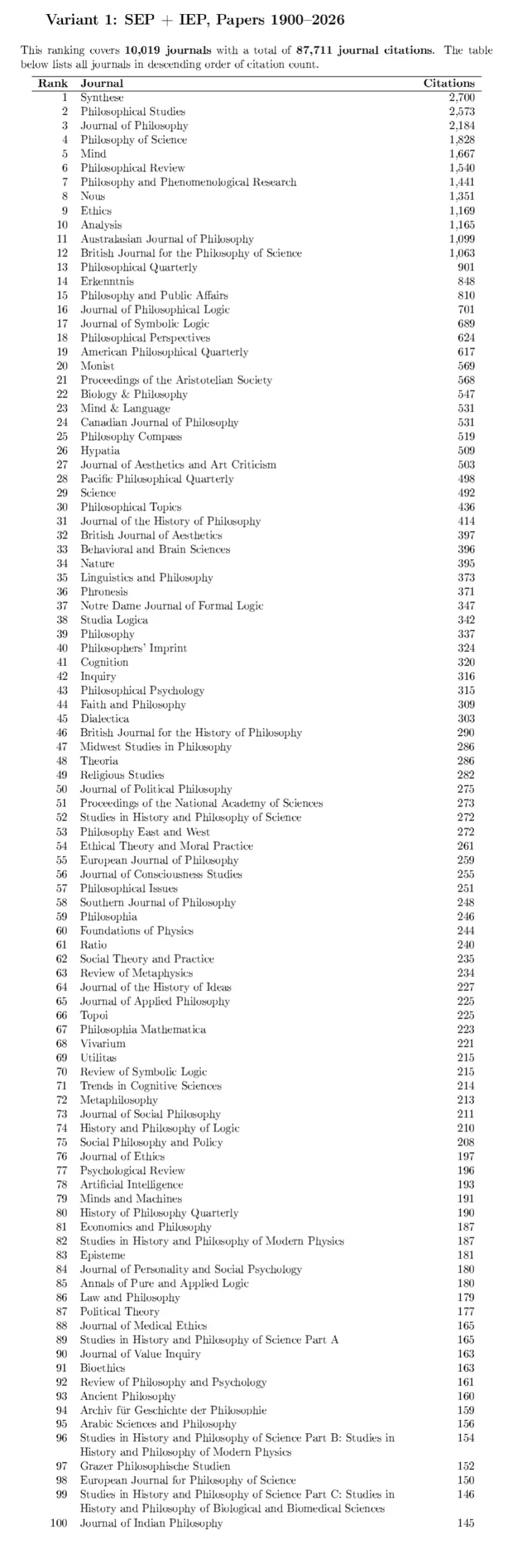
- Granular Variants: Recognizing that different historical lenses yield different insights, Ciecierski generated nine distinct variants of the ranking. These matrix permutations cross-reference the data sources (SEP and IEP combined, SEP alone, and IEP alone) across three distinct publishing timeframes: 1900–2026, 1945–2026, and 1990–2026.
Ciecierski has candidly characterized the project as a dynamic work in progress. He continues to comb through the dataset, refine the parsing logic, and correct anomalies inherent in parsing large-scale bibliographic data from reference encyclopedias.
Supporting Context & Metrics: Unpacking the Rankings
To make sense of the vast landscape of philosophical publishing, Ciecierski’s rankings offer a fascinating window into which outlets truly shape the discourse. The complete dataset, featuring multiple variants, is publicly accessible via the University of Warsaw repository.
Broad Historical Reach vs. Contemporary Focus
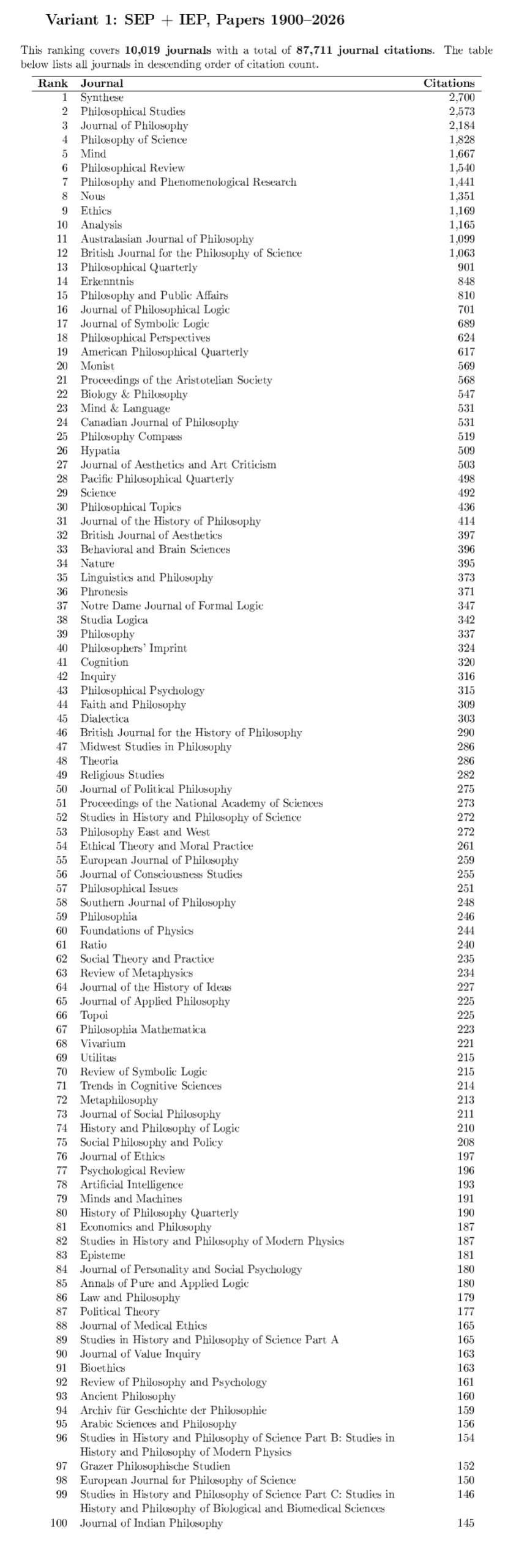
When examining the top 100 journals across the broad 1900–2026 timeframe (combining SEP and IEP citations), long-standing historical flagships of the discipline naturally claim prominent positions. These publications have spent over a century anchoring debates in metaphysics, epistemology, ethics, and logic.
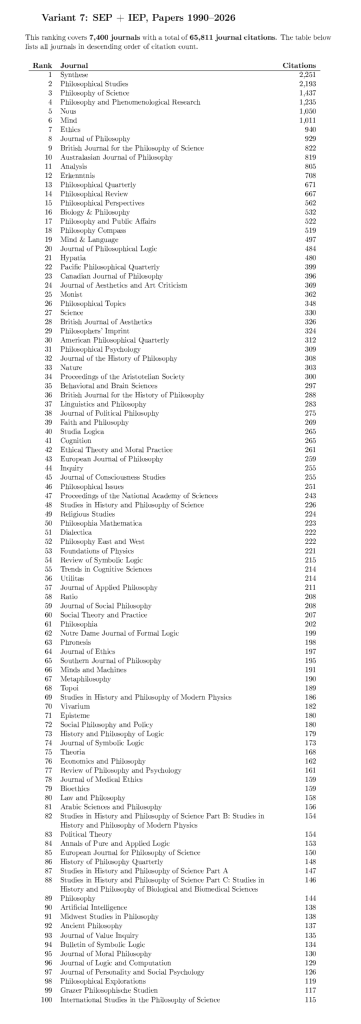
However, the academic landscape shifts when filtering the data to highlight recent decades. In the ranking variant limited to the past 36 years (1990–2026), the influence of contemporary editorial policies, specialized subfield expansion, and shifts in methodological fashion come to the forefront. Journals that have aggressively adapted to modern open-access norms or specialized rapidly growing areas (such as philosophy of cognitive science, applied ethics, or formal philosophy) display notable movement.
+-------------------------------------------------------------------------+
|                  Ciecierski Ranking Architecture                        |
+-------------------------------------------------------------------------+
| Data Sources:      Stanford Encyclopedia of Philosophy (SEP)            |
|                    Internet Encyclopedia of Philosophy (IEP)            |
+-------------------------------------------------------------------------+
| Counting Logic:    1 distinct paper = 1 count per encyclopedia entry      |
|                    (Multiple refs in 1 entry = 1 count)                 |
|                    (Refs in N distinct entries = N counts)              |
+-------------------------------------------------------------------------+
| Exclusions:        Books, edited volume chapters, non-journal media     |
+-------------------------------------------------------------------------+
| Temporal Windows:  1900–2026 | 1945–2026 | 1990–2026                    |
+-------------------------------------------------------------------------+
The Normalization Debate: Nat Hansen’s Intervention
While raw citation counts offer a compelling glimpse into aggregate influence, they introduce a structural bias: high-output journals that publish dozens or hundreds of articles annually naturally accumulate higher gross citation totals than selective, low-volume quarterlies.
Recognizing this variable, Nat Hansen of the University of Reading took to the decentralized social media network Bluesky to test a crucial adjustment. Hansen published a subset of the rankings—focusing on the top 29 journals from the 1990–2026 window—normalized by the total number of articles published by each respective journal.
Hansen’s normalization adjustment levels the playing field, allowing scholars to evaluate the density or efficiency of a journal’s impact relative to its output size. Outlets that practice rigorous selectivity find their relative standing shift when measured against high-volume publishing engines. Hansen’s public experiment underscored an essential tenet of modern scientometrics: "Lots of little decisions impact these rankings, so I encourage other people to have a go at it as well."
Official Statements and Methodological Caveats
Crucially, neither Ciecierski nor collaborating commentators present these rankings as an infallible holy grail or an administrative weapon for tenure and promotion committees.
Ciecierski himself has been explicit about the limitations and ethical boundaries of his work:
"Nor am I presenting this as a recommendation about where to publish. There are virtues, above all, open access, that I consider enormously important independently of any journal’s position in a ranking. Citation counts are not a complete measure of scholarly value."
This disclaimer strikes at the heart of contemporary debates in academic governance. For years, university administrators have misused simplistic journal metrics—such as journal impact factors—to evaluate individual faculty members, often triggering toxic publish-or-perish cultures and distorting research priorities. Ciecierski’s explicit refusal to weaponize his own metrics serves as a vital reminder that bibliographic tracking is a descriptive tool for mapping intellectual history, not a prescription for career management.
Furthermore, by highlighting open access as an independent virtue, Ciecierski acknowledges that a journal’s elite status in a citation ranking does not automatically align with modern ethical imperatives surrounding the democratization of knowledge. A paywalled journal dominating the SEP bibliography still faces legitimate criticisms regarding public accessibility, equity, and global North-South structural imbalances in academic publishing.
Future Outlook: The Evolution of Bibliometrics in Philosophy
Ciecierski’s encyclopedia-citation model points toward a broader transformation in how academic disciplines might evaluate their own publishing ecosystems in the coming years.
- Decentralized and Open Replicability: By utilizing open educational reference tools like the SEP and IEP—which are transparently updated and publicly accessible (in the case of SEP, heavily supported by academic institutions and donations)—Ciecierski has built a ranking system that relies on open data rather than locked commercial silos like Web of Science or Scopus. This aligns with the broader Open Science movement.
- Community-Driven Refinement: As demonstrated by Nat Hansen’s Bluesky normalization exercise, open datasets invite collaborative critique. When methodology is transparent, scholars can quickly fork, adjust, and test alternative variables (such as normalization by article count, weighting by entry scope, or controlling for subfield size).
- Qualitative-Quantitative Synthesis: The ultimate strength of the SEP/IEP citation metric is its proximity to qualitative scholarly judgment. Unlike an automated bot crawling keyword matches across scientific journals, an SEP entry is written by a recognized expert who carefully selects the foundational texts necessary to explain a philosophical problem. Therefore, a citation in an encyclopedia bibliography is an explicit, human endorsement of a paper’s enduring significance within a curated narrative of the field.
Conclusion
Tadeusz Ciecierski’s new journal rankings do not claim to solve all the complexities of academic evaluation, nor do they offer a simple roadmap for authors deciding where to submit their next manuscript. Instead, they provide something far more valuable: a transparent, innovative, and discipline-specific mirror reflecting how philosophical knowledge is actually synthesized and transmitted. By grounding bibliometric analysis in the living literature reviews of the Stanford and Internet Encyclopedias of Philosophy, Ciecierski has provided the philosophical community with a powerful new lens through which to examine its own intellectual history and institutional structures.





Comments
Facebook App ID not configured. Please add it in the Customizer.