
Executive Overview
What defines "American sophistication"? While European tradition has long associated elegance with inherited aristocracy and unhurried nonchalance, the American version of cool emerged from a radically different impulse: self-invention, relentless craft, and a deliberate blending of high artifice with casual ease.
In his comprehensive study, American Sophistication: How the Casual Became Cool (Princeton University Press), Columbia University Emeritus Professor Ross Posnock offers an encyclopedic examination of this elusive cultural construct. Spanning from pre-Revolutionary America to the postmodern era, Posnock’s inquiry charts how a nation forged in democratic anti-elitism produced an unmistakable idiom of poise—one epitomized not by gilded lineage, but by Midwestern transplants, working-class immigrants, and Black jazz innovators operating under the pressures of systemic segregation.
This investigative analysis evaluates the historical mechanics of American sophistication, dissecting its structural paradoxes, its operational taxonomy, and its fundamental divergence from European paradigms. Ultimately, the evolution of American cool reveals that sophistication in the United States has rarely been a passive byproduct of privilege; rather, it functions as a social sleight of hand—an invented armor forged by ambitious outsiders striving to transform hustle into grace.
Read Also
Detailed Chronology: The Evolution of an American Cultural Construct
[1880s–1910s]  The Jamesian Ambition & The European Mirror
   │           • Henry James codifies "charm" and weaponized naïveté in *Daisy Miller*.
   │           • American identity wrestles with European aristocratic standards.
   ▼
[1920s–1930s]  The Heartland Migration & Jazz Age Invention
   │           • Midwesterners (Fred Astaire, Cole Porter, F. Scott Fitzgerald) redefine urban elegance.
   │           • Black musicians (Duke Ellington, Count Basie) forge high composure under segregation.
   │           • Hollywood translates working-class roots (Cary Grant, Maurice Chevalier) into debonair icons.
   ▼
[1950s–1960s]  The Mid-Century Zenith & Liberal Education Satire
   │           • High-water mark of national sophistication: Nichols & May, Leonard Bernstein, JFK era.
   │           • Merging of showmanship and high-brow erudition across theater, television, and politics.
   ▼
[1970s–Present] Postmodern Fragmentation & The Populist Counter-Reaction
               • The aestheticizing of heritage spaces (e.g., Bemelmans Bar) via digital media.
               • Emergence of anti-sophisticated political rhetoric and the flattening of social poise.
Phase I: The Jamesian Antecedents (Late 19th to Early 20th Century)
The foundational DNA of American sophistication was articulated by novelist Henry James, who observed the collision between European social rigidity and American mobility. Characters such as Daisy Miller (Daisy Miller, 1878) and Isabel Archer (The Portrait of a Lady, 1881) represented a distinct "weaponized naïveté"—an innocence coupled with an impatience for arbitrary social codes. Unlike European elites whose authority rested on centuries of precedent, early American figures established their presence through aesthetic ambition and directional energy.
Phase II: The Heartland Migration and the Jazz Age (1920s–1940s)
The interwar period witnessed a paradox: the definitive architects of metropolitan "cool" were overwhelmingly hailing from the American Heartland or overseas working-class environments:
- Fred Astaire (born Frederick Austerlitz in Omaha, Nebraska), the son of an Austrian Jewish immigrant father, transformed rigorous tap technique into an illusion of gravity-defying ease.
- Cole Porter, Broadway’s most urbane lyricist, arrived in New York by way of Peru, Indiana, and Yale.
- F. Scott Fitzgerald, an exile from Minnesota, captured this physical restlessness in The Great Gatsby (1925), describing Jay Gatsby’s "resourcefulness of movement" and perpetual tapping foot—a trait mirroring Astaire’s kinetic energy.
- Cary Grant (born Archibald Leach in Bristol, England), neglected by a tailor’s presser father, trained as a traveling acrobat before recasting himself into the supreme ideal of debonair American masculinity.
Concurrently, within the Black jazz ecosystem, figures like Duke Ellington and Count Basie executed a monumental cultural transformation. Navigating a Jim Crow America that denied them basic civil rights, these artists adopted titles of nobility not as parody, but as an uncompromising assertion of dignity. Operating on grueling touring schedules across segregated transit networks, Ellington cultivated an unyielding composure, transforming Black bourgeois codes of Washington, D.C., into an international standard of artistic majesty.
       [ European Elite ]                   [ Traditional WASP Elite ]             [ American Arriviste Ideal ]
  Inherited Status & Sprezzatura          Frayed Trousers & Shabbiness            Self-Fashioned Elegance & Charm
 (Ease derived from social rank)       (Status signaled by unpretentiousness)      (Status won through ambition & skill)
Phase III: The Mid-Century Zenith (1950s–1960s)
Posnock identifies the mid-twentieth century as the apex of American sophistication. This era saw an alignment between mass media, liberal arts education, and urban performance. The satirical duo Mike Nichols and Elaine May—who met at the University of Chicago—crafted improvisational comedy that satirized the anxieties of an emerging intellectual class. Their comedy required an audience that understood references to Bartók, Albert Schweitzer, and John Donne, signaling a widespread democratization of high-brow literacy.
This period culminated in the presidency of John F. Kennedy, who, alongside Jacqueline Kennedy, synthesized high-culture patronage, political charisma, and dry wit, presenting a polished image of statecraft to the global stage.
Supporting Context & Metrics: A Taxonomy of Sophistication
To evaluate how sophistication functions within American social hierarchies, Posnock’s framework can be categorized into two distinct operational modes:
1. The Dual Taxonomy: Performance vs. Erudition
| Metric / Dimension | Sophistication One (Performative Cool) | Sophistication Two (Intellectual Erudition) |
|---|---|---|
| Primary Exemplars | Fred Astaire, Duke Ellington, Cary Grant | Edmund Wilson, Mary McCarthy, Dwight Macdonald |
| Core Attribute | Effortless physical elegance, rhythmic control, visual poise | Vast cross-disciplinary knowledge, critical severity, literary authority |
| Socio-Economic Origin | Frequently working-class or Midwestern outsiders | Suburban or urban middle-to-upper-middle class |
| Key Expression | Sartorial perfection, physical composure, witty banter | Public intellectuals, essays, academic/literary critique |
| Social Function | "Smart people passing as rich people" | Deconstructing power, culture, and intellectual fraud |
| Rare Synthesizers | Leonard Bernstein: Combined theatrical showmanship with musical scholarship. |
2. The WASP Counter-Code and Class Inversion
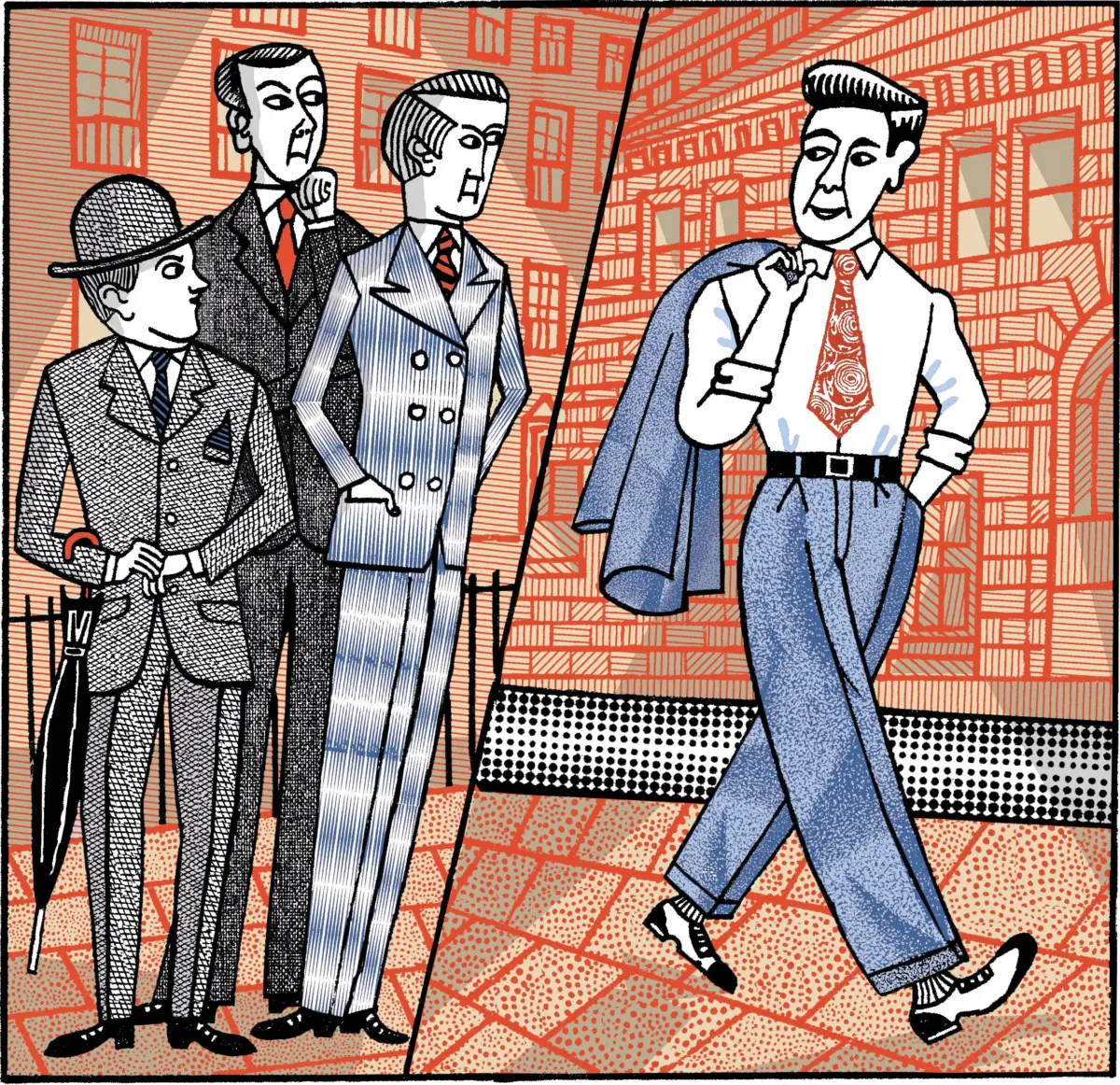
A central paradox of American social dynamics is that inherited wealth often rejects the outward trappings of sophistication. The established Anglo-Saxon Protestant (WASP) elite traditionally viewed top-hat-and-tails elegance as suspect, artificial, or "over-dressed."
Instead, old-money social capital was signaled through deliberate shabbiness:
- Frayed collars and suits worn for decades.
- Banal, plain cuisine (e.g., white-bread sandwiches).
- Rustic, unadorned summer resorts (e.g., Maine, Ipswich, Martha’s Vineyard).
Consequently, high sophistication became the domain of the arriviste—the outsider who mastered style, cadence, and social grace precisely because they could not rely on inherited status.
3. European Sprezzatura vs. American Charm
The European tradition of grace, formalised in Baldassare Castiglione’s 1514 text The Book of the Courtier and captured in Raphael’s portrait of Castiglione, relies on sprezzatura—the art of concealing effort to make complex actions appear entirely unstudied.
EUROPEAN SPREZZATURA                   AMERICAN CHARM
┌──────────────────────────────┐       ┌──────────────────────────────┐
│  • Passive, unhurried grace  │       │  • Active, directional drive │
│  • Presupposes existing rank │   vs  │  • Driven by social mobility │
│  • Conceals all labor        │       │  • Leverages ambition        │
│  • Defensive of status quo   │       │  • Democratic & ingratiating │
└──────────────────────────────┘       └──────────────────────────────┘
American sophistication translates this internal ease into an outward-facing charm. As deployed in American literature and performance, charm is an active force. It combines ambition with a pragmatic disregard for rigid hierarchies. Astaire’s movements are rarely static; they are directional, driving toward a partner, a prop, or a narrative resolution.
Official Statements & Critical Commentary
On Duke Ellington’s Socialization of Cool
Renowned photographer and author Gordon Parks reflected extensively on how Duke Ellington weaponized poise against racial prejudice:
"Ellington never grinned. He smiled. Ellington never shuffled. He strode. It was ‘Good afternoon, ladies and gentlemen,’ never ‘How y’all doin’?’ He extended into Black show business the strict code that he had learned in his Black bourgeois family in Washington, D.C."
Posnock builds on this observation, noting that Ellington’s extreme composure contained a conscious awareness of artifice:
"His statement of transparent filial piety contains a wink within its sincerity, a reminder of the artifice involved in possessing a manner—a truth that he could well have confidingly shared with Astaire."
On the Performative Nature of Style
In assessing the structural mechanics of personal style, Posnock posits a sharp aphorism regarding visual presentation:
"Sophistication insists that being and appearing coincide. We do not express sophistication; we appear sophisticated."
Critical Scrutiny and Analytical Omissions
While Posnock’s study receives praise for its narrative breadth, cultural critics highlight several notable omissions, particularly regarding women who shaped American humor and style:
- Scanted Figures: The study devotes limited space to figures like Anita Loos (whose Gentlemen Prefer Blondes used deceptive innocence to execute sharp satire) and Dawn Powell, whose biting depictions of Manhattan literary life defined 20th-century urban wit.
- The Mary McCarthy Paradox: Critics argue that writer Mary McCarthy’s inclusion under "sophistication" is misaligned; her prose was defined not by assured knowingness, but by a wide-eyed, disingenuous astonishment at societal hypocrisies.
- The WASP Anti-Urban Voice: The evolution of The New Yorker’s signature tone relied heavily on anti-urban voices like E.B. White, James Thurber, and later John Updike, who famously retreated to Ipswich, Massachusetts, proving that American sophistication often drew its strength from rural or regional detachment rather than metropolitan vanity.
Future Outlook: Aspiration in a Flattened Culture
As cultural consumption shifts toward short-form digital media and populist political rhetoric, the structural foundation of traditional American sophistication faces significant recalibration.
          HISTORICAL PARADIGM                        CONTEMPORARY SHIFT
┌─────────────────────────────────────┐    ┌─────────────────────────────────────┐
│ • Craft-based elegance              │    │ • Instant viral visibility          │
│ • Intimate, semi-private sanctuaries│───>│ • Mass-tourist Instagram destinations│
│ • High-brow literacy requirements   │    │ • Flattened, populist aesthetics    │
└─────────────────────────────────────┘    └─────────────────────────────────────┘
The Transmutation of Heritage Spaces
Institutions that once served as quiet incubators of urban style have been reshaped by global tourism and digital exposure. Manhattan’s Bemelmans Bar at The Carlyle Hotel—decorated with murals by Ludwig Bemelmans, himself a Austrian immigrant who rose from busboy to renowned artist—was once a quiet sanctuary for aspiring intellectuals and artists. Today, it operates as a geotagged viral destination.
Yet, cultural analysts suggest that this influx does not represent the death of sophistication, but rather its ongoing democratization. The twentysomethings queuing outside Bemelmans Bar reflect the same fundamental impulse that drove Astaire, Porter, and Gatsby: an eagerness to inhabit a world that feels larger, brighter, and more refined than the one they inherited.
Conclusion: The Democratic Imperative
Ultimately, American sophistication remains distinct from its European forebears because of its underlying accessibility. It does not require ancient titles or ancestral estates. It requires practice, discipline, ambition, and style.
In an era often marked by aesthetic cynicism and populist grievance, sophistication offers a constructive alternative: it is not a mechanism for looking down on the world, but a shared aesthetic commitment to elevating it. Like the Midwestern outsiders and traveling performers who first defined the medium, the American sophisticate continues to prove that cool is not something you are born with—it is something you create.




Comments
Facebook App ID not configured. Please add it in the Customizer.