
Executive Overview
KARACHI — In a move that signals a profound structural evolution in digital consumption across South Asia, audio streaming giant Spotify has officially launched its dedicated audiobook service in Pakistan. Rolling out on November 4, the expansion introduces a massive catalog of over 100,000 English-language titles to millions of local listeners. This strategic initiative transforms Spotify from a music-dominated platform into a comprehensive, multi-format audio ecosystem.
The introduction of the new subscription tier, designated as Audiobooks+, is not merely a localized product launch; it is part of a high-stakes, aggressive international rollout initially announced at the prestigious Frankfurt Book Fair on October 7. By targeting more than 180 global markets by the end of 2026—with a total addressable audience exceeding 780 million people—Spotify is staking its future growth on the explosive global appetite for spoken-word audio.
For Pakistani consumers, this launch shatters traditional geographic and logistical barriers that once made acquiring international bestsellers, academic texts, and literary classics an expensive and cumbersome endeavor. Whether accessed via the newly minted Free tier or the upgraded Premium experiences, local users now possess immediate access to a world-class library right inside their pockets. However, the introduction of this service also invites a deeper, more analytical inquiry: Can subscription-based digital literature capture the imagination of a developing South Asian market where reading habits and disposable incomes are undergoing radical transformations? This report examines the mechanics of the launch, the financial models underpinning it, the technological ecosystem supporting it, and the broader geopolitical and economic ramifications of Spotify’s expanding footprint.
Read Also
Detailed Chronology and Product Mechanics
The Rollout and Subscription Architecture
The blueprint for this massive expansion began solidifying in early October 2024, culminating in the formal debut of Audiobooks+ in Pakistan on November 4. The mechanics of the service have been meticulously engineered to cater to both casual listeners and voracious bookworms.
Under the newly implemented framework, both Free and existing Premium subscribers are granted a baseline allowance of 15 hours of audiobook listening per month for an introductory subscription fee of Rs489. This billing operates on a recurring monthly cycle. Crucially, Spotify has built a protective consumer safeguard into the design: unused listening hours do not roll over, resetting clean at the beginning of each billing cycle to encourage consistent engagement.
What happens when a user burns through their designated 15 hours before the month is out? Spotify has anticipated heavy usage by introducing tiered flexibility:
- Top-Up Packs: Users who exhaust their monthly allowance can instantly purchase an additional 10-hour listening block for Rs579.
- A La Carte Purchases: For individuals who prefer not to enter into a recurring subscription commitment, the platform allows direct, standalone purchases of individual audiobook titles. This provides a traditional retail alternative similar to Audible’s legacy credit model, ensuring that non-subscribers are not alienated from participating in the ecosystem.
Navigating the In-App Experience
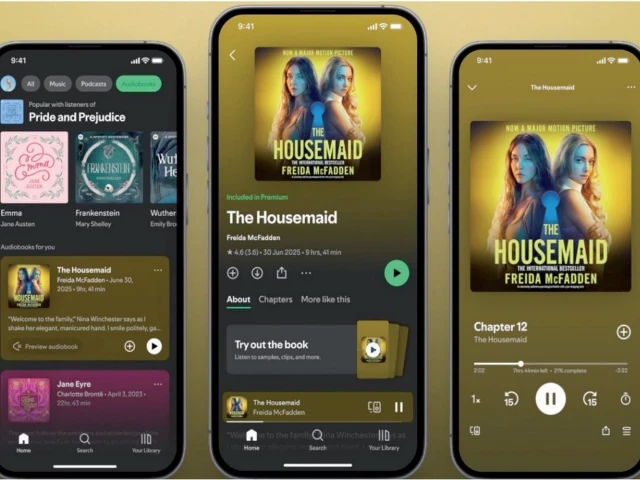
To ensure a frictionless transition from music streaming to literary consumption, Spotify engineers developed a bespoke, dedicated Audiobooks section within the core mobile and desktop applications. Upon updating their software, Pakistani users are greeted with curated carousels, advanced search filters, and personalized recommendations driven by Spotify’s industry-leading recommendation algorithms.
The service is fortified by a robust suite of user-experience features designed to rival, and in some cases surpass, dedicated e-reader and audiobook applications:
- Automatic Bookmarking: The application continuously synchronizes playback progress, allowing users to switch between chapters, sessions, and devices without losing their exact place.
- Integrated Sleep Timer: Recognizing that a significant portion of audiobook consumption occurs right before sleep, listeners can program playback to halt automatically after a selected duration or at the end of a chapter.
- Page Match Technology: This innovative feature bridges the gap between tactile reading and auditory consumption. Page Match enables users to seamlessly alternate between a physical book, a digital e-reader, and the Spotify audiobook version, aligning their progress effortlessly across mediums.
- Offline Synchronization: Acknowledging infrastructural challenges such as fluctuating internet connectivity and mobile data costs in developing markets, Spotify permits users to download complete audiobooks directly to their devices for uninterrupted offline listening.
Supporting Context & Metrics: Global Expansion and Market Positioning
The Global Audiobooks Phenomenon
Spotify’s aggressive push into Pakistan cannot be understood in isolation; it is part of a calculated, multi-year campaign to diversify revenue streams and capture high-margin digital content categories. Spotify entered the audiobook landscape roughly three years ago, initially experimenting by bundling limited audiobook hours into its flagship Premium music tier.
The gamble has yielded staggering returns. Over the past year alone, Spotify’s internal metrics reveal that:
- Monthly audiobook listeners have surged by nearly 40 percent.
- Total listening hours have expanded by more than 30 percent.
- The Audiobooks+ standalone subscription service has crossed the threshold of one million paying subscribers globally in just over a year since its initial pilot rollout.
These numbers illustrate a fundamental behavioral shift. As modern consumers navigate increasingly hyper-connected, fast-paced lifestyles, audiobooks represent a reclaimed window of productivity and leisure. As Spotify executives often emphasize, spoken-word audio is successfully converting non-readers into active literary participants by slipping into the margins of daily life—during morning commutes, mid-day walks, workouts, or quiet moments at the end of an exhausting workday.
Spotify’s Global Infrastructure and Ecosystem
To support services of this magnitude, Spotify commands a vast global technological footprint. Operating in 184 markets worldwide as of December 2022, the platform boasts a massive, geographically diverse user base. However, its historical core remains anchored in North America and Europe, which jointly account for roughly 53% of total users and 67% of total revenue.
The platform’s hardware integration is equally sweeping. Spotify is accessible across nearly every modern connected device, including:
- Desktop operating systems (Windows, macOS, Linux)
- Mobile ecosystems (iOS and Android smartphones and tablets)
- Smart home hardware (Amazon Echo and Google Nest ecosystems)
- Digital media players (Roku devices)
Financially, the company continues to operate on its signature freemium business model. This strategy offers a robust, ad-supported free tier alongside tiered paid subscriptions (Individual, Duo, Family, and Student plans). This dual-engine revenue model protects user acquisition while driving monetization.
Furthermore, Spotify’s cultural reach extends far beyond digital code. Notably, the company serves as the primary corporate sponsor of Spanish football powerhouse FC Barcelona, leveraging high-profile artist collaborations (featuring global superstars like Drake, Travis Scott, and Ed Sheeran) to swap team shirt branding for artist logos in cross-promotional marketing blitzes that bridge the worlds of sport, music, and pop culture.
Official Statements and Industry Insights
The strategic importance of the Pakistan launch was underscored by executive commentary during the global rollout.
"For a lot of people, audiobooks are how they find their way back to reading, on the commute, on a walk, or at the end of a long day," noted Owen Smith, Spotify’s Vice-President of Audiobooks.
Smith’s assertion captures the core psychological driver of the medium: audiobooks remove the friction of physical book-holding and intentional time-blocking, transforming dead time into literary exploration.
Industry analysts point out that launching in Pakistan presents a unique demographic advantage. With a youthful, digitally literate population increasingly reliant on smartphones for both entertainment and education, the introduction of a localized, competitively priced digital library opens up fresh avenues for self-improvement and cultural engagement. Local publishers and educational stakeholders have also expressed cautious optimism, noting that while the initial launch focuses on 100,000 English-language titles, the infrastructure could eventually pave the way for a flourishing market in regional languages, unlocking centuries of indigenous South Asian literature for digital preservation and global consumption.
Future Outlook: Challenges and Opportunities in the South Asian Market
Economic Realities and Pricing Dynamics
While the launch of Audiobooks+ in Pakistan is a milestone worth celebrating, the service faces distinct macroeconomic headwinds. At Rs489 for the base subscription and Rs579 for top-up hours, Spotify has positioned its pricing to be as accessible as possible within the local economic context. However, in a market grappling with inflationary pressures and shifting household budgets, discretionary spending on digital subscriptions remains sensitive.
The success of Audiobooks+ will heavily depend on consumer education. Spotify will need to convince Pakistani users—many of whom are accustomed to consuming pirated text or free digital PDFs—that the convenience, superior audio production quality, professional narration, and ecosystem synchronization justify the monthly investment.
The Royalty and Content Creator Debate
As Spotify deepens its footprint across diverse content formats, it continues to operate under the scrutiny of its unique economic models. Unlike traditional retail sales where artists or publishers receive a fixed lump sum per unit sold, Spotify’s royalty distribution system is complex.
For music, the company distributes approximately 70% of its total revenue to rights holders—primarily major record labels and independent distributors—who subsequently pay artists based on individual, often heavily contested, contracts. While the platform has consistently defended its model as a lawful, highly effective weapon against systemic piracy that generates continuous passive income for creators, critics frequently debate the transparency of streaming royalty structures and their direct impact on physical and digital album sales.
As audiobooks scale globally, the monetization framework for authors, voice actors, and publishers will face similar scrutiny. Ensuring fair compensation for narrators and authors will be crucial in maintaining a healthy, cooperative relationship with the literary community, particularly as Spotify expands into non-English markets where local talent acquisition is vital.
Looking Ahead to 2026
With its sights set on reaching over 780 million potential users across 180+ markets by the close of 2026, Spotify’s expansion into Pakistan is a bellwether for the future of digital media in emerging economies. The platform is no longer just a jukebox for the digital age; it is rapidly consolidating its position as the definitive global gateway for all spoken and musical audio.
For the Pakistani consumer, the era of turning the page with one’s ears has officially begun. Whether navigating the chaotic traffic of Karachi, studying on a university campus in Lahore, or unwinding at home in Islamabad, millions of listeners now hold a universe of 100,000 stories firmly in the palm of their hands. The ultimate test will not be the technology—which is sleek, intuitive, and robust—but how deeply and sustainably the culture of audiobook listening embeds itself into the daily rhythms of Pakistani society.





Comments
Facebook App ID not configured. Please add it in the Customizer.