
Executive Overview
For decades, the global cinematic landscape has operated on a strict dichotomy: the creators and the consumers, the stars on the screen and the spectators in the audience. Nowhere was this division more pronounced than at China’s Hengdian World Studios—affectionately and accurately dubbed "China’s Hollywood." Spanning thousands of acres in the eastern province of Zhejiang, this colossal complex has long served as the beating heart of China’s period drama industry, churning out countless historical epics, imperial romances, and fantasy series.
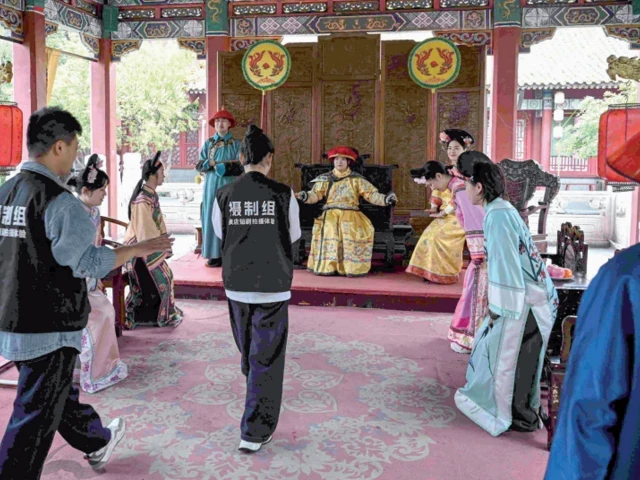
However, a profound transformation is currently underway behind the studio gates. Rather than merely gazing at replica palaces from tour buses or snapping distant photos of soundstages, everyday visitors are now stepping directly into the frame. Armed with professional film crews, elaborate period costumes, and cinematic scripts, tourists are paying to star in their own high-production mini-dramas.
This burgeoning trend of experiential film tourism represents more than just a clever novelty for visitors seeking entertainment beyond conventional sightseeing; it is a fascinating cultural and economic barometer. As China navigates a shifting economic landscape—marked by a protracted property sector slump and cautious consumer spending on traditional luxury goods—the appetite for experiential, memory-driven entertainment has exploded. Hengdian’s mini-drama packages have successfully captured this zeitgeist, offering participants a fleeting, beautifully edited taste of fame, creative agency, and escapism.
Read Also
This report provides an in-depth examination of this evolving phenomenon, exploring the mechanics of the mini-drama boom, the economic shifts driving it, firsthand accounts from directors and participants, and the long-term implications for the global tourism and entertainment industries.
Detailed Chronology and Operational Genesis
The roots of Hengdian’s transition from a closed-off production hub to an interactive playground for the masses can be traced through the convergence of China’s booming short-form video industry and post-pandemic shifts in consumer behavior.
The Evolution of "China’s Hollywood"
Established in the mid-1990s in Dongyang, Zhejiang province, Hengdian World Studios began as an ambitious infrastructure project designed to support director Xie Jin’s historical film The Opium War. Over the subsequent decades, the complex expanded aggressively, constructing jaw-dropping, life-sized replicas of historic architectural marvels. Most notable among these is the sprawling Imperial Palace complex—a meticulous 1:1 scale replica of Beijing’s Forbidden City—alongside sprawling streetscapes modeled after old Shanghai, ancient Guangzhou, and various mythical kingdoms.
For many years, tourists visited Hengdian primarily to gawk at the architecture and hope for a glimpse of A-list celebrities working on location. While lucrative, this traditional sightseeing model had inherent limitations: it was passive, strictly separated the public from the production process, and offered little repeat-visit incentive.
The Launch of the Mini-Drama Experience
The catalyst for the current interactive wave arrived in August of this year, when Hengdian officially opened its professional sets, wardrobe departments, and directing pools to everyday tourists in a structured, high-end format. Rather than random, ad-hoc photo opportunities, the studio engineered a streamlined production pipeline.
Visitors could now book comprehensive packages that mirrored the workflow of an actual film shoot. This included professional costume fittings, period-accurate hair styling, script selections, on-set blocking with experienced directors, and post-production editing.
The response was immediate and overwhelming. Within weeks of launch, booking slots began filling up weeks in advance, creating a logistical bottleneck that tested the limits of the studio’s available crews. Directors who once worked exclusively on commercial television productions found themselves managing tightly scheduled queues of everyday tourists eager to deliver dramatic monologues, engage in palace conspiracies, and execute cinematic fight choreography.
Supporting Context & Metrics: The Economics of Experience
To fully understand why thousands of travelers are flocking to Hengdian to pay for professional film shoots, one must examine the broader macroeconomic climate in China and the fundamental evolution of modern consumer spending habits.
Navigating Economic Headwinds Through Experience
In recent years, China’s domestic economy has experienced a notable deceleration. A prolonged downturn in the real estate market, coupled with broader global economic pressures, has significantly dampened consumer confidence. Traditional luxury markers—such as designer handbags, high-end wristwatches, and luxury home furnishings—have seen a marked cooling in demand as consumers reassess discretionary outlays.
However, this contraction in material goods consumption has been mirrored by an explosive surge in the "experiential economy." Consumers, particularly Millennials and Generation Z, are increasingly reallocating their disposable income away from depreciating physical commodities and toward memorable, shareable experiences. Whether through immersive role-playing games (LARPing), historical re-enactments, or interactive film shoots, modern travelers place a high premium on active participation and emotional resonance.
Pricing, Packages, and Production Metrics
Hengdian’s mini-drama venture has been meticulously priced to capture this demographic without alienating middle-class tourists.
- The Standard Package: Priced at approximately 388 yuan ($55) per person, this tier provides participants with professional hair styling, authentic period costuming, a 30-minute directed shoot on a professional soundstage or outdoor replica set, and a polished 90-second edited video optimized for social media sharing.
- The Premium/Solo Tier: Ranging up to 498 yuan ($70) or more, these packages offer customized original scripts, extended shooting times, and tailored character arcs for influencers or individuals seeking a more singular artistic showcase.
The operational volume is staggering. According to official figures released by Hengdian World Studios, more than 2,000 visitors participated in the mini-drama experience within the first two months of its launch. On weekends and public holidays, operational capacity is routinely pushed to its absolute limits.
+-------------------------------------------------------------------+
|               HENGDIAN MINI-DRAMA METRICS SNAPSHOT                |
+---------------------------+---------------------------------------+
| Launch Window             | August (Current Year)                 |
| Initial Participation     | 2,000+ participants in first 2 months |
| Standard Price Point      | 388 yuan (~$55 USD)                   |
| Premium Price Point       | 498 yuan (~$70 USD)                   |
| Deliverables              | Hair/makeup, costumes, 30-min shoot,  |
|                           | and 90-second edited video            |
| Available Scripts         | 20+ plots (Palace intrigue, romance)  |
+---------------------------+---------------------------------------+
Official Statements and On-the-Ground Perspectives
The human element of Hengdian’s mini-drama phenomenon reveals a fascinating intersection of professional filmmaking labor and public aspirations for self-expression.
The Director’s Perspective
For industry professionals, the influx of amateur actors has created both a scheduling challenge and a refreshing creative dynamic. Wang Weili, a professional director working within the studio complex, noted the relentless pace demanded by the new tourist packages.
"During the National Day holiday, I shoot from morning until dark, and there are still guests we can’t fit in," Wang remarked, highlighting a day in which he managed 20 distinct groups of tourists, guiding each through emotional highs, dramatic betrayals, and climactic confrontations.
Despite the grueling hours, directors find the energy infectious. Unlike professional actors who may suffer from fatigue or burnout on long-running series, tourist-performers bring an unbridled enthusiasm and earnestness to the set. Whether executing a dramatic face-slap in a silk-draped palace chamber or dramatically collapsing over a perceived betrayal, the participants approach each take with palpable joy.
The Participant’s Voice: Escapism, Agency, and Identity
For the visitors themselves, the experience fulfills a diverse array of psychological and social desires.
Clare Huang, a visitor who traveled more than 1,500 kilometers with a group of friends to participate, traced her motivation back to childhood ambitions: "When I was a kid, I loved playing director and getting the other children to act out scenes. I’ve always enjoyed this kind of thing, so today a few of us girls get to see what it feels like." Dressed in immaculate silk robes and jade hairpins, Huang and her friends spent their day orchestrating complex court intrigues before gathering around their smartphones to review rushes, critique performances, and share fits of laughter between takes.
For younger demographics, the appeal extends into modern social rituals. Xie, a 28-year-old digital influencer who made the pilgrimage to Hengdian after discovering the attraction via viral social media clips, paid 498 yuan for a solo performance centered on an original script.
"We don’t have proms in China, so now people go out in costume instead," Xie explained, touching upon the evolving cultural expressions of China’s youth. "Everyone is willing to dress up a bit more boldly and show themselves in the best way they can."
With over 20 distinct scripts available—heavily themed around the tropes of historical palace intrigue, forbidden romance, and tragic betrayal—participants are empowered to temporarily shed their everyday identities and inhabit characters defined by power, drama, and emotional intensity.
Future Outlook: The Next Chapter for Immersive Entertainment
As the mini-drama experience at Hengdian World Studios moves past its initial launch phase, industry analysts and studio executives are already looking toward the horizon to determine how this trend will mature and scale.
Expanding the Cinematic Catalog
To maintain high repeat-visit rates and appeal to an increasingly diverse visitor base, Hengdian is reportedly exploring the expansion of its script library beyond traditional historical period dramas (gubu). Future iterations are expected to incorporate modern urban thrillers, republican-era espionage dramas, and futuristic sci-fi narratives. By leveraging the studio’s massive inventory of specialized sets—from gritty alleyways to futuristic laboratory backdrops—the complex can diversify its offerings to match changing television trends.
Technological Integration and AI Post-Production
The logistical bottleneck of editing 90-second cinematic clips within tight turnaround windows presents a clear opportunity for technological innovation. Industry insiders suggest that future iterations of the mini-drama experience may integrate AI-assisted editing suites, automated color grading, and real-time visual effects (VFX) generation. This would not only reduce labor costs for the studio operators but also allow participants to select sophisticated background digital assets—such as digitally rendered CGI dragons, sprawling imperial armies, or burning ancient cities—directly into their final deliverables.
A Blueprint for Global Studio Tourism
Hengdian’s successful pivot offers a powerful blueprint for studio complexes worldwide. As traditional film tourism faces diminishing returns from passive observation, studios in Los Angeles, Mumbai, London, and beyond are closely watching the "Hengdian model." The realization that everyday consumers are willing to invest capital and time to become active creators rather than passive observers signals a permanent shift in how physical entertainment infrastructure can monetize its assets.
Ultimately, Hengdian World Studios has achieved something remarkable: it has transformed a massive, industrial-scale filmmaking factory into an emotional engine of self-expression. By handing the director’s megaphone and the lead role over to the public, the studio has ensured that the magic of cinema is no longer something merely watched from afar, but a memory actively lived, filmed, and shared.




Comments
Facebook App ID not configured. Please add it in the Customizer.