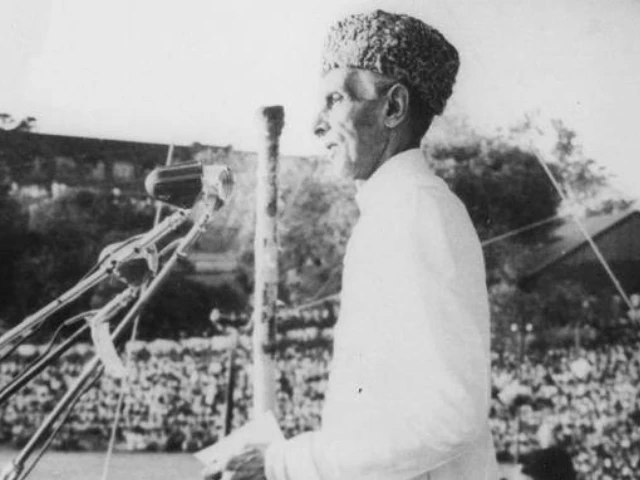
Every August, public discourse across Pakistan is framed by a familiar visual and auditory lexicon: green-and-white flags fluttering from residential rooftops, the stirring notes of the Qaumi Tarana, archival clips of Quaid-e-Azam Muhammad Ali Jinnah delivering addresses on state sovereignty, and jubilant crowds surging through the thoroughfares of major metropolitan centers. This collective memory serves as an essential touchstone for national identity, anchoring the annual independence commemorations in a narrative of triumph and liberation.
However, the historical reality of state-building is rarely as neat, instantaneous, or monolithic as popular commemoration suggests. The transition from British colonial dominion to sovereign statehood in August 1947 was not a single, isolated moment of total institutional completion. Rather, it was the genesis of a massive, improvised nation-building enterprise. In the chaotic days and months surrounding the midnight partition, the nascent state of Pakistan faced a profound administrative void. It was forced to invent, adapt, or hastily construct its foundational institutions, symbols, currency, and everyday bureaucratic paperwork on the fly.
From midnight radio waves that pierced the dark to announce the birth of a country, to flags approved just three days before the transfer of power, and transitional currency notes bearing the portrait of the British monarch, the construction of Pakistan’s statehood was an intricate mosaic of improvisation and vision. This analysis examines the granular, often overlooked historical milestones that characterized the transformation of an abstract geopolitical concept into a functioning, sovereign republic.
Detailed Chronology: The First Days of a Sovereign State
The creation of Pakistan unfolded through a rapid, compressed sequence of events that pushed administrators, political leaders, and citizens to their limits. Below is a detailed chronological mapping of the crucial milestones that marked the birth and early institutionalization of the state:
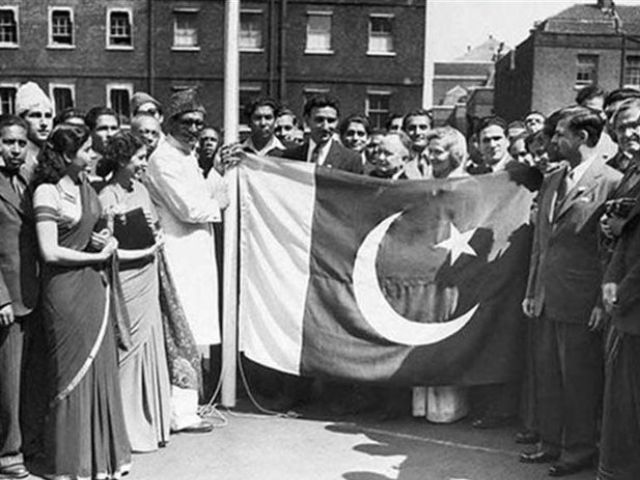
August 11, 1947: The Constituent Assembly of Pakistan formally approves the design of the national flag, just three days before the country comes into existence. Designed by Syed Amir-uddin Kedwaii, the flag establishes the visual heraldry of the new dominion, balancing a majority-representation green field with a white minority stripe, a progress-symbolizing crescent, and a light-and-knowledge star.
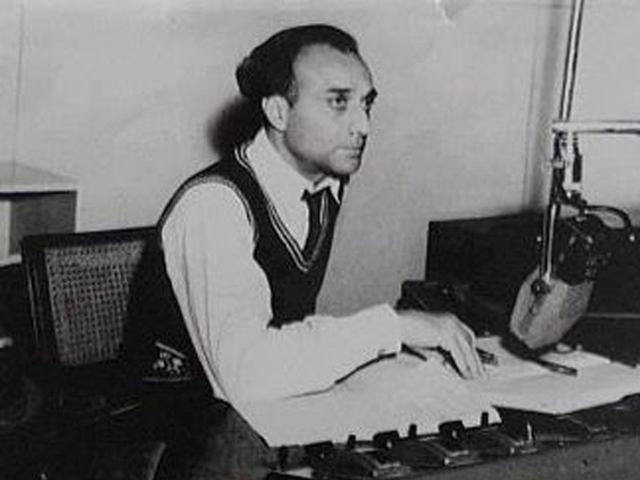
Midnight, August 14–15, 1947: The Pakistan Broadcasting Service goes live on air. Zahur Azar delivers the historic English broadcast, followed immediately by Mustafa Ali Hamdani’s Urdu announcement from Lahore, officially declaring to the world that the independent sovereign state of Pakistan has come into existence.
August 14, 1947: The historic Transfer of Power ceremony takes place at the Sindh Assembly Building in Karachi. Lord Louis Mountbatten, representing the British Crown, addresses the Constituent Assembly, formalizing the handover of sovereign authority.
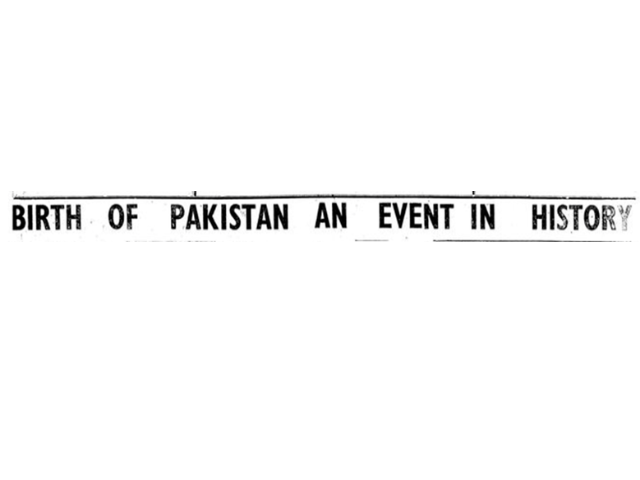
August 15, 1947: Newspapers hit the streets with the landmark, dramatic headline: "BIRTH OF PAKISTAN AN EVENT IN HISTORY," capturing the awe and disbelief of an unprecedented geopolitical realignment.
August 15, 1947: Muhammad Ali Jinnah is sworn in as Pakistan’s first Governor-General at a ceremony in Karachi, with Chief Justice Mian Abdur Rashid administering the oath. The inauguration is punctuated by a thunderous 31-gun salute and the swearing-in of the country’s inaugural Cabinet.
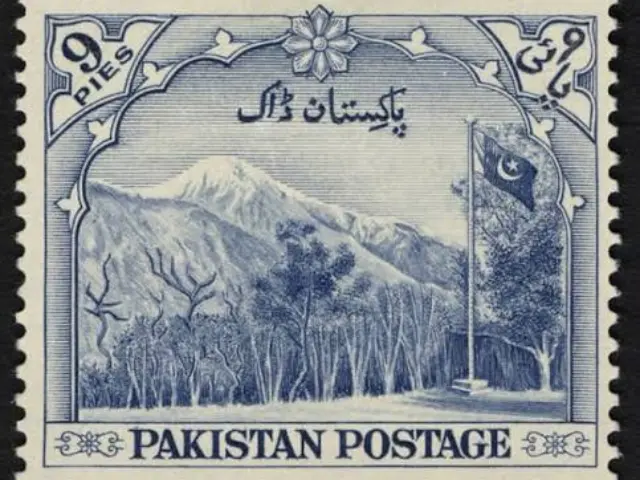
October 1, 1947: Pakistan issues its first commemorative postage stamps, providing an early administrative tool for the sovereign nation, even as broader postal and monetary systems continue to rely on provisional measures.
October 1, 1948: The Government of Pakistan issues an emergency banknote series in denominations of Rs5, Rs10, and Rs100, marking a critical step toward monetary independence, though early provisional issues continue to circulate alongside them.
July 9, 1948: The first regular series of definitive postage stamps, designed by renowned artist Abdur Rahman Chughtai, is introduced, nearly eleven months after independence.
August 1954: The Qaumi Tarana (National Anthem) is officially approved, seven years after independence, with lyrics penned by Hafeez Jalandhari and composition by Ahmad G. Chagla.
December 24, 1957: The State Bank of Pakistan issues a Rs100 banknote featuring the portrait of Quaid-e-Azam Muhammad Ali Jinnah, cementing a visual break from the colonial currency era.
1959–1967: The federal capital shifts temporarily to Rawalpindi before transitioning permanently to the purpose-built master-planned city of Islamabad, moving away from the original coastal hub of Karachi.
Supporting Context & Metrics: Navigating the Administrative Void
To fully comprehend the magnitude of Pakistan’s post-1947 state-building endeavor, one must evaluate the stark material and infrastructural realities inherited at partition. The British Indian Empire’s partition was executed at breakneck speed under the Radcliffe Award, leaving Pakistan with disproportionate administrative challenges, fractured supply chains, and severely limited physical assets.
Infrastructural Constraints at Inception
The newly minted state inherited a fraction of the integrated infrastructure previously managed from New Delhi. In the broadcasting sector, for instance, Pakistan was allotted a mere three radio stations across its vast eastern and western wings: Lahore, Peshawar, and Dhaka. Television was non-existent, and telecommunication networks were primitive, relying heavily on telegraph lines and trunk-call exchanges that were frequently overwhelmed by the massive demographic dislocations of the partition migrations.
+-----------------------------------------------------------------+
|          INFRASTRUCTURAL INHERITANCE (AUGUST 1947)              |
+--------------------------+--------------------------------------+
| Asset Category           | Initial Allocation / Status          |
+--------------------------+--------------------------------------+
| Radio Stations           | 3 (Lahore, Peshawar, Dhaka)          |
| Federal Capital          | Karachi (Port & Commercial Hub)      |
| Currency Systems         | Overprinted British Indian Rupees    |
| Postage Stamps           | Overprinted British Indian Issues    |
| National Anthem          | Absent (Adopted in 1954)             |
| National Flag            | Approved 3 days prior (Aug 11, 1947) |
+--------------------------+--------------------------------------+
The Financial and Monetary Dilemma
Economically, the new state faced an acute existential crisis. The State Bank of Pakistan did not exist on August 14, 1947; the financial architecture was initially anchored through provisional arrangements utilizing the Reserve Bank of India.
For everyday commerce, the transition was literal and symbolic. Early provisional banknotes and currency issues had to make do with what was available. Currency circulating in the opening months frequently carried the portrait of the British monarch, King George VI, stamped over or accompanied by the newly minted legend "Government of Pakistan." It was not until the emergency issues of October 1948, and eventually the definitive Jinnah-portrayed notes introduced in December 1957, that the nation achieved true monetary autonomy.
Similarly, postal communication—the lifeblood of governance and commerce—relied initially on existing British Indian postage stamps overprinted with the word "Pakistan." The country’s first definitive series of postage stamps, masterminded by artist Abdur Rahman Chughtai and featuring the crescent and star alongside the motto "Pakistan Zindabad," did not enter circulation until July 1948, nearly a year after the formal declaration of independence.
Official Statements and Archival Records
The weight of these early administrative hurdles is well-documented in official state archives, contemporary newspaper front pages, and historical broadcasts.
Capturing the gravity of the midnight hour, the inaugural broadcast transmitted by the Pakistan Broadcasting Service on August 14, 1947, set the tone for an administrative machinery built on determination. Zahur Azar’s historic English announcement rang out across the airwaves:
"At the stroke of twelve midnight, the independent sovereign state of Pakistan will come into existence. This is Pakistan Broadcasting Service. We now bring you a special programme on the dawn of Pakistan’s independence."
This declaration was immediately mirrored by Mustafa Ali Hamdani’s Urdu transmission from the Lahore station, providing linguistic inclusivity to a populace spanning diverse regional and cultural backgrounds.
In print media, the editorial stance of the era reflected both the profound triumph and the sobering reality of institutional creation. The front page of August 15, 1947, which broadcast the monumental headline:
"BIRTH OF PAKISTAN AN EVENT IN HISTORY"
served not merely as a report of current affairs, but as a formal declaration of historical permanence. Archivists note that these early publications capture a society in motion—a country actively introducing itself to its citizens and to the international community.
The formalization of state symbols further underscores this deliberate, step-by-step construction. When Syed Amir-uddin Kedwaii’s flag design received official sanction from the Constituent Assembly on August 11, 1947, it codified the nation’s core values into heraldic design. As outlined in diplomatic and cultural records by the Ministry of Foreign Affairs:
The dark green field symbolizes the Muslim majority population.
The white vertical stripe institutionalizes the protection, rights, and inclusion of religious minorities.
The white crescent represents progress.
The five-pointed star stands as an emblem of light, guidance, and knowledge.
Future Outlook: Legacy and Evolution of the Pakistani State
Looking back from the vantage point of the modern era, the historical narrative of Pakistan’s founding offers vital lessons in institutional resilience. The common tendency to view the state’s emergence as an immaculate, fully formed conception overlooks the immense human effort, improvisation, and administrative grit required to turn a map on paper into a breathing republic.
The challenges faced by the architects of 1947—building institutions from scratch, unifying fractured administrative units, stabilizing volatile monetary supplies, and forging a cohesive national identity out of diverse regional heritages—laid the groundwork for the modern Pakistani state. Karachi’s initial role as a bustling commercial and political capital, its subsequent transition to Rawalpindi, and the ultimate establishment of Islamabad as the permanent federal seat reflect an evolving administrative maturity. Similarly, the evolution from provisional currency bearing foreign monarchs to sovereign financial instruments, and from overprinted stamps to indigenous artistic masterpieces like Chughtai’s definitive series, maps the physical crystallization of sovereignty.
As Pakistan continues to navigate contemporary socio-economic, political, and technological transformations, the memory of its foundational years remains a powerful reminder. The nation was built not by the effortless unfolding of a pre-determined destiny, but through the relentless, day-to-day labor of its people and leaders who turned an impossible dream into an enduring reality. Understanding this complex genesis enriches our appreciation of the state’s institutional heritage, proving that the work of nation-building did not end at midnight in August 1947—it had only just begun.






Comments
Facebook App ID not configured. Please add it in the Customizer.