
Executive Overview
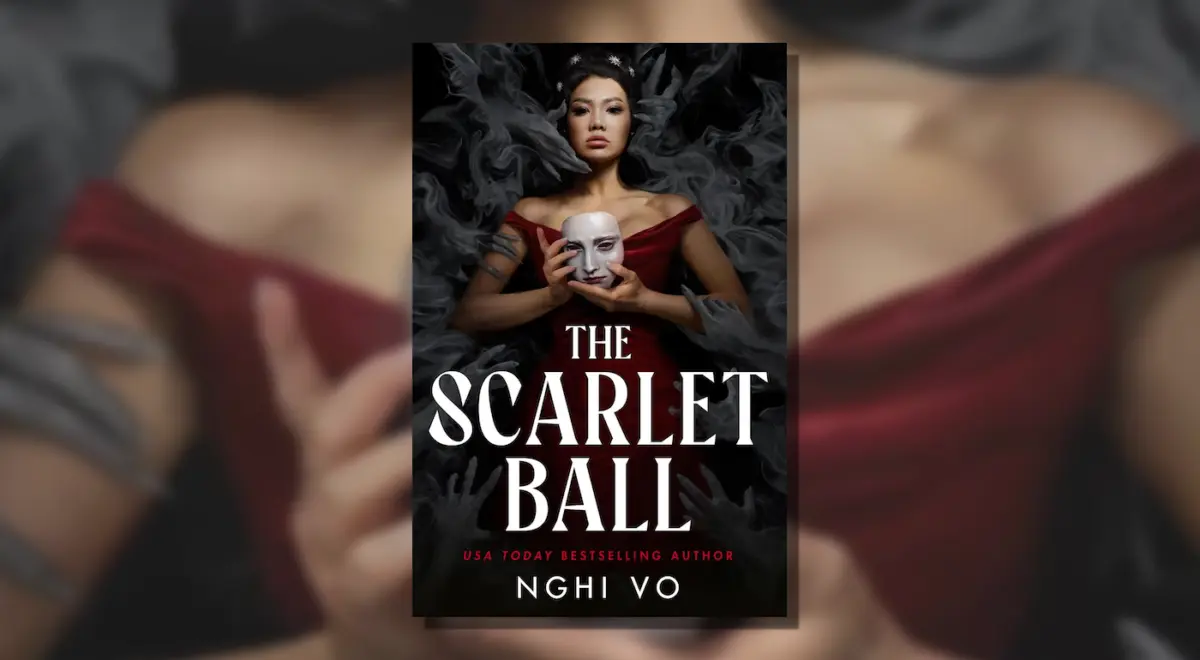
In the continuously expanding landscape of historical fantasy, few authors possess the surgical linguistic precision and uncanny atmospheric control of Nghi Vo. Tor Books is set to publish Vo’s latest masterwork, The Scarlet Ball, on October 6, a novel that promises to violently dismantle the gilded cages of the late-nineteenth-century American elite. Blending the stratified social warfare of Gilded Age New York with blood-soaked, occult body horror, Vo introduces readers to a world where high society is sustained by literal demonic enterprise.
At the structural center of this terrifying narrative is Judith Ban—a former convent girl, disgraced courtesan, and failed thief whose multi-ethnic heritage (born of a Vietnamese adventuress and a French naval officer) leaves her uniquely positioned on the razor’s edge of survival. To escape the grinding poverty of Manhattan’s tenements and the inescapable shadow of her past, Judith accepts a Faustian bargain with the matriarch of the ultra-powerful Howard family. Her mission: to seamlessly assume the identity of the missing Howard granddaughter, Iphigenia Marshall, who vanished on the eve of her society debut.
With Miss Marshall’s face quite literally stitched over her own, Judith must navigate the lethal, hyper-exclusive mating rituals of New York’s legendary "Four Hundred." The stakes are absolute: secure a powerful, albeit monstrous, husband with infinite hungers at the impending Scarlet Ball, or be entirely consumed by the very systemic machinery that built the city. This exclusive feature offers a deep dive into the harrowing world of The Scarlet Ball, including an analysis of its major thematic currents and the complete, chilling literary excerpt that establishes Vo’s newest triumph.
Read Also
Detailed Chronology: The Transformation of Judith Ban
The journey from the damp, crowded pews of Mulberry Street to the gaslit parlors of the Howard estate is charted through a harrowing transformation sequence that bridges psychological dread with visceral, artisanal body horror.
Phase One: The Strip-Down of Identity
The narrative opens in the liminal space between destitution and reinvention. Judith, shedding the anonymous, protective dullness of her "shopgirl black" garments at Madame Valois’s establishment, stands exposed in French undergarments that signal a past far more cosmopolitan than her current station allows. This stripping away of economic armor acts as the first step in a ritualistic shedding of the self. Mrs. Howard—cold, calculating, and ruthlessly pragmatic—evaluates Judith not as a human being, but as raw biological inventory: clean enough, sufficiently pale under the duress of shop labor, and capable of being masked by gloves that conceal the physical wreckage of hard labor.
Phase Two: The Gilded Shell
The donning of the dress—a marvel of satin and silk costing enough to sustain an ordinary family for half a year—represents Judith’s entry into elite theatricality. As Mrs. Howard fastens the endless row of silk-covered buttons running up her spine, Judith undergoes a psychological metamorphosis. She is no longer a shopgirl or a clandestine survivor; she is an artifact, a structural shell reinforced with grosgrain ribbons. Yet, this transition is immediately complicated by the presence of Henry Howard.
The introduction of Mr. Howard establishes the ambient, monstrous baseline of the family. His physical presence—shifting casually under a tailored dinner jacket, accompanied by the uncanny absence of sound when he traverses a room—forces Judith into a primal realization of mortal danger. When his human façade briefly ripples to reveal a jawline and teeth anatomically incompatible with a human skull, the true nature of the Howard fortune is unmasked. They are not merely wealthy; they are predators presiding over a human farm.
Phase Three: The Surgical Erasure
The most arresting sequence in the text occurs at the vanity table, framed by an ancient, trick-playing silver mirror that moves independently of its subject. Under the guise of grooming—powdering hair, heating steel tongs over gas lamps, and applying tinted wax to form tidy Newport waves—Mrs. Howard performs a meticulous, unyielding subjugation of Judith’s physical autonomy.
This preparation culminates in actual, bone-deep surgery. Immobilized against the vanity by an unseen, coercive force, Judith experiences the terrifying reality of bodily reconstruction:

- The Tools: Chatelaine-hung scissors that sound not like delicate embroidery instruments, but like the heavy-duty shears used to cut through leather and felt at the shop.
- The Technique: Curved needles and coarse black thread deployed in a mattress stitch—a method designed to join two edges over uneven surfaces.
- The Mask: A shimmering, rustling skin-perforated artifact with a wide, screaming mouth, stretched and sewn directly over Judith’s face.
Phase Four: The Silent Carriage Ride
Seated inside a smoothly sprung carriage alongside the monstrous Henry and the implacable Mrs. Howard, Judith exists in a state of hot, localized numbness. The physical trauma of having a new face stitched to her skull is mirrored by psychological dissociation. Yet, beneath the manufactured stillness, the true essence of Judith Ban survives. Deprived of her physical bag of tools and stones, she realizes that her core ambition remains untouched. The itch beneath the skin is not merely the irritation of foreign thread, but the restless, indomitable spirit of a woman who refuses to be erased.
Supporting Context & Metrics: The Architecture of Historical Fantasy
To fully appreciate the narrative weight of The Scarlet Ball, it is vital to examine the literary and historical framework within which Nghi Vo operates.
The Gilded Age Aesthetic Meets Occult Horror
The late nineteenth century in New York City was characterized by extreme disparities in wealth, the rise of monopolistic capitalism, and the rigid enforcement of social strata epitomized by Ward McAllister’s "Four Hundred." By superimposing the ritualistic consumption of demonic marriage onto this historical backdrop, Vo creates a biting social satire. The debutante season is reframed for what it metaphorically always was: a brutal marketplace where young women are evaluated, traded, and ultimately consumed by patriarchal and systemic forces.
Comparative Narrative Metrics
- Publication Date: October 6 (Tor Books)
- Audio Adaptation: Narrated by Natalie Naudus, bringing a distinct vocal texture that enhances the atmospheric tension of the text.
- Protagonist Profile: Multiracial heritage (Vietnamese/French), working-class resilience, multilingual, skilled in trade craft, and possessing an unyielding survival instinct.
- Core Conflict: Class mobility purchased through physical and spiritual self-commodification, juxtaposed against an impending supernatural debutante ball.
Official Statements and Editorial Insights
In promotional materials released by Tor Books, editors emphasize The Scarlet Ball as a definitive evolution in Nghi Vo’s critically acclaimed bibliography. Known for her lyrical prose and sharp subversion of genre tropes—demonstrated in works like The Chosen and the Beautiful and the Singing Hills novellas—Vo brings a distinctly intersectional lens to historical fantasy.
"In Judith Ban, Nghi Vo has created a protagonist who defies every easy categorization of victim or villain," notes the editorial team at Tor Books. "She is a survivor who treats her own body as negotiable territory in a war for ultimate power. The novel explores the terrifying price of entry into spaces that were never built to welcome the marginalized, let alone let them conquer."
Furthermore, the inclusion of narrator Natalie Naudus for the audiobook edition guarantees an immersive auditory experience. Naudus’s performance captures the dry, cynical wit of Judith’s internal monologue alongside the chilling, velvet-draped menace of the Howard household.
Future Outlook: The Significance of The Scarlet Ball
As the publishing industry prepares for the October 6 release, anticipation surrounding The Scarlet Ball points toward a major cultural moment in speculative fiction. The novel arrives at a time when readers increasingly demand historical narratives that interrogate the dark underbellies of empire, class, and assimilation.
By marrying the lush, decadent prose of Gilded Age social drama with the visceral terror of body modification and demonic pacts, Vo has crafted a narrative that is as intellectually stimulating as it is pulse-pounding. As Judith Ban rides toward the Scarlet Ball—her new face secured with coarse black thread and her ambition burning brighter than ever—readers are left with a lingering, electrifying question: When you sell your face to monsters, do you become one of them, or do you learn how to tear them apart from the inside out?
Pre-orders for The Scarlet Ball are currently available through Macmillan and major independent booksellers, with the audio edition launching simultaneously.





Comments
Facebook App ID not configured. Please add it in the Customizer.