
Executive Overview
Every June, the geography of professional basketball temporarily bifurcates along the emotional fault lines of triumph and despair. In Manhattan, a celebratory parade welcomes the victors of the NBA season—a ritual of confetti and champagne for the ultimate survivors of an eighty-two-game gauntlet. Weeks later, across the East River in Brooklyn, a vastly different assembly convenes. This is the realm of the vanquished, the lottery-bound, and the rebuilding. Yet, as the 2025–26 NBA season draws to its close, the landscape of failure is shifting.
The annual NBA Draft Lottery has long operated as a paradoxical theater: a system where losing is incentivized, and competitive regression is systematically monetized into future assets. For franchises like the Washington Wizards and the Utah Jazz, systemic roster degradation paid off handsomely, converting mathematical futurity into coveted top selections in a draft class universally heralded as historically talented. Conversely, organizations like the Brooklyn Nets endured a catastrophic convergence of poor on-court performance, draft lottery regression, and historical cultural eclipse, highlighting the precariousness of rebuilding models.
Compounding this existential shift, the NBA stands on the precipice of a regulatory revolution. Beginning next year, sweeping structural reforms to the draft lottery will effectively neutralize the financial and structural incentives for intentional losing, commonly known as "tanking." Consequently, the class of 2026 represents the final cohort of franchises permitted to straightforwardly engineer defeat as a pathway to organizational salvation.
Read Also
Beyond the front-office mathematics, the draft itself functions as an industry event masquerading as a public spectacle—a corporate-sponsored bazaar where elite teenagers are processed by middlemen, encased in tailored suits, and funneled into a hyper-monetized ecosystem of social media scoops, betting markets, and digital consumer experiences. As traditional sports journalism gives way to a relentless, scoop-driven attention economy, the draft serves as a mirror reflecting the contemporary intersection of commerce, culture, and athletic fandom.
Detailed Chronology: A Night at the Barclays Center
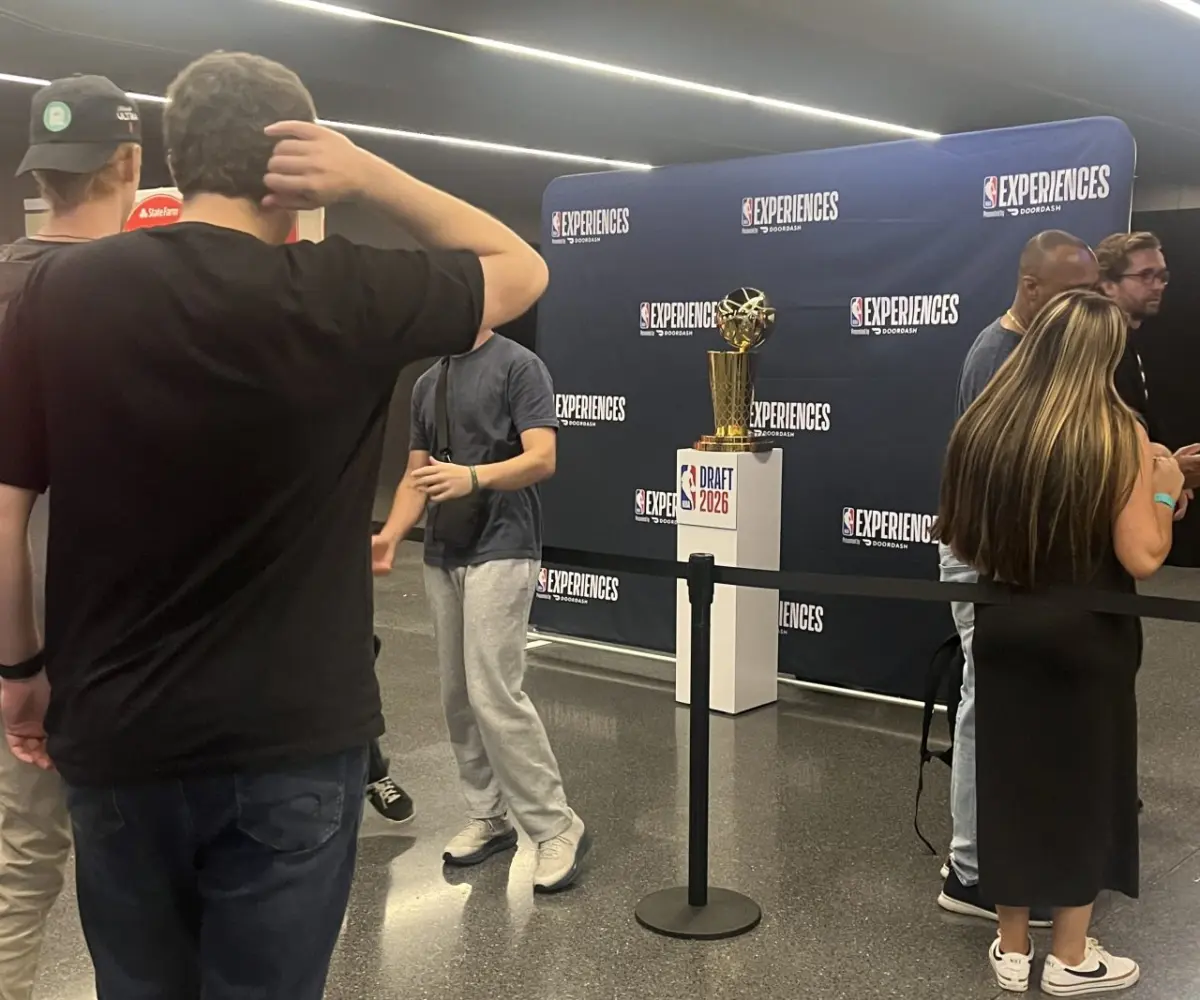
The sensory experience of the NBA Draft at the Barclays Center is carefully orchestrated to blur the boundaries between consumerism and pageantry. Walking through the security checkpoints, patrons are immediately confronted with an array of app-driven engagements and photo-op installations. A glass box displays what is allegedly the official Rookie of the Year trophy, flanked by queues for the "NBA Experience," where fans can pose alongside replicas of the Larry O’Brien Championship Trophy—complete with sponsorship branding courtesy of DoorDash.
As the evening progresses, the informal dress code of the arena reveals the distinct strata of the basketball industrial complex. Fans arrayed in team jerseys—heavy on the newly emboldened Wizards contingent alongside the perennial New York faithful—contrast sharply with the formal wear of media personnel, team executives, and player agents. The latter group wears the unmistakable air of entrepreneurial triumph, occasionally pausing to hand out bedazzled team hats to their children once the picks are officially recorded.
The chronology of the draft unfolds not in a vacuum, but against a relentless backdrop of digital notifications. While the commissioner steps to the podium to a customary chorus of ritualistic boos, the true timeline of events is broadcasted minutes in advance across private channels:
- The Opening Selection: Rumors and push notifications from fantasy basketball applications and aggregators break the news that the Washington Wizards have secured AJ Dybantsa at number one, long before the announcement reverberates through the arena’s acoustics.
- The Mid-Lottery Shuffles: As the selections progress to the seventh pick—where the Sacramento Kings select Darius Acuff Jr.—the arena’s energy shifts. Behind the press rows, a group of dedicated young fans tracking personal "Big Boards" erupts in specialized analysis and localized celebration.
- The Draft-Board Slides: Surprises ripple through the crowd as prospects slide down the board. The selection of Morez Johnson Jr. by the Dallas Mavericks at ninth sparks murmurs of confusion, which gradually harden into outrage as unselected prospects like Yaxel Lendeborg continue to fall. When Lendeborg is finally claimed at eleven by the Golden State Warriors, the response from the mock-drafters in the audience mimics the joyous pandemonium of a championship victory.
- The Concourse Exodus: Following the completion of the first twelve selections, an ambient restlessness permeates the stadium. Fans filter out toward the concourses, where the rigid architectural hierarchy of the modern sports arena briefly dissolves. Media members mingle with children questioning the delay of college standouts, while executives and former players traverse the corridors amid an anarchic, crowd-driven energy.
Supporting Context & Metrics: The Economics of Futility
To understand the mechanics of the draft, one must interrogate the underlying arithmetic that governs modern NBA front offices. The league’s lottery system utilizes weighted odds derived from regular-season records, transforming numerical ineptitude into draft capital.
| Franchise | Regular Season Outcome | Lottery Outcome / Asset Trajectory |
|---|---|---|
| Washington Wizards | Bottom-tier record | Converted losses into top draft positioning |
| Utah Jazz | Rebuilding trajectory | Secured premium lottery positioning via weighted odds |
| Brooklyn Nets | Third-worst record (23% win rate) | Fell from tied-best lottery odds down to 6th; depleted historical capital |
| Indiana Pacers | Eastern Conference finalist to lottery-bound | Surrendered pick to LA Clippers due to unfulfilled lottery protections |
| Sacramento Kings | 45.2% top-four probability missed | Secured the 7th overall pick, extending post-"Beam Team" stagnation |
The structural vulnerability of this system is perhaps best exemplified by the Indiana Pacers. Following a Cinderella run to the 2025 Eastern Conference Finals—and a grueling seven-game series against the Oklahoma City Thunder—star guard Tyreese Haliburton suffered a catastrophic Achilles tendon rupture. The resulting on-court collapse pulled the Pacers into a lottery tie with Brooklyn and Washington. However, due to mid-season transactional adjustments, their lottery protection failed when they slipped to fifth overall, forcing them to surrender their pick outright to the Los Angeles Clippers and exit the first round empty-handed.
Simultaneously, the regulatory framework governing these transactions—the Collective Bargaining Agreement (CBA)—enforces a byzantine labyrinth of rules. From salary aprons and frozen draft picks to Bird Rights, taxpayer mid-level exceptions, and traded player exceptions, the financial architecture of the NBA demands an ad-hoc fluency in contract law and corporate accounting. Mastery of these instruments is no longer optional for front offices; it is the primary determinant of sustained competitiveness.
Official Statements & Industry Perspectives
The cultural apparatus surrounding the NBA draft has undergone a profound metamorphosis, shifting away from traditional journalistic analysis toward an access-driven, scoop-centric attention economy. This transformation is embodied by the evolution of league insiders and news-breakers.
For over a decade, the architecture of NBA scoops was dominated by Adrian Wojnarowski, whose "Woj bombs" defined the digital news cycle. However, Wojnarowski’s sudden retirement in 2024—prompted by a disillusionment with the transactional vacuity of modern sports reporting—left a vacuum swiftly filled by his former protégé, Shams Charania. Now operating under the banner of ESPN, Charania represents a newer, more monomaniacal strain of sports media, one explicitly tethered to social media propagation and commercial betting integrations.
Stationed at a modest desk separate from the primary analyst table during the draft, Charania’s presence underscored the tense relationship between traditional broadcast media and real-time digital leakage. While regulatory warnings from league headquarters successfully curbed major on-air leaks for the evening, the underlying tension remained palpable:
"Nobody gives a shit. Nobody remembers in the end. It’s just vapor."
— Adrian Wojnarowski, reflecting on the transient nature of modern sports journalism upon his retirement.
This quote encapsulates the existential crisis facing contemporary sports media. When instant notification loops, betting market fluctuations, and player psychodrama overshadow the actual athletic competition on the hardwood, the game risks becoming secondary to its own meta-narrative. The modern fan is no longer merely a spectator of a sport; they are participants in an endless, algorithmically driven soap opera.
Future Outlook: The End of an Era and What Lies Ahead
As the NBA prepares to implement its overhauled lottery rules next season, the deliberate deconstruction of rosters for draft positioning will officially enter history. The elimination of tanking incentives forces front offices to pivot toward developmental sophistication, holistic cultural alignment, and immaculate asset management rather than strategic failure.
For the franchises mired in the current rebuilding cycle—the Wizards, the Jazz, the Kings, and the perpetually snake-bitten Nets—the mandate is clear. The safety net of guaranteed high lottery returns is vanishing. Success will no longer be measured by the passive accumulation of ping-pong balls, but by the active, efficient conversion of talent into sustainable, winning infrastructure.
As the lights at the Barclays Center dimmed and the last promotional Funko Pop was distributed, the prevailing sentiment among the crowd was not one of closure, but of tentative redemption. Fans of struggling franchises departed into the New York night clinging to a singular, enduring hope: that the cycle of engineered failure has finally run its course, and that out of the depths of systemic loss, a genuine path toward the light has finally opened.





Comments
Facebook App ID not configured. Please add it in the Customizer.