
Executive Overview
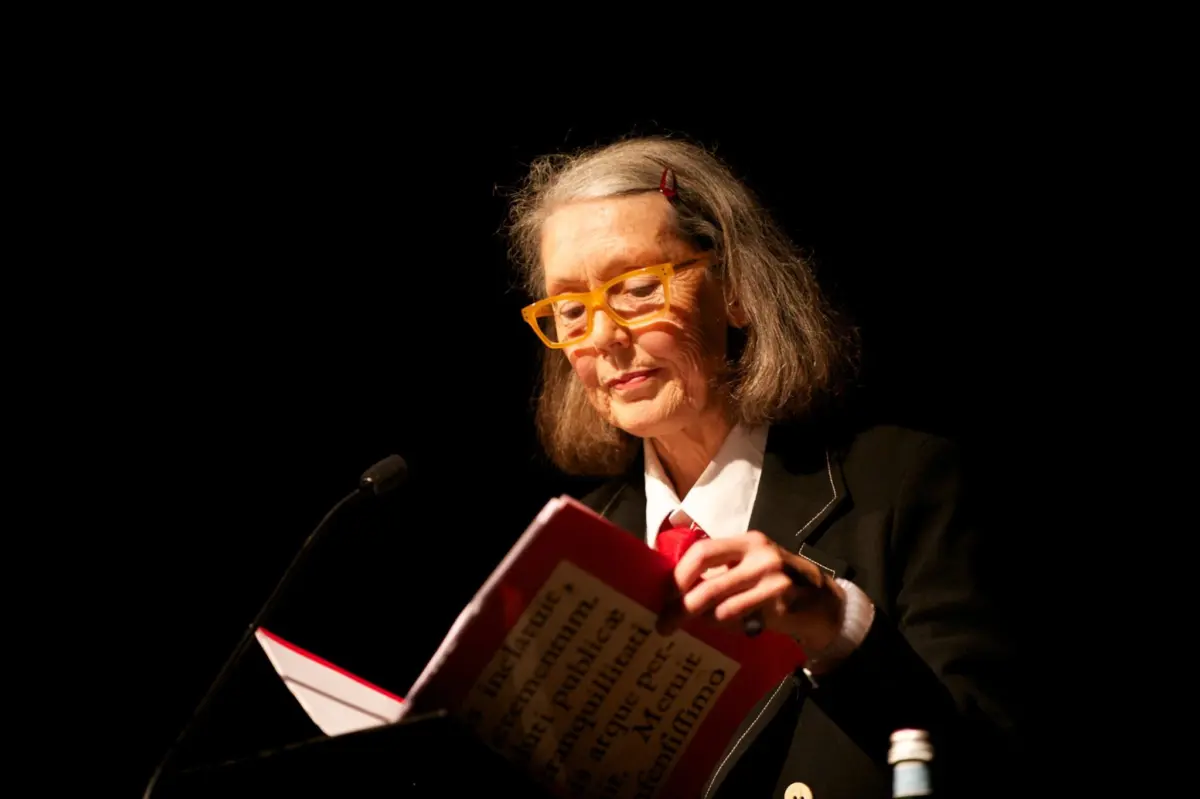
On October 8, 2026, the global literary community received news it had long anticipated, yet scarcely dared to expect: the Nobel Prize in Literature was awarded to the visionary Canadian poet, classicist, and translator Anne Carson. Announced by the Swedish Academy in Stockholm, the distinction recognizes Carson for what the Nobel Committee described as "her bold and inventive oeuvre that, in playful dialogue with the classical tradition, has created new forms for contemporary literature."
For decades, Carson has occupied a singular space in world letters. She is an author who defies standard categorization, operating simultaneously as a rigorous academic of ancient Greek and a radical avant-garde disruptor. Her work bridges the chasm between antiquity and modernity, utilizing ancient myths, philosophical inquiries, and experimental typography to map the terrain of human grief, desire, and intellect.
The announcement has sent shockwaves of celebration through international poetry circles. From Toronto to London, readers and fellow writers have hailed the decision as a triumph for adventurous literature. Long championed by institutions ranging from The Poetry Society in the United Kingdom to prestigious global fellowship committees, Carson’s elevation to Nobel laureate cements her legacy not merely as a master of contemporary verse, but as a defining architect of twenty-first-century thought. This comprehensive profile explores the trajectory of her monumental career, the foundational aesthetics of her genre-bending works, her deep ties to institutions like The Poetry Society, and the legacy of a writer who forever changed how we converse with the classical past.
Read Also
Detailed Chronology: A Portrait of the Artist as a Classicist and Iconoclast
Anne Carson was born in Toronto, Ontario, in 1950. Long before she became an internationally celebrated voice on the contemporary poetry stage, her intellectual life was rooted in the rigorous study of the ancient world. For over thirty years, Carson balanced a career as a classics professor—teaching ancient Greek language, literature, and mythology at various universities across North America—with an unquenchable drive to write poetry that refused to behave like conventional verse.
This dual identity as scholar and creator shaped the foundational cadence of her output. Her academic immersion in Sappho, Sophocles, and Euripides did not produce dry philological commentary; instead, it provided her with a dynamic toolkit for contemporary expression. Her breakthrough arrived in 1998 with the publication of Autobiography of Red, a "novel in verse" that reimagined the myth of Geryon and Herakles through a lens of modern queer longing, vulnerability, and cinematic pacing. The book was a critical sensation, instantly establishing Carson as a writer capable of melding high classical scholarship with startling emotional immediacy.
Throughout the late 1990s and 2000s, Carson’s bibliography expanded at a dizzying pace, marked by relentless formal experimentation. In 2001, she published The Beauty of the Husband: A Fictional Essay in 29 Tangos, a breathtaking sequence exploring the anatomy of a failed marriage through the aesthetic philosophy of John Keats. The collection earned her the prestigious T.S. Eliot Prize, making her the first woman to win the award.
As her career progressed, Carson continually dismantled the physical boundaries of the book itself. In 2010, she published Nox, an elegiac masterpiece presented as an accordion-fold facsimile of a handmade scrap-book. Created in memory of her estranged brother Michael, Nox combined photographs, letters, paintings, dictionary entries, and translated fragments of Catullus, proving that grief could be physically manifested through typography and design.
Her relentless output continued through the 2010s and 2020s with works such as Red Doc> (a sequel to Autobiography of Red), Decreation, Float (a collection of loose pamphlets designed to be read in any order), and Wrong Norma (2023). Alongside her original writing, Carson’s translations of Greek drama—including definitive versions of Sophocles’ Elektra and Antigone, and Euripides’ Bakkhai and Iphigenia Among the Taurians—became gold standards for theatrical production and literary translation alike.
The culmination of this half-century of literary labor arrived on that crisp October morning in 2026, when the Nobel Committee officially inducted Carson into the pantheon of literature’s highest honorees.
Supporting Context & Metrics: The Anatomy of an Unprecedented Oeuvre
To understand the weight of Anne Carson’s Nobel Prize, one must examine the staggering breadth and critical reception of her work. Carson’s career is defined by an accumulation of top-tier international honors that few living writers can rival. Prior to her Nobel win, her mantle already held:
- The T.S. Eliot Prize (for The Beauty of the Husband, 2001)
- The Griffin Poetry Prize (won twice, cementing her dominance in Canadian and international poetry)
- The Princess of Asturias Award for Literature (2020)
- Fellowships from the Guggenheim Foundation and the MacArthur Foundation (the latter widely known as the "Genius Grant")
- The Lannan Literary Award and The Pushcart Prize
Selected Bibliography of Major Works
- Autobiography of Red (1998)
- The Beauty of the Husband (2001)
- Men in the Off Hours (2000)
- Decreation (2005)
- Nox (2010)
- Red Doc> (2013)
- Float (2016)
- Wrong Norma (2023)
Forthcoming Releases
Carson’s creative engine shows no signs of slowing down following her Nobel recognition. Publishers have scheduled two major releases for the coming months:
- Beware the Man Whose Handwriting Sways Like a Reed in the Wind (Scheduled for February 2027)
- Highlights of Colonialism (Scheduled for November 2027)
Contributions to Dramatic Arts
Carson’s engagement with performance extends far beyond the printed page. Her translations of Greek tragedy are regularly staged by avant-garde theater companies worldwide. Furthermore, her expanding footprint in audio and performance art was highlighted in March 2026, when the renowned theater company Complicité produced her one-act radio play, I Don’t Do Innocents.

Official Statements and Institutional Responses
The announcement from Stockholm triggered an immediate cascade of praise from cultural ministries, literary societies, and academic bodies across the globe.
In its official citation, the Nobel Prize committee underscored the transformative nature of her craft:
"The Nobel Prize in Literature for 2026 is awarded to Anne Carson for her bold and inventive oeuvre that, in playful dialogue with the classical tradition, has created new forms for contemporary literature."
The resonance of this achievement was felt acutely within the United Kingdom’s literary infrastructure, particularly at The Poetry Society, with which Carson shares a rich and storied history. In 2013, Carson delivered The Poetry Society’s prestigious Annual Lecture at the British Museum in London, an address that also formed part of the University of Liverpool’s Kenneth Allott Lecture series.
Titled "Stammering, Stops, Silence: On the Method and Uses of Untranslation," Carson’s lecture investigated the generative spaces where language fails, breaks down, or resists transference from one tongue to another. Originally published in the Society’s flagship publication, The Poetry Review, the lecture has been made freely available online by the organization to celebrate her Nobel victory.
The Poetry Society’s engagement with Carson extends across generations. Poems by Carson featured prominently in the Winter 2023 issue of The Poetry Review. Moreover, as part of The Poetry Society’s T.S. Eliot Prize Young Critics programme in Autumn 2026, young critic Cal O’Reilly published an incisive review of Carson’s seminal collection, The Beauty of the Husband, demonstrating how her work continues to captivate and challenge emerging readers decades after its initial publication.
Future Outlook: The Enduring Legacy of an Avant-Garde Master
As the literary world processes the 2026 Nobel Prize in Literature, questions naturally turn to what Anne Carson’s victory signifies for the broader ecosystem of poetry and translation.
For too long, poetry has occasionally been marginalized in major prize conversations, often viewed as too insular or niche compared to the sprawling global novel. By selecting Carson—a poet whose primary vehicles are lyric intensity, classical fragmentation, and essayistic verse—the Swedish Academy has sent a resounding signal about the vital importance of hybrid, formally daring writing in the contemporary cultural landscape.
Carson has consistently challenged the boundary lines separating poetry from philosophy, translation from creation, and visual art from text. In works like Nox and Float, she demonstrated that the physical book could be an interactive site of archaeological recovery and emotional exposure. Her influence on younger generations of writers is immeasurable; she has licensed a whole cohort of poets to embrace erudition without sacrificing emotional rawness, and to treat the dead languages of antiquity not as museum artifacts, but as living, breathing contemporaries.
With two major new books—Beware the Man Whose Handwriting Sways Like a Reed in the Wind in February 2027 and Highlights of Colonialism in November 2027—already slated for publication, the newly minted Nobel laureate remains as fiercely productive and intellectually restless as ever.
Anne Carson’s Nobel Prize is not merely a retrospective crown for a lifetime of distinguished labor; it is an active endorsement of an ongoing artistic revolution. It honors a writer who taught us that poetry can stammer, fall silent, fracture across the page, and yet still speak with absolute, piercing clarity to the heart of what it means to be human.




Comments
Facebook App ID not configured. Please add it in the Customizer.