
Executive Overview
On September 1, 2026, the global publishing industry officially crossed the threshold into the high-stakes autumn literary season. As summer’s leisure reading fades, publishers deploy their most anticipated frontlist titles, positioning them for holiday sales, year-end retrospectives, and the upcoming awards season. This week’s release slate represents a critical barometer for speculative fiction—encompassing Science Fiction, Fantasy, Horror, and Young Adult (YA) literature—revealing not only shifting thematic preoccupations but also the structural economic realities facing modern publishing.
As documented by Locus Magazine, the premier journal of the speculative fiction field, this week’s arrivals showcase a diverse range of narrative voices. The curated selections span bold post-human landscapes, mythic fantasy quests, psychological and ecological horror, and complex, socially conscious YA adventures.
However, the significance of the September 1 rollout extends far beyond individual book acquisitions. It highlights a broader industry transformation characterized by the integration of multimedia marketing—exemplified by Locus’s weekly video roundups—and an increased reliance on grassroots, reader-supported journalism to sustain critical coverage in an era of media consolidation.
Read Also
Detailed Chronology: The September 1, 2026 Release Landscape
The first week of September serves as the traditional launchpad for major autumn campaigns. To understand the strategic distribution of these titles, it is necessary to examine how publishers segment their key offerings across the primary subgenres of speculative fiction.
[Late August: Summer Lull]
       │
       ▼
[September 1: Autumn Launchpad] ──► *Peak Frontlist Releases* (Sci-Fi, Fantasy, Horror, YA)
       │
       ▼
[Mid-October: Mid-Season Peak]  ──► *Major Literary Prize Campaigns*
       │
       ▼
[November/December: Holiday Rush]─► *Gift Market & Year-End Retrospectives*
Science Fiction: Exploring Post-Humanism and Deep Space Realism
The Science Fiction titles debuting on September 1, 2026, reflect a distinct shift away from traditional space opera toward hard speculative realism and post-humanist ethics. Key themes dominating this week’s releases include:
- The Ethics of Quantum Communication: Novels exploring the societal fragmentation that occurs when instantaneous communication across interstellar distances becomes possible, yet remains restricted to elite corporate cartels.
- Socio-Political Climate Fiction (Cli-Fi): Rather than depicting distant apocalypses, this season’s sci-fi focuses on the bureaucratic and human complexities of managed retreat from uninhabitable coastal zones, emphasizing localized resilience over grand technological salvations.
- The Human-Machine Synthesis: Reflecting real-world anxieties surrounding artificial intelligence, the new releases explore the psychological toll of cognitive offloading and neural integration, questioning where human agency ends and algorithmic governance begins.
Fantasy: The Renaissance of Mythic Realism and Cozy Grimdark
The fantasy releases of early September demonstrate a fascinating divergence in reader demand. On one end of the spectrum, epic fantasy continues to embrace "mythic realism"—sprawling, politically intricate secondary worlds that eschew Eurocentric feudal tropes in favor of complex, non-Western historical analogues.
Concurrently, the "cozy grimdark" subgenre continues to consolidate its market share. These narratives combine the high stakes, morally grey characters, and visceral world-building of traditional grimdark with intimate, community-focused resolutions. Rather than saving the cosmos, protagonists in these novels are often depicted trying to preserve a single sanctuary, business, or family unit amidst systemic collapse.
Horror: Ecological Dread and Psychological Isolation
Horror releases for September 1 capitalize on the transition into autumn, leaning heavily into atmospheric and psychological tension. The dominant trend for Fall 2026 is "ecological dread" (eco-horror), where the natural world is not merely a setting, but an active, retaliatory force reacting to human exploitation. Additionally, publishers have released several highly anticipated psychological thrillers that explore themes of digital isolation, detailing the horror of losing one’s identity to curated online realities and deepfake manipulation.
Young Adult (YA): Diverse Magic Systems and Intersectional Activism
The Young Adult sector continues to be a powerful driver of industry revenue. The September 1 releases highlight a mature, highly sophisticated approach to speculative themes. YA fantasy and science fiction titles this week are characterized by:

- Intersectional World-Building: Magic systems that are intrinsically tied to cultural heritage, language, and social class, moving away from arbitrary power scales.
- Themes of Collective Action: Moving past the "Chosen One" trope, current YA narratives emphasize community organization, mutual aid, and collaborative resistance against authoritarian structures.
Supporting Context & Industry Metrics
The release of the September 1 slate occurs against a backdrop of shifting economic variables within the publishing ecosystem. To understand the environment in which these books must compete, we must analyze the key metrics defining the speculative fiction market in 2026.
| Metric / Trend Indicator | 2024 Baseline | 2026 Current Status | Strategic Impact |
|---|---|---|---|
| Speculative Fiction Market Share | ~18% of fiction sales | ~22% of fiction sales | Dominates film/TV licensing pipelines; drives publisher profitability. |
| Audiobook Market Penetration | 35% of total consumption | 42% of total consumption | Publishers prioritize simultaneous audio-print releases; rising production values. |
| Direct-to-Consumer (D2C) Sales | 12% of publisher revenue | 19% of publisher revenue | Increased reliance on special editions, newsletters, and targeted video content. |
| Paper & Supply Chain Cost Index | High volatility (+15%) | Stabilized (+3% YoY) | Predictable print runs; resurgence of high-quality hardcovers with sprayed edges. |
The Multimedia Imperative: Video Curation as a Discovery Engine
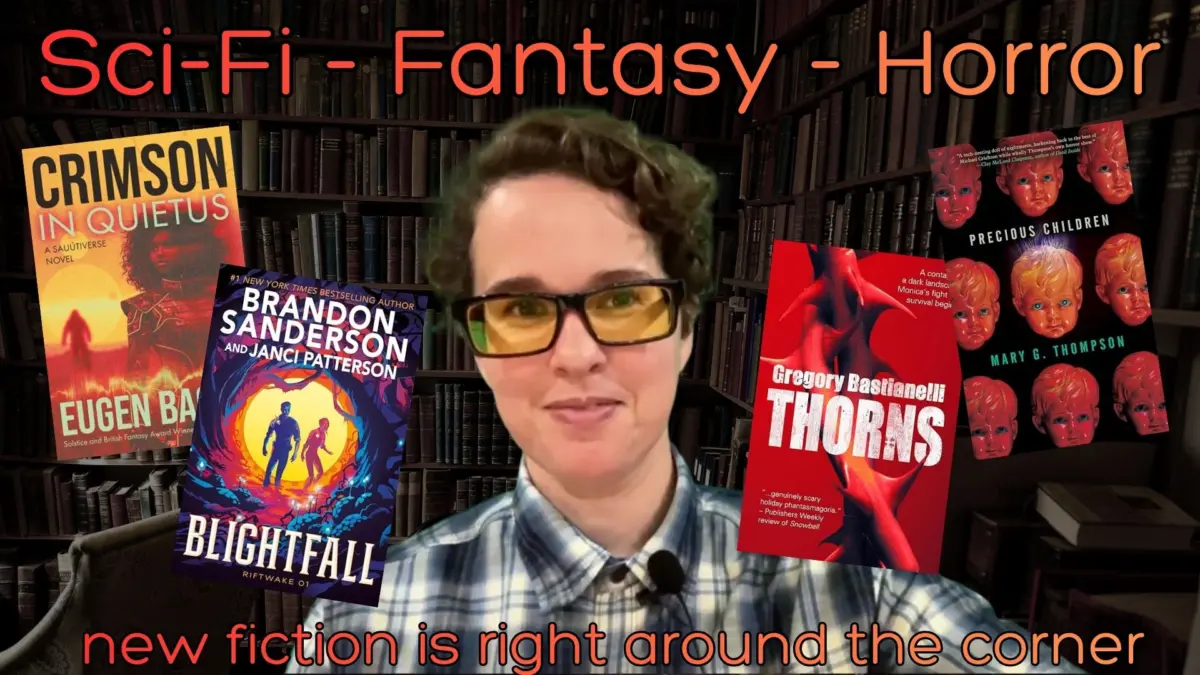
As traditional retail spaces face ongoing economic pressures, the discovery engine for new books has shifted decisively toward digital curation. Locus Magazine’s integration of video roundups (such as their September 1 YouTube broadcast) reflects a vital strategic pivot.
Publishers report that visual-first platforms, including YouTube, TikTok, and Instagram, are now responsible for over 50% of organic book discovery among readers aged 18 to 35. These video previews serve as an essential bridge, translating static cover art and text-heavy back-cover copy into dynamic, engaging narratives that capture consumer attention in a crowded media landscape.
         [Consumer Views Video Roundup]
                       │
         ┌─────────────┴─────────────┐
         ▼                           ▼
[E-Book/Audiobook Purchase]    [Local Bookstore Visit]
         │                           │
         └─────────────┬─────────────┘
                       ▼
         [Social Media Word-of-Mouth]
                       │
                       ▼
         [Algorithmic Amplification]
Official Statements and Industry Perspectives
The critical role of specialized media in sustaining this literary ecosystem cannot be overstated. Independent platforms provide the rigorous critique, historical context, and industry reporting that algorithmic storefronts lack.
In an official statement addressing the publication’s ongoing community fundraising campaign, the editorial board of Locus emphasized the fragile economics of independent cultural journalism:
"While we are proud to present hundreds of reviews and news stories each year, the reality of modern publishing is that we cannot sustain this work without direct reader support. We rely on one-time and recurring donations to keep our magazine and website operational. Independent journalism is the bedrock of the speculative fiction community; it ensures that midlist authors, debut voices, and marginalized perspectives receive the critical attention they deserve in an increasingly consolidated market."
Industry analysts point out that without reader-supported entities like Locus, the speculative fiction landscape risks becoming an monoculture dominated entirely by major conglomerates’ high-budget marketing campaigns. Independent curation ensures that literary merit, innovation, and diverse storytelling continue to find an audience.
Future Outlook: Speculative Fiction’s Trajectory Toward 2027
As the industry progresses through the final quarters of 2026 and looks toward 2027, several structural trends are poised to redefine the speculative fiction landscape:
- The Rise of Eco-Conscious Print Production: With environmental concerns remaining at the forefront of public discourse, major publishing houses are committed to transitioning to carbon-neutral paper sourcing and localized print-on-demand networks to minimize shipping emissions.
- Hybrid Publishing Models: The boundary between self-published success stories and traditional publishing will continue to blur. Publishers are increasingly monitoring digital serialization platforms to acquire proven intellectual properties, offering these authors premium physical distribution and translation rights.
- Transmedia Integration: Speculative fiction novels are increasingly written with adaptation in mind. The rapid expansion of streaming platforms has created an insatiable demand for rich, world-built intellectual properties, meaning that a successful September 1 release may well be greenlit for a television adaptation by the following spring.
Ultimately, the September 1, 2026 release slate demonstrates that despite economic headwinds and shifting consumption habits, the human appetite for speculative storytelling remains robust. By offering readers a mirror to examine contemporary anxieties through the lens of the fantastic, these new titles do not merely provide escapism—they offer a vital map for navigating an increasingly complex world.


Comments
Facebook App ID not configured. Please add it in the Customizer.