
Executive Overview
The contemporary art community is mourning the sudden and unexpected passing of Lucien Smith, a defining figure of the early-2010s New York art scene, who has died at the age of 37. Smith’s meteoric rise, abrupt withdrawal from the commercial market, and subsequent reinvention as a champion of emerging talent left an indelible mark on the cultural landscape of the 21st century.
Confirmed to ARTnews by early champion and dealer Bill Powers, the news of Smith’s passing has reverberated across social media and institutional circles alike. No official cause or place of death has been publicly disclosed at this time.
Born in 1989 and minted as an art-world wunderkind before his mid-twenties, Smith captured the zeitgeist of a hyper-connected, digital-first era. He was celebrated for his radical, unorthodox painting techniques—most notably his "Rain" paintings executed with fire extinguishers—and was thrust into the speculative frenzy of the "zombie formalism" market movement. Yet, rather than comfortably riding the wave of hyper-commodification, Smith spent the latter half of his career dismantling the very systems that built him. He pivoted toward philanthropy, community-building, and digital innovation, dedicating his energy to empowering unrepresented creators and nurturing a healthier, more sustainable creative ecosystem.
Read Also
Detailed Chronology
The Cooper Union Prodigy and Overnight Sensation
Lucien Smith’s trajectory within the fine arts was characterized by acceleration and intensity. A native New Yorker, Smith earned his Bachelor of Fine Arts from the prestigious Cooper Union in 2011. Even before graduation, his raw output caught the eye of veteran dealer Jeanne Greenberg Rohatyn during his thesis exhibition. Rohatyn’s early endorsement set the wheels in motion for an ascent that many veterans of the industry described as unprecedented.
In 2012, Smith mounted his first solo gallery exhibition, titled Good Vibrations, at Bill Powers’s Half Gallery. The show served as a manifesto of his early material philosophy. Writing for Office magazine in 2018, Powers recalled the exhibition:
"It was all appropriated guitar bodies which Lucien had then turned into wall sculpture by either painting or adorning them with bottle caps, glitter, tin foil, etc. Think John Armleder meets junkyard Duchamp."
By 2013, at just 24 years old, Smith had firmly arrived. A New York Times T Magazine profile that year cemented his status as a bonafide prodigy, noting his rapid inclusion in rosters at cutting-edge galleries such as OHWOW, Brand New, and the Susanne Geiss Company. Recognition quickly transcended the traditional art press; Smith was twice named to Forbes’s coveted "30 Under 30" lists in 2013 and 2014.
The Zenith of the "Rain" Paintings and Market Frenzy
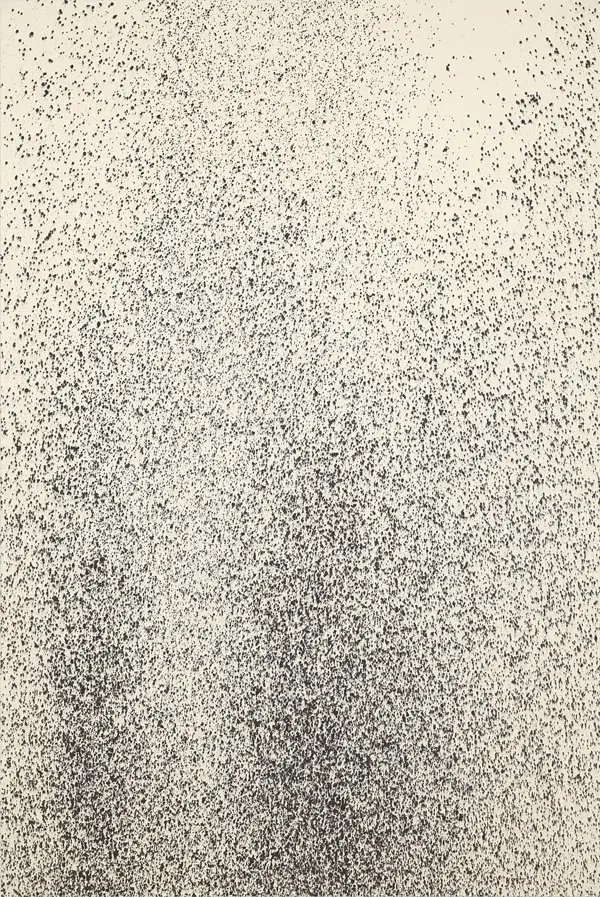
Smith’s signature creation—the "Rain" series—became emblematic of a specific market bubble characterized by rapid production, high speculative returns, and youthful celebrity. Executed by spraying acrylic paint onto unprimed canvases using commercial fire extinguishers, these large-scale abstractions captured a striking atmospheric quality that resonated with a new generation of millennial collectors.
As demand for emerging contemporary art exploded against the backdrop of a recovering global economy and the nascent power of Instagram, Smith’s market value soared. In 2013, his seminal work Hobbes, the Rain Man, And My Friend Barney / Under the Sycamore Tree (2011) fetched $389,000 at Phillips New York—a high watermark for the artist’s auction record. Shortly after, a companion "Rain" painting pulled in $372,000 at Sotheby’s London.

This hyper-accelerated market did not go unnoticed by critics. In 2014, artist and critic Walter Robinson famously coined the term "Zombie Formalism" in an essay for Artspace, grouping Smith alongside contemporaries like Jacob Kassay. Robinson described their aesthetic as utilizing a "straightforward, reductive, essentialist method of making a painting" that resurrected the long-dormant aesthetics of Clement Greenberg.
Personal Revelations and Retreat from the Spotlight
Behind the glittering facade of auction records and gallery parties, pressures were mounting. In 2014, Smith delivered a candid, emotionally raw TEDx talk at Columbia College, detailing a deeply troubled family background. He spoke publicly about catching his father, Terrence Sanders-Smith, cheating on his mother, fashion designer Melissa Dizon Ramsey—an experience he classified as foundational trauma that instilled in him an enduring, pervasive fear of failure. The public airing of family grievances led to a bitter, public fallout, with his father publishing a scathing blog post denouncing his son.
The combination of familial friction, relentless market expectations, and the pitfalls of early notoriety began to take its toll. By September 2014, following the purchase of a home in Montauk, Long Island, Smith made the shocking decision to step away from the commercial gallery circuit.
"I really want to stay out of the art world right now," he told the Observer at the time. His retreat proved prophetic; by 2015, The New York Times reported that the volatile emerging art sector was undergoing a necessary market correction as speculative fatigue set in.
Reinvention: Philanthropy, Nonprofits, and Digital Labs
Rather than fading into obscurity, Smith channeled his institutional disillusionment into systemic reform. In 2015, he founded Serving the People (STP), a digital registry and nonprofit organization designed to support unsigned painters, photographers, and multidisciplinary creators.
In a 2018 interview with Bill Powers, Smith articulated the mission behind STP:
"It’s a group which seeks to nourish emerging talent in art, music and film. Our goal is to provide an alternative platform for creative inquiry and experimentation. We want to help bring awareness to the unrefined, uncommercial and create a market for it as well."
Smith’s institutional footprint expanded in 2020 when he mounted his first museum solo exhibition, Southampton Suite, at the Parrish Art Museum in Water Mill, New York. In interviews surrounding the exhibition, he described the institutional homecoming as a "therapeutic experience," using the platform to advocate for small, independent galleries struggling under the weight of an increasingly corporate art market.
Always restless and forward-thinking, Smith embraced the technological shifts of the early 2020s. In 2021, at the height of the non-fungible token (NFT) boom, he assumed the role of director of the Cultural Innovation Lab at Lobus, an equity management firm, and subsequently launched his own digital art collection, titled Seeds.

Full Circle: Culinary Arts and a Return to Painting
True to his multidisciplinary nature, Smith’s final years were marked by ambitious cultural interventions. In 2024, he collaborated with the estate of Gordon Matta-Clark to reopen Food, the legendary SoHo restaurant originally founded in 1971 by artists Tina Girouard, Carol Goodden, and Matta-Clark. Reimagined as an artist-run hub, the resurrected space aimed to provide steady work opportunities for young creatives while hosting programming designed to revitalize downtown New York’s avant-garde community.
"For creatives, many work opportunities can feel like distractions from their practice," Smith told The Art Newspaper during the launch. "I believe that if you put time and energy into young creatives, that in turn will create a much healthier ecosystem."
In a poignant twist of fate, just weeks before his passing, reports emerged that Smith had returned to his roots. Working with a modified industrial airbrush that recalled the fire extinguishers of his early career, he produced a new body of paintings slated for exhibition at the Tripoli Gallery in Wainscott, New York.
Reflecting on this full-circle creative journey, Smith told Artnet News:
"Life has taken me full circle. I think it is time to return to the process I was given."
Supporting Context & Metrics
To understand Lucien Smith’s legacy, one must examine the socio-economic ecosystem of the early 2010s New York art market—a period defined by the convergence of social media, low-interest liquidity, and a generation of tech-savvy young buyers.
- The Speculative Bubble: Smith’s swift ascent coincided with the rise of Instagram as an art advisory tool. Collectors could view, covet, and acquire works based on digital reproductions within seconds, bypassing traditional curatorial vetting processes.
- Auction Benchmarks: While many artists of the "Zombie Formalism" era experienced severe market drops following the 2015 correction, Smith’s auction high of $389,000 for Hobbes, the Rain Man, And My Friend Barney / Under the Sycamore Tree (2011)—achieved at Phillips New York—remains a testament to the brief yet intense speculative heights of the period.
- Institutional Recognition: Despite early skepticism from traditionalists regarding his rapid commercialization, Smith secured significant institutional validation, highlighted by his inclusion in major group shows and his 2020 solo institutional debut at the Parrish Art Museum.
Official Statements and Tributes
The art world has responded to Smith’s sudden passing with an outpouring of grief, remembering him not only as an innovative creator but as a deeply empathetic friend and mentor who dedicated his platform to lifting others up.
- Bill Powers (Dealer and Early Supporter): Confirming the news to ARTnews, Powers captured the collective grief of the community with a poignant sentiment: "Lucien lives in a wordless place inside us now."
- Joel Mesler (Artist): Expressing his sorrow via text message to ARTnews, Mesler shared: "I loved him and I’m hapy knowing he found some serenity later in life," accompanied by a heart emoji.
- Andrew Kuo (Artist): Taking to X (formerly Twitter), Kuo wrote: "Lucien Smith was our friend and his death is tragic. This is a loss for our community. Damn. Rest in peace, Lucien."
Future Outlook
The sudden loss of Lucien Smith at age 37 leaves a profound void in the contemporary art ecosystem. He leaves behind a complex legacy: that of a prodigy who experienced the highest highs of market commercialization, possessed the self-awareness to step away from its toxicity, and dedicated his subsequent years to building alternative, nurturing infrastructures for the next generation of creators.
Institutions, collectors, and peers are now left to reckon with a multi-faceted career cut tragically short. Whether through the digital networks of Serving the People, the community-centric ethos of his revival of Food, or his final, meditative returns to spray-painted abstraction, Smith’s impact on how art is made, consumed, and supported in the 21st century will endure. As the art world pauses to honor his memory, conversations surrounding the mental health of young artists, the ethics of market speculation, and the necessity of sustainable creative communities will undoubtedly carry his legacy forward.


Comments
Facebook App ID not configured. Please add it in the Customizer.