
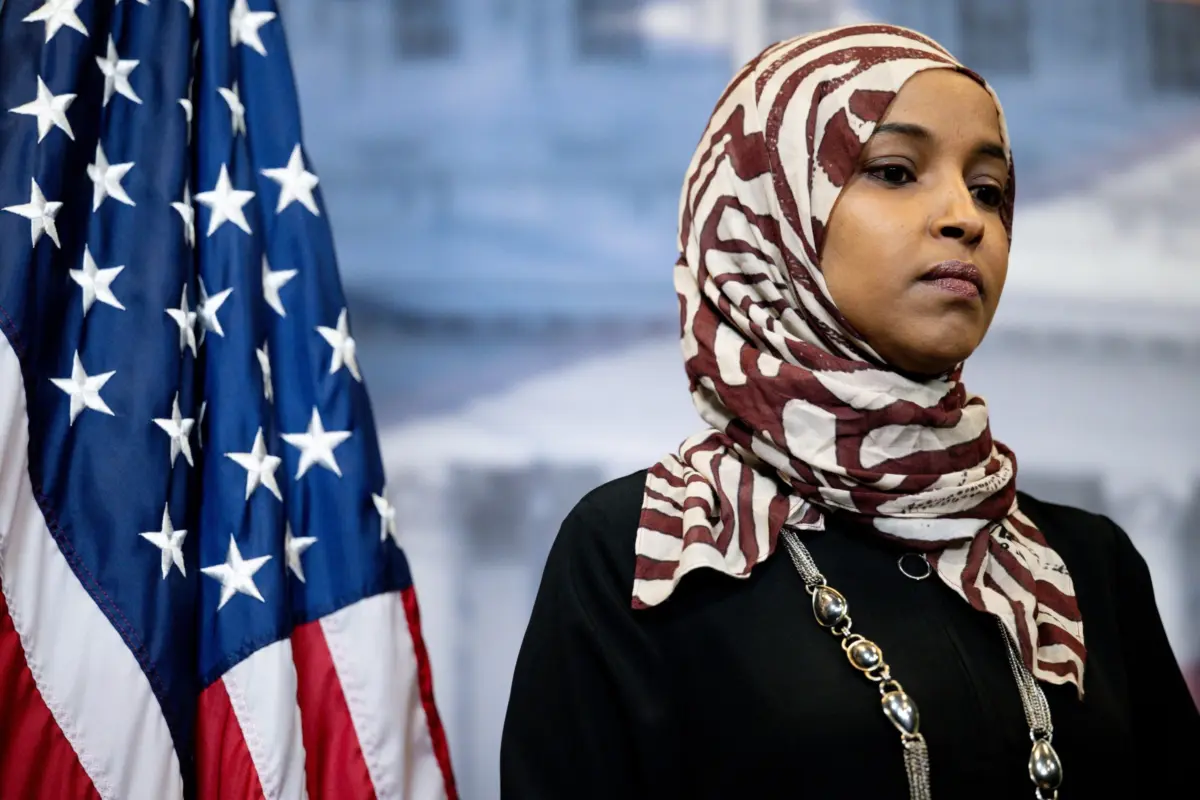
Executive Overview
In what legal scholars and civil rights advocates are calling an unprecedented escalation of executive power, federal law enforcement officers executed a high-profile raid on the Washington, D.C., residence of U.S. Representative Ilhan Omar (D-MN). The operation, conducted by Homeland Security personnel, marks a stunning departure from historical norms governing the separation of powers and the traditional independence of the American judicial system.
Subsequent investigative reporting by major outlets, including The Wall Street Journal, has revealed that the raid was not an isolated administrative inquiry, but rather a tactical component of a coordinated, multi-agency initiative. The ultimate objective of this campaign is to strip the Minnesota congresswoman of her U.S. citizenship, vacate her congressional seat, and ultimately force her deportation from the United States.
Representative Omar, a Somali-American refugee who arrived in the United States as a young girl fleeing civil war, has long been a vocal critic of Donald Trump and his administration’s policies. Her status as a prominent progressive legislator and a symbol of modern American pluralism has made her a frequent target of political animus. However, utilizing the formidable machinery of the Department of Justice (DOJ) and the Department of Homeland Security (DHS) to target a sitting member of the federal legislature for denaturalization crosses a historic political and constitutional Rubicon.
Read Also
This development does not occur in a vacuum. Throughout the current administration, the systematic repurposing of traditionally nonpartisan federal agencies to investigate, harass, and punish political adversaries has become a defining characteristic of governance. If the federal government succeeds in deploying denaturalization as a political weapon against an elected federal official, it fundamentally alters the social contract of American democracy. It establishes a chilling precedent wherein constitutional rights, including the foundational right to citizenship, are no longer permanent guarantees under the rule of law, but rather conditional privileges subject to the political goodwill of the executive branch.
Detailed Chronology of Events
The unfolding legal and political crisis involving Representative Omar began with a sudden, forceful intervention at her private residence and quickly expanded into a sprawling legal challenge centered on events that occurred decades ago.
The Washington, D.C., Raid
On Monday morning, Homeland Security investigators executed a search warrant at the Washington, D.C., home of Representative Ilhan Omar. The raid immediately drew intense public scrutiny and widespread condemnation from legal experts due to its blatant disregard for established Justice Department protocols.
Under longstanding DOJ policy designed to protect the integrity of democratic elections, federal prosecutors and law enforcement agencies are explicitly instructed to avoid taking overt, visible investigative steps in politically sensitive cases within 60 days of an election. Bypassing this customary buffer period to execute a dramatic, media-accessible raid on a sitting lawmaker’s home signaled to observers that the administration was prioritizing political optics and urgency over institutional norms.
Uncovering the Core Objective
While the initial hours following the raid were characterized by speculation and defensive posturing from administration defenders, the true scope of the federal operation came to light on Wednesday evening. Citing senior government officials and internal planning documents, The Wall Street Journal reported that the investigation into Omar is explicitly engineered to build a legal case for denaturalization.
According to these reports, federal investigators are scrutinizing immigration paperwork and biographical data submitted by Omar’s family when she was a minor. Omar entered the United States as a refugee at age 12, having spent years in a refugee camp in Kenya following her family’s displacement from Somalia. She became a fully naturalized U.S. citizen at age 17.
The administration’s legal theory reportedly hinges on allegations that Omar or her family members misrecorded or misstated her age and familial relationships on refugee and immigration documents to expedite their resettlement or legal status. By targeting the foundational paperwork of her naturalization process, federal attorneys hope to prove that her citizenship was fraudulently obtained—the primary legal pathway through which the federal government can initiate denaturalization proceedings.
The Judicial Hurdle
Despite the aggressive posture of the executive branch, federal law strictly limits how citizenship can be revoked. The executive branch cannot unilaterally strip a naturalized citizen of their status by administrative decree.
To achieve denaturalization, the Department of Justice must file a formal civil or criminal lawsuit in a federal district court, bearing the heavy burden of proof to demonstrate by "clear, unequivocal, and convincing" evidence that the naturalization was secured through willful misrepresentation or fraud. Consequently, while the raid on Omar’s home served as a dramatic opening salvo, any genuine attempt to revoke her citizenship will require a protracted, highly public courtroom battle that will inevitably reach the Supreme Court.
Supporting Context & Metrics: The Denaturalization Machine
While the targeting of a sitting member of Congress represents an extreme escalation, the legal strategy directed at Representative Omar is part of a broader, systemic effort by the current administration to ramp up denaturalization proceedings across the United States.
A Quiet But Aggressive Priority
Historically, the revocation of U.S. citizenship from naturalized Americans has been an exceedingly rare remedy. It was traditionally reserved for egregious cases involving convicted war criminals, international terrorists, or high-profile perpetrators of massive financial fraud who concealed their identities to enter the country.
However, during the second Trump administration, expanding the scope and volume of denaturalization cases has transformed from a rare judicial tool into a systematic administrative priority. Investigative reports published earlier this year by outlets including NBC News and The New York Times revealed that the DOJ has quietly established specialized units dedicated entirely to identifying, investigating, and prosecuting foreign-born American citizens for historical discrepancies in their immigration files.
Scaling Up the Numbers
Internal agency metrics and whistleblowers indicate that the administration established ambitious internal benchmarks for denaturalization filings. Earlier this year, the DOJ targeted hundreds of individuals for potential citizenship revocation, with internal memos outlining goals to ramp up filings to hundreds of new cases per month.
Legal aid organizations, immigrant advocacy groups, and constitutional scholars have raised immediate alarms over this statistical surge. Critics note that combing through decades-old immigration paperwork—which is frequently complicated by the chaotic record-keeping inherent to war zones, refugee camps, and displaced populations—inevitably exposes naturalized citizens to retrospective scrutiny for minor, immaterial administrative errors.
While the administration has faced significant procedural hurdles and judicial skepticism in lower federal courts when attempting to scale up these operations, the sheer volume of resources dedicated to the initiative demonstrates a coordinated campaign to test the legal boundaries of citizenship security in America.
Official Statements and Institutional Reactions
The revelation of the federal investigation into Representative Omar has ignited a firestorm of political debate, dividing lawmakers along stark partisan lines and prompting urgent warnings from legal scholars and human rights defenders.
Congressional Response and Defense of Institutional Norms
Democratic leadership and numerous progressive and moderate lawmakers rallied swiftly around Representative Omar, condemning the investigation as an authoritarian abuse of state power.
In a joint statement released shortly after The Wall Street Journal report, congressional leaders characterized the raid and denaturalization effort as an existential threat to the legislative branch’s independence. "When the executive branch uses the coercive power of the federal police state to target, investigate, and attempt to deport a duly elected member of Congress simply for exercising her First Amendment rights and criticizing the president, we are no longer operating within the bounds of a constitutional republic," the statement read.
Defenders of Representative Omar have also highlighted the xenophobic undertones of the administration’s campaign. As a Muslim, Black, and naturalized refugee woman, Omar has frequently been the target of racially charged rhetoric from political opponents who have questioned her belonging in American civic life. Legal advocates argue that targeting her citizenship directly operationalizes these political grievances through the legal system.
Administration Justifications and Counter-Arguments
Conversely, defenders of the administration and administration officials have defended the investigation as a routine application of the law, arguing that no individual—regardless of their political office—should be immune from accountability regarding immigration compliance.
Administration spokespersons have framed the inquiry as a matter of national security and the integrity of the nation’s borders. In press briefings, officials asserted that federal law enforcement has a solemn duty to investigate credible allegations of immigration fraud, regardless of when the alleged infraction occurred or the current political status of the individual involved.
"The rule of law applies equally to all persons residing within the United States," a Department of Justice spokesperson stated in response to inquiries regarding the probe. "If an individual obtained admission or citizenship through fraudulent misrepresentations to federal authorities, the law provides mechanisms to address and correct that violation."
Legal analysts, however, dismiss these justifications as pretexts, pointing to the selective nature of the investigations and the extraordinary departure from standard DOJ operating procedures as clear evidence of political weaponization.
Future Outlook: A Precarious Precedent for American Citizenship
As this high-stakes legal and political drama unfolds, its implications extend far beyond the political future of Representative Ilhan Omar. The case serves as a watershed moment for the conceptual integrity of American citizenship.
The Erosion of Conditional Security
Under the Fourteenth Amendment of the U.S. Constitution, birthright citizens enjoy a nearly inviolable status. However, naturalized citizens hold a status that, while legally equivalent in terms of rights and responsibilities, has historically been viewed as theoretically vulnerable to revocation in cases of extreme fraud. By weaponizing this theoretical vulnerability into an active, large-scale political weapon, the administration is transforming naturalized citizenship into a second-class legal status.
If the executive branch establishes the precedent that political opponents can be subjected to retroactive immigration audits and denaturalization proceedings, the fundamental security of millions of naturalized Americans is compromised. Millions of immigrants who came to the United States seeking refuge, built lives, contributed to the economy, and swore allegiance to the Constitution now face the unsettling reality that their right to remain in their homes may depend on the shifting political winds of Washington.
The Broader Political Landscape
Beyond immigration law, the investigation into Omar highlights the accelerating deterioration of institutional norms within American governance. The systematic bending of nonpartisan law enforcement agencies to serve partisan political ends undermines public trust in the fundamental fairness of the justice system.
Whether the DOJ ultimately succeeds in convincing a federal court to strip Representative Omar of her citizenship remains to be seen. The legal hurdles are immense, and the evidentiary standards required for denaturalization are rigorous. Nevertheless, the mere initiation of the process represents a crossing of a dangerous threshold. It signals that the guardrails protecting political opponents from state-sponsored harassment have been severely compromised, moving the United States toward a political reality where fundamental rights are granted not by the permanence of the rule of law, but by the transient goodwill of those who hold executive power.





Comments
Facebook App ID not configured. Please add it in the Customizer.