
Executive Overview
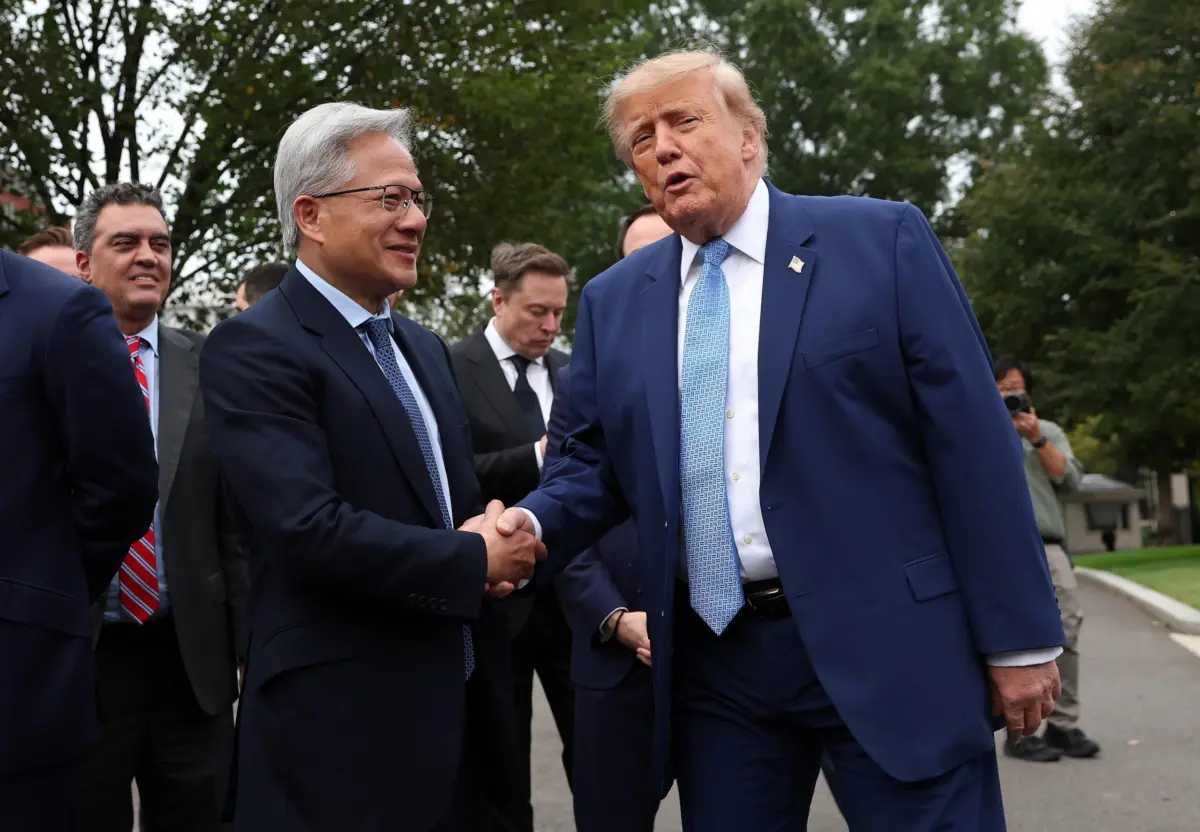
In an unprecedented display of direct presidential intervention in corporate governance, President Donald Trump personally rescued the artificial intelligence sector from a deepening leadership crisis over the weekend, paving the way for Jensen Huang to
reclaim his position as the Chief Executive Officer of Nvidia. Huang, who had stepped down less than two weeks prior amid a cascade of damaging personal scandals—including multiple alleged affairs, one reportedly involving a suspected Chinese intelligence operative—resumed his post at the helm of the world’s most critical semiconductor manufacturer on Monday morning.
The dramatic reinstatement followed a direct phone call from President Trump into an emergency Nvidia board meeting over the weekend. During the call, the president reportedly offered sweeping personal and political "assurances" regarding ongoing legal and national security liabilities swirling around Huang’s private conduct.
Read Also
The move marks a stark, watershed moment in modern American political-economic history. Never before has a sitting U.S. president so nakedly bypassed traditional institutional guardrails to exert direct influence over the leadership structure of a publicly traded American mega-corporation. Yet, for Trump, Elon Musk, and a vocal contingent of Silicon Valley’s techno-right allies, the decision was viewed as an urgent necessity.
Nvidia is not merely a hardware manufacturer; it has evolved into the absolute linchpin of the global technology economy. Functioning simultaneously as the primary architect of cutting-edge AI silicon and the financial engine powering major artificial intelligence research laboratories through complex capital-sharing schemes, Nvidia’s stability is inextricably linked to the broader macroeconomic health of the United States. Huang’s return instantly galvanized Wall Street, triggering a sharp relief rally on Monday morning and temporarily staving off a looming correction in the tech-heavy equities markets.
However, this high-stakes political rescue does not come without profound costs. By elevating market stability and personal relationships above severe, unresolved national security investigations, the White House has invited intense scrutiny. With Huang scheduled to testify before the U.S. Senate next week—and facing aggressive oversight from newly empowered Democratic congressional majorities—the saga surrounding Nvidia’s iconic leader is far from over. What began as a corporate ethics scandal has rapidly escalated into a constitutional and geopolitical flashpoint.
Detailed Chronology: From Resignation to Presidential Rescue
The sequence of events leading to Jensen Huang’s stunning return to Nvidia’s corporate headquarters reads like a Silicon Valley political thriller, compressing months of geopolitical tension and corporate crisis into less than a fortnight.
The Fall: Scandal and Resignation
The turmoil began roughly two weeks ago when investigative reports surfaced detailing multiple alleged extramarital affairs involving Huang. Among the revelations was an alleged romantic entanglement with a woman suspected by counterintelligence officials of having ties to Chinese state security agencies.
For a company operating at the absolute bleeding edge of national security, military dual-use technologies, and advanced semiconductor design, the allegations struck like a thunderbolt. The revelation that the chief executive of the nation’s most vital technological asset may have exposed himself to foreign compromise triggered immediate alarm bells within the intelligence community, the Department of Commerce, and the Department of Defense.
Facing mounting pressure from institutional investors, independent board members, and regulatory watchdogs, Huang abruptly tendered his resignation. Wall Street reeled, and technology stocks suffered a broad-based sell-off as analysts tried to fathom an artificial intelligence landscape devoid of the man universally credited with building its foundational infrastructure.
The Vacuum and Market Tremors
In the immediate wake of Huang’s departure, Nvidia attempted to project stability through interim leadership, but the vacuum was immediately felt. Market analysts warned of an impending "perfect storm"—a convergence of tightening export controls, overextended capital expenditure cycles by major cloud providers, and the sudden evaporation of leadership confidence.
Nvidia’s unique business model relies heavily on its role as what financial analysts term the "central bank of AI." Beyond selling the H100, B200, and subsequent generations of graphics processing units (GPUs) that power every major frontier model, Nvidia has systematically deployed multi-billion-dollar financing arrangements and equity stakes to keep cash-burning foundational research labs—such as OpenAI, Anthropic, and various autonomous vehicle startups—solvent and heavily reliant on Nvidia hardware. Without Huang at the helm to broker these complex, high-stakes maneuvers, institutional confidence began to fracture.
The Weekend Intervention
Recognizing the systemic risk to both the technology sector and the broader equity markets, Trump’s inner circle—bolstered by vocal interventions from billionaire tech entrepreneur Elon Musk and other prominent figures in the administration’s orbit—urged swift executive action.
Over the weekend, as the Nvidia board convened in an emergency session to chart the company’s future, President Trump dialed directly into the proceedings. According to sources familiar with the call, the president delivered an unequivocal message of support, offering direct political and regulatory assurances that the administration would insulate the company from the fallout of ongoing security reviews.
The intervention proved decisive. Reassured by the highest levels of executive power that federal regulatory actions, export restrictions, and national security probes would not impede Huang’s tenure, the board reversed its previous stance. By Monday morning, Jensen Huang was back in the CEO’s chair, ready to steer the ship once more.
Supporting Context & Metrics: The "Indispensable Man" and the AI Economy
To understand why a sitting American president would risk political capital to rescue a corporate executive from a personal scandal, one must examine the staggering systemic importance of Jensen Huang and the company he built.
The Central Bank of AI
Nvidia’s dominance over the global artificial intelligence boom is absolute. While competitors like Advanced Micro Devices (AMD), Intel, and a slew of custom application-specific integrated circuit (ASIC) projects from hyperscalers like Google, Amazon, and Microsoft have attempted to chip away at its market share, Nvidia maintains an estimated 80% to 90% stranglehold on the market for high-performance AI training and inference silicon.
+-----------------------------------------------------------------+
                    THE NVIDIA AI ECOSYSTEM
+-----------------------------------------------------------------+

         +---------------------------------------------+
         |            NVIDIA (Jensen Huang)            |
         |    - Advanced GPU & Silicon Architecture    |
         |    - "Central Bank of AI" Financing Engine  |
         +---------------------------------------------+
                                |
         +----------------------+----------------------+
         |                                             |
         v                                             v
+-----------------------------+               +-----------------------------+
|    AI Research Labs         |               |    Hyperscale Cloud         |
|    (OpenAI, Anthropic, etc.)|               |    (Microsoft, Google, etc.)|
|    - Relies on Nvidia Chips |               |    - Massive Cluster Builds |
|    - Capital-Sharing Deals  |               |    - Infrastructure Spend   |
+-----------------------------+               +-----------------------------+
However, Nvidia’s influence extends far beyond hardware manufacturing. Through structured financial investments—pumping tens of billions of dollars directly into the AI ecosystem—Nvidia has engineered a self-sustaining loop of demand. Companies receive billions in backing from Nvidia, only to turn around and spend the vast majority of those funds purchasing Nvidia’s own high-end GPUs.
This complex financial architecture has led financial commentators to dub Nvidia the "central bank of AI." If the central bank stumbles, the entire financial superstructure underpinning the generative AI boom threatens to collapse in on itself, potentially wiping out trillions of dollars in market capitalization across the tech sector.
Market Reaction and Economic Stabilization
The immediate economic response to Huang’s reinstatement underscored his irreplaceable status. Within minutes of the Monday morning opening bell, Nvidia shares surged, lifting major indexes—including the S&P 500 and the Nasdaq Composite—out of their pre-market slump.
For the Trump administration, which has closely tied its political fortunes to the health of the stock market and American technological supremacy over geopolitical rivals like China, Huang’s return was seen as a macroeconomic imperative. Letting the nation’s premier chipmaker founder over personal misconduct was deemed an unacceptable luxury in an era of fierce global competition for technological hegemony.
Official Statements and Institutional Reactions
The unprecedented nature of the White House intervention has triggered sharp, polarized reactions across Washington, Wall Street, and the broader technology landscape.
The Administration and Silicon Valley Allies
Supporters of the move, both within the White House and across Silicon Valley’s libertarian and techno-nationalist wings, defended the president’s actions through the lens of national security and economic pragmatism.
"In the middle of a generational tech race against our foreign adversaries, America cannot afford to bench its most valuable players over puritanical distractions," noted an administration official speaking on condition of anonymity.
Elon Musk, a close ally of the president and an influential voice in tech policy discussions, echoed similar sentiments on social media, emphasizing that maintaining technological dominance in artificial intelligence supersedes personal conduct evaluations. From this perspective, Huang is viewed as a strategic national asset whose operational genius cannot be easily replaced by a bureaucratic succession process.
Congressional Alarm and Institutional Critics
Conversely, legal scholars, government watchdogs, and congressional leaders have raised severe ethical and national security alarms regarding the president’s direct involvement in corporate reinstatement.
Critics point out a profound hypocrisy and potential conflict of interest: an administration that has frequently railed against corporate foreign entanglements and security risks has actively intervened to protect an executive directly implicated in potential foreign intelligence exposure.
Furthermore, legal experts argue that the president’s actions blur the traditional boundaries between the executive branch and private enterprise, establishing a dangerous authoritarian precedent where corporate leadership is determined not by boards of directors and shareholder votes, but by presidential fiat and personal loyalty to the executive.
Future Outlook: Congressional Reckoning and Regulatory Headwinds
While Jensen Huang’s immediate return has successfully soothed jittery equity markets and stabilized Nvidia’s day-to-day operations, the fundamental controversies surrounding his tenure have not vanished—they have merely been postponed.
The Upcoming Senate Hearings
The true reckoning for Huang and his corporate defenders is scheduled for next Thursday, when the embattled CEO is slated to testify before a joint session of congressional committees on Capitol Hill.
Following recent midterm electoral shifts that have secured Democratic majorities in both the House and the Senate, lawmakers are sharpening their knives. The upcoming hearings are expected to probe deeply into:
- The precise nature of Huang’s alleged relationships and whether any proprietary or classified Nvidia technology was compromised.
- The extent of communications between the White House and Nvidia’s board of directors during the weekend intervention.
- The systemic antitrust and financial stability risks posed by Nvidia’s dominant financing schemes within the artificial intelligence sector.
Navigating a Bipartisan Minefield
As Huang steps back onto the public stage, he faces an extraordinarily narrow path forward. He must successfully convince skeptical lawmakers—many of whom view Big Tech with deep suspicion—that his personal indiscretions pose no ongoing threat to American security, all while managing an increasingly complex regulatory landscape marked by tightening U.S. export restrictions on advanced semiconductors to China.
For President Trump, the gamble is equally high. By personally guaranteeing Huang’s viability, the White House has tethered its own credibility to Huang’s future performance and integrity. Should further revelations emerge during next week’s congressional testimony, or should national security agencies uncover genuine compromises, the political fallout could prove devastating for an administration that staked its economic reputation on a weekend phone call.
For now, the artificial intelligence industry breathes a collective sigh of relief, its "indispensable man" safely back at the helm. But as Wall Street celebrates the return of market normalcy, Washington is bracing for what promises to be one of the most explosive congressional confrontations of the decade.





Comments
Facebook App ID not configured. Please add it in the Customizer.