The global contemporary art market is experiencing a structural realignment, and at the epicenter of this shift is the enduring influence of African creativity. In October 2026, the prestigious 1-54 Contemporary African Art Fair returned to London’s historic Somerset House for its milestone 14th edition. Gathering international collectors, curators, and institutions, this year’s iteration transcends the traditional bounds of a commercial art fair. Instead, it operates as both a marketplace and a museum-grade institution, boldly addressing historical gaps in the art market and celebrating the breadth of the African diaspora’s artistic output.
Most notably, the 2026 edition introduces an ambitious, dedicated section focusing on African modernism. Curated by acclaimed art historian Nancy Dantas and titled “West Wind,” this special presentation directly responds to a major institutional retreat: Sotheby’s closure of its dedicated African modernism department in 2025. By stepping into this market and intellectual vacuum, 1-54 has asserted itself not merely as a platform for contemporary sales, but as a vital custodian of 20th-century art history. Featuring legendary mid-century masters alongside contemporary innovators, the fair illustrates an unbroken lineage of aesthetic experimentation, political liberation, and cultural self-determination.
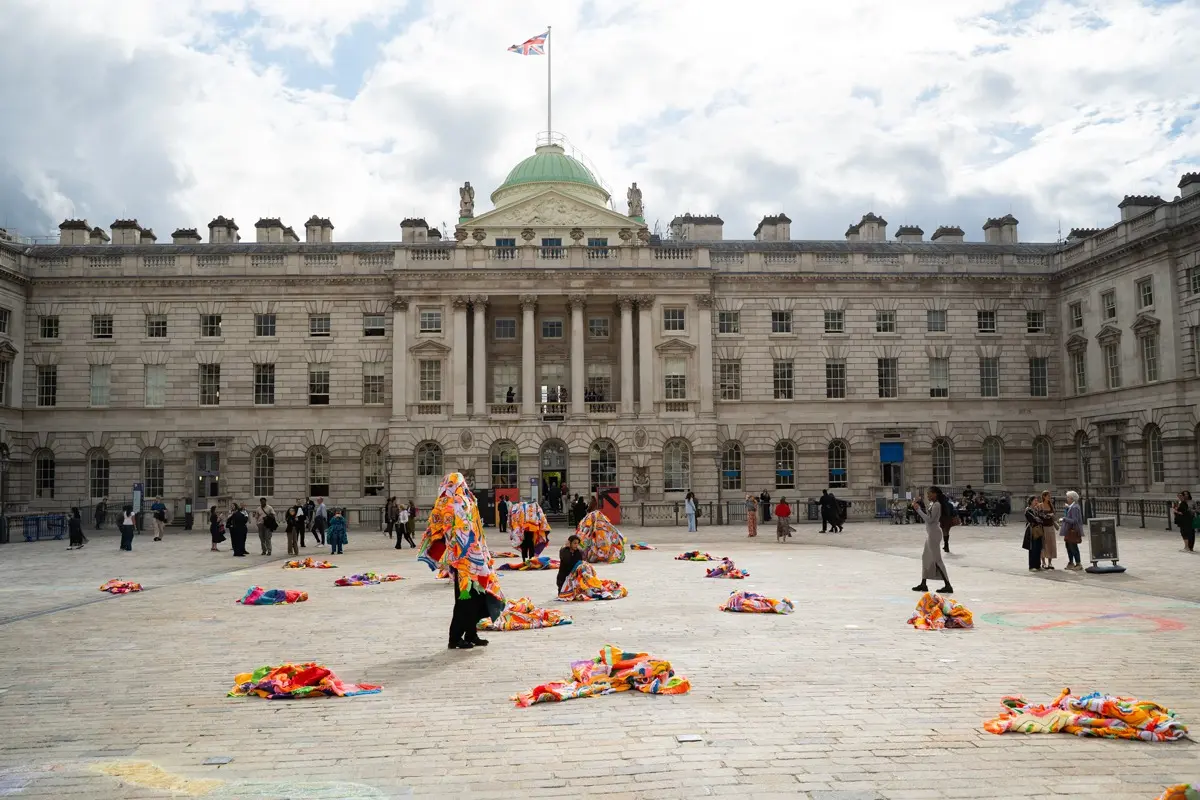
Running through Sunday at Somerset House, the 14th edition showcases a carefully curated selection of international galleries, pushing the discourse surrounding African art into new territories. From the sunlit neoclassical courtyards of Somerset House to the intimate, high-stakes gallery booths inside, this year’s fair is a masterclass in how commercial platforms can champion historical preservation, elevate marginalized narratives, and command global market attention.
Detailed Chronology: From Grassroots Vision to Global Pillar
To understand the weight of the 14th edition of 1-54, one must trace its evolution from a visionary startup to an irreplaceable fixture in the international art calendar. Founded by Touria El Glaoui in 2013, the fair was conceived as a direct corrective to the systemic underrepresentation of African and diaspora artists within mainstream Western art fairs and auction houses.
The Formative Years (2013–2018)
In its inaugural years, 1-54 faced an art market that largely pigeonholed African art into reductive, ethnographic categories. By establishing its flagship home at Somerset House in London—and later expanding to international editions in New York, Marrakech, and temporarily Paris—El Glaoui created a borderless platform. The fair prioritized curatorial rigor, inviting prominent independent curators to design special projects, execute site-specific installations, and foster critical discourse. During this period, 1-54 transformed from a boutique alternative fair into a primary destination for blue-chip collectors seeking authentic engagement with the continent’s dynamic art ecosystems.
The Institutional Pivot and Expansion (2019–2024)
As global demand for contemporary African art surged, 1-54 served as the launching pad for numerous artists who now command international museum exhibitions and record-breaking auction prices. The fair adapted by expanding its physical footprint at Somerset House, integrating performance art into its daily programming, and forging partnerships with major institutions like Tate Modern, the Victoria and Albert Museum, and the Serpentine Galleries. However, as the market for contemporary works matured, industry observers noted a persistent blind spot: while contemporary African artists were enjoying unprecedented market success, the foundational mid-century modernists who paved the way were frequently overlooked by major Western auction houses and mainstream galleries.
The 2025 Market Disruption and the 2026 Renaissance
The turning point for the current 14th edition occurred in 2025, when international auction giant Sotheby’s shuttered its dedicated African modernism department. This corporate withdrawal threatened to cast mid-20th-century African art back into the shadows of art history, leaving institutional gaps in scholarship, authentication, and market visibility.
Rather than letting this vital era of art history recede, 1-54’s leadership and curator Nancy Dantas seized the moment. The conceptualization and realization of the “West Wind” section at the 2026 London fair represent a deliberate, high-stakes intervention. Named after and inspired by Miriam Makeba’s iconic 1966 political anthem for unity, “West Wind” rectifies the market oversight left by major auction houses. By bringing museum-quality modernist works to a commercial fair setting, the 14th edition bridges the historical chasm between 20th-century liberation movements and 21st-century contemporary expressions, establishing a definitive chronology of artistic resilience.
Supporting Context & Metrics: The Shift in the Global Art Market
The launch of the “West Wind” section at the 14th edition of 1-54 occurs against a backdrop of sweeping macroeconomic and cultural shifts within the global art market. For decades, the secondary market for African art suffered from a lack of institutional infrastructure, reliable price indices, and academic cataloging. However, metrics from the past five years indicate a profound structural transformation.
Market Valuation and Institutional Demand
According to recent cultural economy reports, auction sales of contemporary African art have grown exponentially over the past decade, outpacing several traditional collecting categories in terms of compound annual growth rate (CAGR). Yet, this growth has historically been concentrated in contemporary works created by living artists born after 1970. Mid-century modernism—produced during the tumultuous and inspiring era of African decolonization spanning the 1950s through the 1970s—remained undervalued and under-researched outside of a handful of specialized galleries and regional institutions in Cairo, Dakar, and Johannesburg.
When Sotheby’s dissolved its dedicated African modernism department in 2025, market analysts feared a chilling effect on liquidity and institutional acquisition. The concern was that collectors would lose confidence in the asset class, and estates of late modernist masters would struggle to find global platforms.
The Interventional Impact of "West Wind"
The inclusion of "West Wind" at 1-54 London directly counters this contraction. By gathering masterworks by mid-century luminaries such as Sudanese pioneer Ibrahim El-Salahi, Mozambican modernist Bertina Lopes, and Cameroonian ceramic sculptor Seyni Awa Camara, the fair provides immediate market validation and scholarly framing.
Geographic Diversity: The galleries participating in 1-54 represent an increasingly decentralized network. Over 40% of the exhibiting galleries are based on the African continent itself—spanning Lagos, Casablanca, Accra, Nairobi, and Cape Town—ensuring that economic benefits and cultural stewardship remain anchored in home markets.
Museum Acquisitions: In previous editions, museum groups from the Tate, the Museum of Modern Art (MoMA) in New York, and the Centre Pompidou have utilized 1-54 as a primary sourcing ground. The introduction of blue-chip modernist works in 2026 is expected to drive accelerated institutional acquisitions, as international curators seek to fill historical gaps in their permanent collections.
Audience Engagement: Somerset House continues to report record-breaking foot traffic for the fair’s run, with public attendance increasing year-on-year by an estimated 12% to 15%, driven by a demographic of younger, highly diverse collectors and art enthusiasts.
Official Statements and Curatorial Vision
The intellectual and artistic integrity of the 14th edition is anchored by the collaborative vision of fair founder Touria El Glaoui and guest curator Nancy Dantas. Their statements illuminate the urgency, purpose, and emotional resonance driving this year’s presentations.
Reflecting on the milestone 14th edition and the launch of the modernist initiative, Touria El Glaoui emphasized the fair’s foundational mission:
"When we launched 1-54 fourteen years ago, our goal was singular: to create an uncompromised, world-class platform that dismantled the geographical and market boundaries restricting African artists. Today, as we witness shifting institutional priorities globally, our responsibility has only deepened. We are not just showcasing the art of the present; we are reclaiming the art of the past to secure the integrity of our cultural future. The ‘West Wind’ section is a testament to our unwavering commitment to historical truth and artistic continuity."
Curator Nancy Dantas elaborated on the conceptual framework of the "West Wind" exhibition, drawing a direct line between mid-century socio-political liberation and contemporary aesthetic expression:
"Naming this presentation after Miriam Makeba’s 1966 anthem was deliberate. Makeba’s voice carried a message of continental unity, resistance, and unyielding dignity during a time when nations across Africa were shaking off the shackles of colonial rule. The artists we are featuring—El-Salahi, Lopes, Camara, and their contemporaries—were working within that exact historical vortex. They were inventing visual vocabularies that declared independence from European academic traditions. When major auction houses retreat from this history, it is up to platforms like 1-54 to step into the breach, ensuring that these monumental figures are neither forgotten nor undervalued in the global canon."
Participating gallerists have similarly praised the fair’s fearless pivot. Several dealers exhibiting within the top booths noted an unprecedented surge of interest from private collectors eager to acquire historical modernist pieces that contextualize the contemporary works dominating today’s market.
Future Outlook: The Next Decade of 1-54 and African Art Hegemony
As the 14th edition of the 1-54 Contemporary African Art Fair concludes its run at Somerset House, art market experts are already looking toward the horizon. The success of this year’s fair—particularly the triumph of the "West Wind" modernist section—signals a permanent evolution in how the global art ecosystem values African creativity.
1. Institutional Permanence and Secondary Market Growth
The vacuum left by corporate auction houses in 2025 has effectively been filled by independent, highly specialized commercial platforms like 1-54. By proving that a commercial fair can successfully curate, contextualize, and sell museum-grade 20th-century modernist works, 1-54 has laid the groundwork for a more robust, independent secondary market for African art. In the coming years, we can anticipate the establishment of dedicated private foundations, regional research archives, and specialized galleries aimed exclusively at preserving and promoting mid-century African modernism.
2. Decentralization of the Global Art Capital
For decades, the trajectory of African art required validation from Western art capitals—New York, London, and Paris. However, the economic and cultural infrastructure being built across the African continent is rapidly decentralizing the art world. With vibrant local hubs in Lagos, Marrakech, Dakar, and Johannesburg driving primary market production, international fairs like 1-54 act as vital bridges rather than gatekeepers. The future will likely see increased cross-continental collaborations, artist-run spaces, and South-South economic exchanges that bypass traditional Western markets entirely.
3. Educational Outreach and Next-Generation Stewardship
A core pillar of 1-54’s future strategy involves educational programming, mentorship, and curatorial training. By fostering the next generation of African art historians, critics, and curators—exemplified by the leadership of Nancy Dantas—the fair ensures that the narrative surrounding African art is authored, interpreted, and protected by voices from the continent and its diaspora.
In summary, the 14th edition of the 1-54 Contemporary African Art Fair at Somerset House will be remembered as a watershed moment. By refusing to let historical narratives be erased by corporate retrenchment, and by boldly uniting the radical visions of mid-century masters with the vibrant energies of contemporary creators, 1-54 has cemented its status not merely as a fair, but as an indispensable pillar of global art history.





Comments
Facebook App ID not configured. Please add it in the Customizer.