
Executive Overview
In the contemporary landscape of global cinema, international film markets are routinely dominated by predictable formulas, domestic comfort zones, and risk-averse distribution models. Yet, every generation, an independent feature emerges to shatter these structural limitations, proving that visionary world-building transcends linguistic and geographic borders. Enter Rains Over Babel, Colombia’s official submission for Best International Feature at the 99th Academy Awards.
Directed with breathless audacity by twenty-something filmmaker Gala del Sol, Rains Over Babel is an intoxicating, genre-defying cinematic mosaic. Described by critics as a queer Latin American reimagining of Dante’s Inferno, the film weaves together intersecting narratives that are simultaneously campy and cool, deeply heartfelt, and delightfully bonkers. The plot follows a motley crew of characters: a deputy grim reaper (Felipe Aguilar Rodriguez) frantically scheming to clear his debts to an unforgiving boss (Saray Rebolledo); a drag queen—who may or may not be an incarnation of Jesus Christ (William Hurtado)—wrestling with his devout, overbearing preacher father (Jhon Narváez); and an underground rescue mission aimed at extracting a singer (Jacobo Vélez) from a hellish, hedonistic sex club. Guiding audiences through this kaleidoscope are fourth-wall-breaking narrators: the devil, El Boticario (Santiago Pineda), and the guardian angel Erato (Sofia Buenaventura).
Despite being an independent production crafted on a modest budget, Rains Over Babel has evolved into an international phenomenon. It has conquered global film festival circuits, achieved a staggering 14-week theatrical run across 23 countries, and earned critical adoration that recently brought its director to the hallowed halls of Pixar and Lionsgate. As Gala del Sol embarks on her awards-season press tour, she sits down to discuss the arduous road to distribution, the defiant power of queer South American fantasy, and her ambitious blueprint for an interconnected "Gala del Sol universe."
Read Also
Detailed Chronology: From Sundance Breakthrough to Global Distribution
The journey of Rains Over Babel from an unexpected midnight screening to an Oscar contender is a masterclass in independent perseverance. The film’s trajectory began in January 2025 at the Sundance Film Festival, where it caught the attention of audiences seeking a vibrant antidote to a turbulent sociopolitical climate. For many queer viewers in the United States, January 2025 marked a period of profound anxiety and political regression. Dropping into this tense cultural moment, the joyous, unapologetic fantasy of Rains Over Babel offered a vital emotional release.
Yet, despite its immediate critical acclaim in Park City, the film faced an uphill battle in securing a U.S. theatrical release. Risk-averse distribution executives balked at what they perceived as a "double-niche" property: a Spanish-language film centered around explicitly queer themes.
"We got a bunch of nos from the U.S.," recalls del Sol during her awards-season press tour. Major studios and indie distributors alike feared the commercial viability of a South American fantasy project. However, the film’s international appeal quickly eclipsed domestic hesitation. While the U.S. market remained largely closed off, Rains Over Babel found enthusiastic theatrical distribution in 23 countries across the globe. It secured prominent streaming homes via HBO Max in Europe and FILMIN in Spain, gradually building an impassioned grassroots following.

The true turning point occurred on April 16, 2025, when the film finally premiered in commercial theaters in Colombia. Conventional industry wisdom predicted a short, two-week theatrical window before the film would quietly fade into obscurity. Instead, Rains Over Babel defied all projections, maintaining a dominant commercial presence for an astonishing 14 weeks.
"The industry maybe has a limiting belief about the reach of LGBTQIA+ stories, and I think we defied that," del Sol reflects. When major executives eventually called her production team asking how they achieved such longevity, the answer was rooted in direct, community-driven engagement. Eschewing traditional, sterile marketing campaigns, del Sol personally spearheaded social media outreach, interacting directly with fans, answering questions, and fostering a digital community.
This grassroots momentum translated into unprecedented audience devotion. Viewers returned to cinemas four, five, and even six times to unpack the film’s dense visual layers. One dedicated fan went so far as to see the film nine times, eventually becoming a close personal friend of the director. This collective word-of-mouth campaign proved that the audience for sophisticated, queer South American speculative fiction is not merely a niche demographic—it is a vast, underserved market hungry for representation.
Supporting Context & Metrics: Redefining South American Cinema
The historic run of Rains Over Babel challenges deeply entrenched systemic biases within the global film industry. For decades, traditional gatekeepers have propagated the limiting belief that South American cinema must adhere to specific socio-realist paradigms—that regional films must focus heavily on systemic violence, poverty, or gritty historical drama to be considered "prestigious." Furthermore, industry financiers have long argued that high-concept fantasy and science fiction are prohibitively expensive for Latin American production houses.
Rains Over Babel systematically demolishes these false dichotomies. By blending heavy, substantive themes—such as religious repression, existential guilt, and queer marginalization—with the vibrant aesthetics of magical realism and campy dark comedy, del Sol proves that genre storytelling can elevate serious discourse rather than diminish it.
Aesthetic Philosophy: Tropical Punk and Retrofuturism
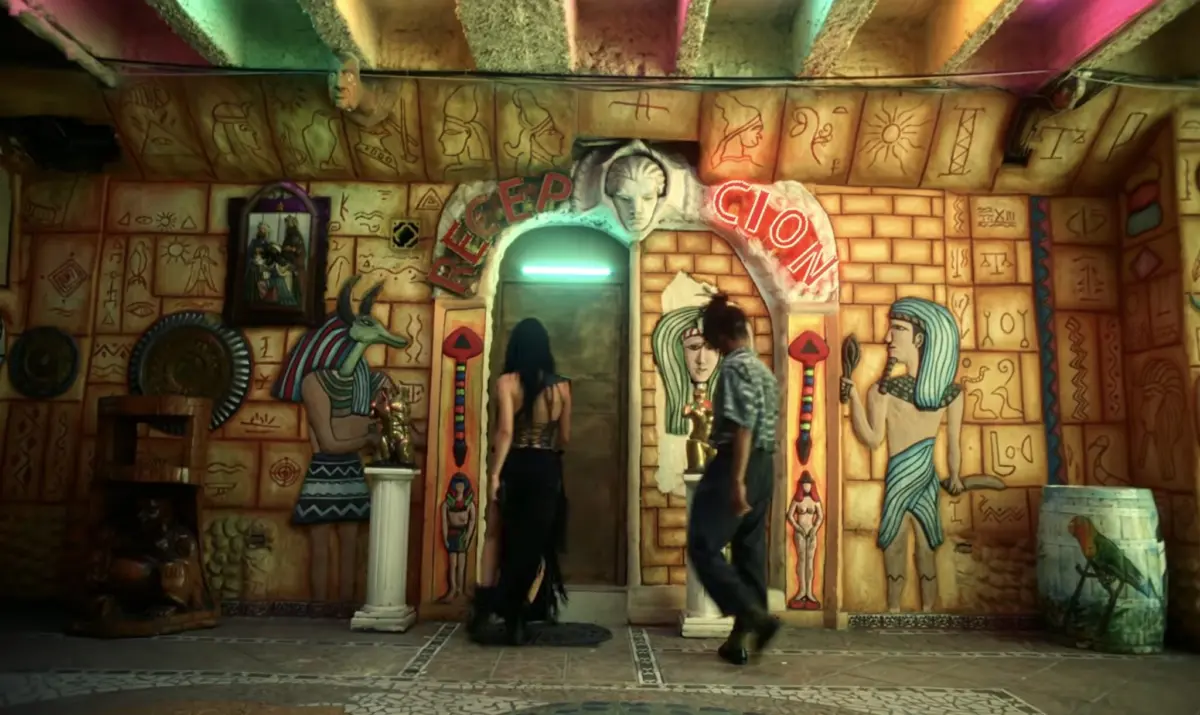
The visual identity of Rains Over Babel is an achievement in world-building, born directly from the director’s subconscious. Del Sol describes her distinctive stylistic framework as "retrofuturistic tropical punk" or "tropical steampunk."

Drawing heavily upon the cultural architecture of her hometown of Cali, Colombia—which holds the ironic global distinction of boasting the highest concentration of both motels and churches—del Sol constructs a heightened, parallel dimension where demigods walk among ordinary mortals.
- The Alchemy Workshop: The film opens inside El Boticario’s mystical workshop, a meticulous recreation of Spanish-Mexican surrealist painter Remedios Varo’s masterpiece Harmonia. Complete with alchemical stones, mystical resonance notes, and a library featuring an eye-shaped bed, the set immediately signals to the viewer that normal physical laws do not apply.
- Anachronistic Design: By taking the vibrant, gritty punk aesthetics of the 1990s and "tropicalizing" them through a 1970s retro-lens, del Sol achieves complete artistic freedom. Death is personified not as a terrifying skeletal reaper, but as La Flaca—a stunning, sophisticated woman who gambles human lifespans in seedy, neon-lit bars.
The Animals as Method Actors
One of the most charming anecdotes to emerge from the production concerns the film’s non-human cast. Traditional film production schedules typically dread working with live animals due to unpredictability and time constraints. However, Rains Over Babel upended expectations entirely.
"My ADs scheduled so much time for the animals, and honestly? They were the best actors," del Sol laughs. Featuring a menagerie that included a salamander, a snake, a cat, and even a dwarfism-afflicted horse, the animal cast hit their marks with uncanny precision. "Whenever we hit record, they acted! The lizard opened its eyes and moved a little bit and took out its tongue… It was almost as if they were paid actors."
Official Statements and Industry Validation
The critical momentum of Rains Over Babel has transitioned from indie film festivals to the inner sanctums of Hollywood royalty. In late 2025, the film secured a private screening at Pixar Animation Studios—an surreal experience for a young independent director.
"Someone from Pixar saw it at Sundance, actually, and I get this email from Pixar one day and I think it’s a scam… I didn’t believe it at first," del Sol admits. Presenting the film to veteran animators and artists at Pixar, followed by a subsequent screening at Lionsgate, marked a surreal validation of her artistic vision. During the post-screening Q&A at Pixar, del Sol humorously found herself overwhelmed: "I was doing the Q&A and they were asking me questions, and I was like, ‘I should be asking you guys questions!’"
These institutional nods culminated when the Academy of Colombian Film Arts and Sciences selected Rains Over Babel as the country’s official submission for the 99th Academy Awards in the Best International Feature category, alongside a matching nomination consideration for the prestigious Goya Awards.

Reflecting on the deeper artistic philosophy of her work, del Sol points to the medieval tradition of the bouffon—the court jester who holds a mirror up to power through subversive comedy.
"That’s what I think we can do through genre and that’s the magic of it: it makes the messages more digestible to the audience. You can still talk about heavy subjects, as we do in Rains Over Babel… but we don’t do it through a lens that’s merely melodrama."
Future Outlook: Building the "Gala del Sol Multiverse"
Far from treating Rains Over Babel as a standalone lightning-in-a-bottle success, Gala del Sol is systematically laying the groundwork for an expansive, interconnected cinematic universe. Rooted in the lucid dreams she experienced during her university years—where recurring figures like Boticario and Erato served as her nocturnal guides—her upcoming slate of projects promises to plunge audiences deeper into the surreal architecture of the city of Maya.
Upcoming Projects in the Pipeline
- The Carmilla Adaptation (Tropical Lesbian Vampires):
Set to shoot next year, del Sol’s next directorial feature is a tropicalized adaptation of Sheridan Le Fanu’s foundational 1872 gothic vampire novella Carmilla. Relocating the narrative from an isolated Eastern European castle to a sun-drenched sugarcane hacienda in the fictional tropical city of Maya (specifically set within the twin towns of Sweet Waters and Salty Waters), this film takes place 200 years prior to the events of Rains Over Babel. - The Temple Motel Project:
In co-production with Carlos López Estrada’s Antigravity Academy, del Sol is developing a high-concept psychological thriller set within an underground sex motel named The Temple. The narrative follows two lovers who wake up after a night together only to discover their memories fading. Trapped in a labyrinthine hotel corridor where elevator buttons have vanished except for the subterranean basement levels (starting at floor -7), they must navigate literal physical manifestations of their past memories while being hunted down by an immortal bellboy and his talking crow, Eleazar. If they fail to escape before dawn, they face a terrifying fate: transforming permanently into human-sized wooden puppets.
Conclusion
As Rains Over Babel continues its historic Oscar campaign, it stands as a testament to the revolutionary power of uncompromised creative vision. Gala del Sol has not merely delivered a successful foreign-language indie; she has cracked open the door to a vibrant, untapped frontier of South American speculative fiction. With a dedicated fanbase already cosplaying her characters and a burgeoning cinematic empire on the horizon, the global film industry is officially on notice: the Gala del Sol multiverse is here, and it is reshaping the boundaries of modern cinema.





Comments
Facebook App ID not configured. Please add it in the Customizer.