In the literary landscape of contemporary American poetry, few voices achieve the delicate, unsettling balance between sensory immediacy and deep-seated psychological rumination quite like Gina Franco. On August 3, 2026, The Missouri Review featured Franco’s poem “Still at Work, the Fault Opens” as its Poem of the Week. Pulled from her upcoming, highly anticipated manuscript Throne, this piece offers a masterclass in how language navigates grief, trauma, and the deceptive elasticity of memory.
Franco, an esteemed professor at Knox College who divides her time between Galesburg and Chicago, Illinois, has built a formidable reputation across collections such as The Accidental (winner of the CantoMundo Prize) and The Keepsake Storm. Her work has graced the pages of premier literary journals including AGNI, The American Poetry Review, Narrative, Poet Lore, Poetry, and 32 Poems. Furthermore, her inclusion in the Library of America anthology Latino Poetry—edited by Rigoberto Gonzalez—cements her stature as a vital architect of modern verse.
“Still at Work, the Fault Opens” confronts the reader with a landscape where psychological boundaries blur. The poem moves fluidly between an act of casual cruelty on a street corner and a harrowing, visceral memory of a father plunging into a flooded river to save a drowning woman. By juxtaposing everyday brutality with moments of high-stakes heroism and domestic quietude, Franco explores how the human mind attempts to find closure where none is easily granted. This review-style investigative feature examines the mechanics of Franco’s poetry, the broader thematic ecosystem of Throne, and the critical reception surrounding one of the most striking poems of the 2026 literary calendar.
To understand the immense emotional architecture of “Still at Work, the Fault Opens,” one must trace the winding, associative logic of its narrative progression. Unlike traditional narrative poems that march forward with chronological neatness, Franco’s work behaves much like the human subconscious: associative, recursive, and haunted by returns.
The Threshold and the Window
The poem opens with a speaker standing at a domestic threshold, looking out:
Maybe I shouldn’t have stood at the window watching the boy whip the soft-eared dog with his leash as they passed.
This voyeuristic, static beginning establishes a sense of passive culpability. The speaker, newly risen in a gown, is caught in that liminal fog between sleep and waking, where "the enemy" is no longer easily categorized. Immediately, the internal landscape mirrors the external turbulence: "The mind blows / through the mind with the mouths / of its many heads."
The Memory of the Flood
From this mundane act of cruelty—a boy lashing a dog—the poem plunges downward into the abyss of memory. The vertical axis of the poem becomes dizzying. Below the speaker, a river hangs "by a thread, seamless river, bottomless bed." Above or within this churning space, the speaker’s father surges:
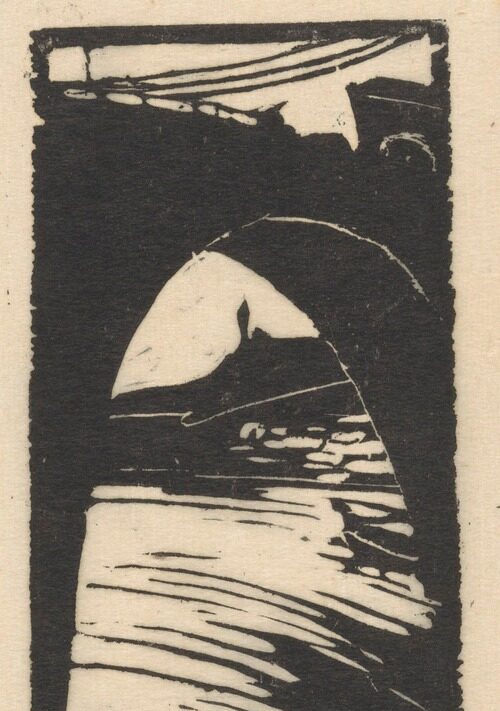
Above it my father surges from the bridge, leaps into brown air where the wind seizes hold of him and blows him back against the girders as he plunges to the flood.
Franco does not offer this rescue as a clean, heroic vignette. It is raw, violent, and messy. The father rises from the water "his pockets flush with glass, his arms filled / with the white-haired woman he’d pulled / from the car sinking fast." The imagery is tactile and unforgiving—mud, glass, rain, sodden banks, and ambulance flares.
The Domestic Aftermath
The transition from the raging river to the quiet, strained domestic sphere is jarring yet seamless. The father is driven home by a medic. His mother’s hands shake mud and glass into the grass. His clothes—symbols of his near-fatal exertion—are stripped off and dropped into the yard like discarded bodies.
Crucially, the poem highlights emotional alienation within the family unit:
Dead, being looked at, he didn’t look at us. As when an enemy afoot will watch without looking. As when my mother, hands at her sides, stood by, and no one took the lead to move.
The Convergence of Past and Present
As the father retreats inside, the poem loops back to the opening vignette. The boy releases the dog, the dog licks the boy’s face in an abrupt, disorienting forgiveness, and they pass out of view. The poem closes with a devastating telescoping of time and trauma, fusing the father’s rescue of the woman with older, unresolved domestic violences:
The fault that opens. My mother, my father, lifting her in arms to throw her, sack over fence, to the bed of the drive. The time she was left to lie unconscious at my feet. Still I stood.
Through this cyclical structure, Franco suggests that trauma is not a linear event to be survived and left behind; it is an open fault line in the earth of the psyche, shifting unpredictably beneath our feet.
To fully appreciate the weight of “Still at Work, the Fault Opens,” it is necessary to examine the broader career and critical reception of Gina Franco. Her work occupies a distinctive space in American letters, bridging lyric poetry, narrative fragmentation, and Southwestern borderland sensibilities.
Published Works and Accolades
The Accidental (University of Arizona Press): Winner of the prestigious CantoMundo Prize, this collection established Franco’s voice as one of rich linguistic texture and deep philosophical inquiry.
The Keepsake Storm: A critically acclaimed exploration of memory, landscape, and inheritance.
Throne (Upcoming Manuscript): The forthcoming collection from which “Still at Work, the Fault Opens” is drawn. According to early commentary, Throne deepens Franco’s exploration of places where historical and personal violence intersect with spiritual yearning.
Latino Poetry (Library of America): Edited by Rigoberto Gonzalez, this landmark anthology features Franco’s widely anthologized poem “The Line,” cementing her place in the canon of foundational American poetry.
Critical Metrics of Publication
Journal Placements: Franco’s work appears with regularity in top-tier literary magazines that maintain rigorous acceptance rates (often below 1%):
AGNI
The American Poetry Review
Narrative Magazine
Poet Lore
Poetry (published by the Poetry Foundation)
32 Poems
Academic Influence: Operating from Knox College in Galesburg, Illinois, while maintaining roots in Chicago, Franco represents a vital midwestern academic-poetic nexus that influences generations of emerging writers.
Official Statements and Authorial Insights
In her official author’s note accompanying the publication of “Still at Work, the Fault Opens” in The Missouri Review, Franco provided profound insight into the psychological underpinnings of her latest manuscript, Throne.
“‘Still at Work, the Fault Opens’ is a poem from my manuscript Throne, and as with many of the poems in the book, it explores experiences where thought seeks closure just as what happened seems both unacceptable and incomprehensible,” Franco explains.
She elaborates on the mechanics of memory and emotional culpability:
“In the poem, thought moves through the knowing and unknowing of what it believes it sees and remembers, what it has felt and has been. If there is a fault at work, it is that some experiences keep opening beyond the mind’s tendency toward foreclosure. Thrown into experiences that leave us feeling culpable yet simultaneously helpless, memory is tempted to find an adversary.”
This commentary illuminates the central tension of the poem: the human impulse to assign blame or locate an "enemy" (whether it is the boy whipping the dog, the storm battering the bridge, or family members standing mutely by) when faced with catastrophes that defy neat emotional accounting. Memory, in Franco’s view, is not a static museum of the past; it is an active, seismic fault line that refuses to stay sealed.
Future Outlook: The Anticipation of Throne
The release of “Still at Work, the Fault Opens” serves as a major bellwether for the contemporary poetry scene, signaling the impending arrival of Gina Franco’s full-length collection Throne. As readers and critics pore over individual poems emerging from this manuscript—such as her features in reviews and literary journals—several key trajectories for her work become clear:
Deepening Engagement with Trauma and Witness: Franco is moving further into the territory of the passive witness. By focusing on the figure standing at the window—watching, remembering, yet unable to intervene—she asks difficult questions about complicity and the burdens of observation.
The Landscape of the American Midwest and Borderlands: While grounded in intellectual and academic rigor, Franco’s imagery retains the dust, riverbeds, and atmospheric weight of her regional touchstones, creating a universal resonance from specific topographical roots.
Continued Canonical Consolidation: With her inclusion in major anthologies like the Library of America’s Latino Poetry and sustained placement in elite journals, Franco is positioned as one of the definitive poetic voices of her generation.
As the literary community awaits the full publication of Throne, “Still at Work, the Fault Opens” stands as a brilliant preview of a poet operating at the absolute height of her powers. It challenges readers to look out their own windows, confront the uneasy currents of their own memories, and acknowledge the deep, persistent faults that continue to open beneath our feet.







Comments
Facebook App ID not configured. Please add it in the Customizer.