Television’s most rigorous superhero psychological study continues to peel back its cosmic onion with the third installment of HBO Max’s critically acclaimed series Lanterns. Entitled "OutKast"—a thematic title that reverberates across racial, familial, and interstellar boundaries—Episode 3 halts the present-day narrative momentum to plunge viewers headfirst into the formative years of John Stewart.
Directed with a clinical, unblinking eye and scripted by Vanessa Baden Kelly, "OutKast" eschews traditional superhero spectacle in favor of a deeply haunting, structural interrogation of duty, generational trauma, and systemic marginalization. Operating out of sequence within the same calendar year as its predecessor, this narrative pivot shifts the spotlight from active planetary threats to the quiet, agonizing recruitment process that forged one of the Green Lantern Corps’ most formidable modern standard-bearers.
Through a deft employment of non-linear storytelling, the episode braids two primary historical arcs: the harrowing military assignment that yielded John Stewart’s dishonorable discharge, and the militant, hyper-disciplined domestic upbringing orchestrated by his parents, Bernadette and John Stewart Sr. As the narrative bridges these domestic training grounds with the cold, bureaucratic halls of Guardian oversight via Lianna (Laura Linney), Lanterns establishes itself as a rare speculative property willing to question the ideological foundations of justice itself.
The episode opens in media res, tracing an unsettlingly physical descent. John Stewart falls multiple stories through the skeletal frame of an abandoned, hollowed-out shopping mall, crashing heavily onto a precarious stack of discarded mattresses. Guided only by a cryptic, upward-pointing industrial arrow, he navigates the decaying infrastructure until he reaches a stark, windowless backroom office.
There, Lianna (Laura Linney), a towering emissary of the immortal Guardians of the Universe, delivers a minimalist directive: sit down and wait. John complies with chilling military precision. He remains stationary in that chair for an entire day and through the grueling expanse of the overnight hours. When Lianna returns the following morning, she registers genuine astonishment at his unflinching adherence to the command.
This endurance test serves as the framing device for a comprehensive autopsy of John’s life. Lianna requires deep, unvarnished insight into his psychological architecture to determine his suitability for a vacant slot in the Green Lantern Corps—an elite, interstellar police force ostensibly sworn to protect the cosmos through the radical absence of fear.
The Original Sins of Recruitment
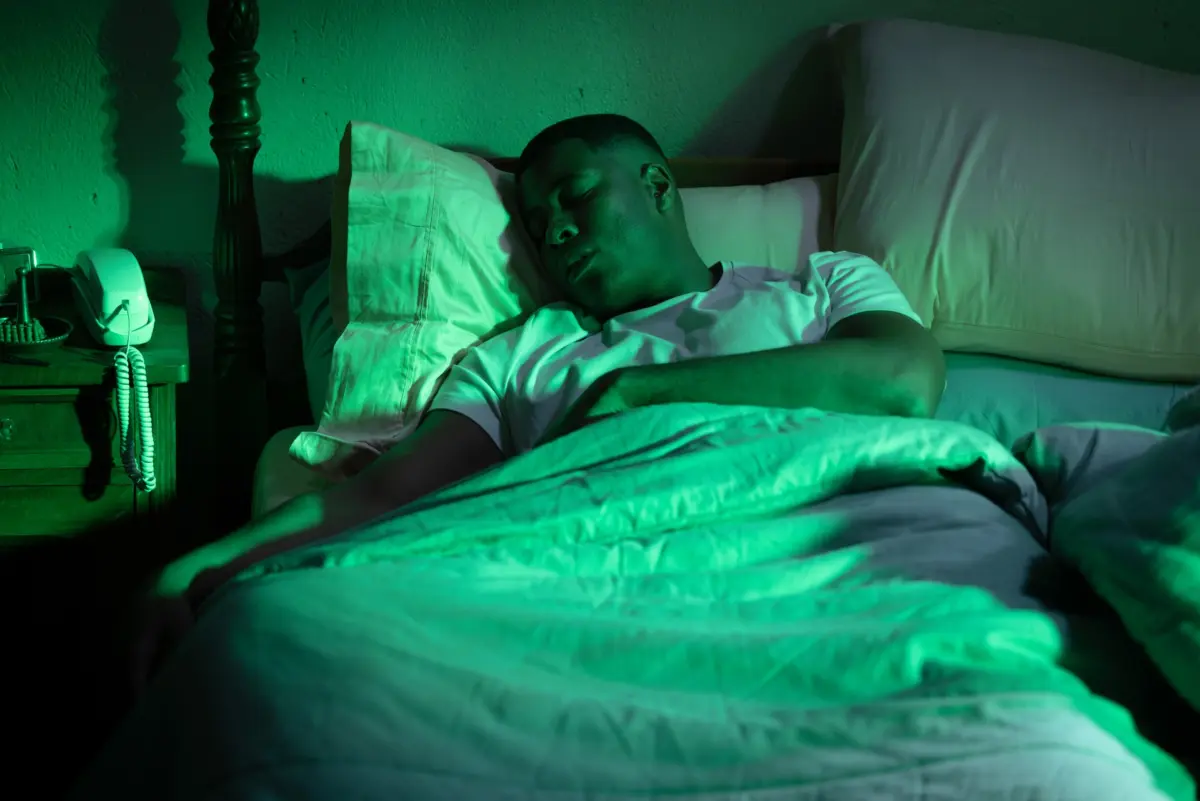
The investigation first turns backward to John Stewart Sr., revealing a generational legacy of cosmic selection. Years prior, the elder Stewart was similarly targeted by the Guardians. Roused violently from his bed in the dead of night, he found himself encapsulated within an inescapable alien energy sphere. When interrogated regarding his internal emotional state, John Sr. offered an honest, fundamentally human response: he admitted he was afraid.
For this display of self-preservation, he was summarily rejected by the cosmic arbiters.
The aftermath of this encounter fractured his terrestrial life. Insisting that the extraterrestrial visitation was indisputably real, John Sr. was branded delusional by his community and nearly abandoned by his wife, Bernadette (Jasmine Cephas Jones). The crisis draws a direct intervention from Lianna, who attempts to offer recompense, noting that their blunt screening protocols historically produced catastrophic psychological fallout across multiple human candidates.
Bernadette seizes the moment to excoriate the emissary, delivering a blistering critique of cosmic ignorance regarding terrestrial racial dynamics. She challenges Lianna’s detached expectation that a Black man in America could navigate a world saturated with systemic violence without experiencing fear. Recognizing her cultural blind spot, Lianna backs down, musing that perhaps the younger generation—their young son, John Jr.—might eventually mature into the unique emotional discipline required to wield a power ring.
This confrontation cements a radical pivot for the Stewart household. Bernadette informs her husband that their ultimate, non-negotiable family project will be forging their young son into a vessel that knows no fear.
The Architecture of Fearlessness
When John Jr. (played in youth by Jayce Eiland) turns five years old, the traditional markers of childhood joy are violently discarded. Ignoring his innocent request for simple crayons, his parents present him with a makeshift Lantern costume, initiating a grueling, militaristic regimen designed to excise vulnerability.
Bernadette installs sophisticated satellite equipment in the home and spins a psychological web, telling her son that local birds act as biological surveillance drones reporting directly to the Guardians. John’s childhood is systematically dismantled:
High-Stakes Marksmanship: He is trained to shoot apples off his father’s head with live ammunition.
Urban Disorientation: He is forced to navigate hostile, crime-ridden neighborhoods alone at night, with corporate fast-food cheeseburgers serving as his sole reward.
Fraternal Alienation: His brothers are systematically isolated from this specialized focus, breeding deep household resentment and taunts that John is performing as a "white boy."
The breaking point arrives when a frustrated Bernadette challenges John to shoot an apple off his father’s head, suspecting his unflappable exterior is merely a mask. Paralyzed by doubt, the boy fails. Later discovered sketching by his mother, Bernadette confesses the foundational lie: the birds are not reporting, and she has no direct line to the Guardians, though her faith in their omniscient gaze remains absolute.
In a moment of quiet, defiant maturity, John agrees to complete the test—not on his father, but on his mother. He successfully pierces the apple resting on Bernadette’s head, sealing his psychological transformation with a deadpan declaration that he despises cheeseburgers.
The Nine-Month Forest
Flashing forward to his tenure in the United States Marine Corps, the narrative explores the mechanics of John’s professional undoing. Deployed as an elite sniper, he is tasked with assassinating a high-value terrorist holed up in a heavily fortified, remote Russian compound.
During a high-altitude airdrop, John suffers a severe puncture wound to his torso courtesy of a jagged tree branch. Stranded deep behind enemy lines, he performs field surgery on himself and endures over nine months of isolation in the harsh forest terrain, living off insects and waiting for an optimal, uncompromised line of sight.
His patience is preempted by Hal Jordan.
In a chaotic display of impulsive vigilantism, Hal bombs the compound, extracts the target directly to Guantanamo Bay, and leaves the geopolitical fallout in shambles. To shield the U.S. government from an international diplomatic crisis with Russia—stemming from intelligence Hal drunkenly extracted from a strip club informant—the Marine leadership makes John a scapegoat. He receives a dishonorable discharge, punctuated by a hollow assurance that his institutional masters will "remember his fine work."
The Handoff and the Handshake
Back in the interrogation room, Lianna presses John on Hal Jordan’s reckless interference. When John displays institutional loyalty—framing Hal’s actions merely as following orders—Lianna shatters that illusion. She exposes the Guardians’ deep-seated institutional friction regarding Hal’s dangerous penchant for meddling in localized terrestrial disputes. When she pivots to Sinestro, probing John’s awareness of Hal’s fallen mentor, John displays a pragmatic, unflappable indifference to interpersonal institutional drama.
Following his discharge, John drifts into a lethargic depression until Bernadette steers him toward art school, framing it as a complementary skillset for the cosmic destiny they trained him to inherit. His artistic precision eventually catches the eye of an undercover scout. Following a meticulous sketching trial that requires him to perfectly reproduce his father’s vintage watch from memory, John is handed a Green Lantern ring and directed down a trapdoor, plunging directly into the mattress pile that opened the episode.
Lianna officially offers him the position, clarifying the operational mandate: he will be trained as Hal Jordan’s clandestine replacement, operating as an insider without Hal’s knowledge. John accepts the parameters without hesitation.
Returning home to share the triumphant news, John finds Hal already seated at his family’s dining table. Hal dismisses him outside, coldly asserting that he has zero interest in babysitting a sidekick or carrying tactical backup before rocketing into the upper atmosphere. John watches him go, turning to a nearby bird to dryly observe that he is reasonably confident his new mentor likes him.
Supporting Context & Metrics
Analytical Category
Episode Detail / Thematic Implication
Director / Showrunner Vision
Executed with a deliberate, slow-burn pacing designed to subvert standard comic book pacing expectations.
Key Writer
Vanessa Baden Kelly, whose script balances systemic social commentary with intimate character psychology.
Primary Cast Additions
Laura Linney (Lianna), Jasmine Cephas Jones (Bernadette Stewart), Jayce Eiland (Young John Stewart).
Thematic Core
The psychological toll of institutionalized emotional suppression and the intersection of systemic racism and cosmic destiny.
Narrative Pivot
Expands the DC Universe television lore by contextualizing the friction between human agency and Guardian oversight.
Official Statements & Critical Commentary
Industry analysts have universally lauded "OutKast" for its willingness to anchor high-concept space opera in the gritty, unglamorous realities of American domestic life. In statements surrounding the series’ structural ambitions, the creative team emphasized that John Stewart’s journey cannot be separated from his identity as a Black man navigating institutional power structures.
"We wanted to examine what it actually costs a family to prepare a child to enter a space that historically does not care about their humanity," notes the production’s thematic framing. "When the Guardians appear as distant, unfeeling, and culturally detached overseers, the parallel to earthly institutional power becomes inescapable."
Critics have similarly highlighted the brilliance of the episode’s titular metaphor:
The "OutKast" Dichotomy: Using the musical group OutKast as an auditory backdrop for John’s youth underscores his profound alienation—not only from mainstream society, but from his own siblings who view his hyper-driven, emotionally numbed existence as an abandonment of their shared cultural reality.
The Mother-Son Dynamic: Bernadette’s projection of her own unfulfilled ambitions onto her youngest son creates a complex web of resentment. John resents her for manufacturing a destiny built on emotional starvation, while Bernadette harbors a buried bitterness toward her husband, John Sr., whose initial human display of fear cost him the cosmic ring she was certain she could have mastered.
Future Outlook
As Lanterns moves past its mid-season character studies, Episode 3 leaves the overarching cosmic mystery humming ominously in the background while fundamentally reshaping the chessboard.
By positioning John Stewart as a secret, systemic replacement for Hal Jordan—trained by a man who actively resents the concept of backup—the series sets up an explosive interpersonal dynamic for the remaining episodes. Will John’s deeply ingrained military conditioning and manufactured emotional detachment allow him to navigate the treacherous political waters of the Green Lantern Corps, or will the suppressed trauma of his upbringing finally puncture his armor?
With next week’s trajectory remaining unconfirmed—swinging between a return to active planetary investigations or further historical unpacking—proven narrative confidence suggests that Lanterns will continue to use its cosmic sandbox to explore the most intimate, vulnerable corners of the human condition.





Comments
Facebook App ID not configured. Please add it in the Customizer.