
Executive Overview
In the literary world, the age-old adage "write what you know" is often tossed around as casual advice for aspiring novelists. However, for author Nicole Brooks—whose recent critically acclaimed thriller No Higher Ground has garnered widespread praise for its unflinching and chillingly realistic portrayal of Complex Post-Traumatic Stress Disorder (CPTSD)—that advice carried a profound, deeply personal weight. Following the release of her novel, Brooks was inundated with messages from readers and mental health advocates marveling at her precise rendering of the disorder. The underlying question in their inquiries was always the same: How did you manage to get it so accurately?
The answer, as Brooks revealed in a striking personal essay, is both heartbreaking and revelatory: she did not merely research the condition; she lives with it. “Like knows like has never rung truer,” Brooks reflects.
By channeling the agonizing isolation, hypervigilance, and profound survival mechanisms of her own childhood into her protagonist, Raven, Brooks has achieved a literary rarity—a fictional narrative that maps the invisible architecture of trauma with clinical precision. This investigative feature explores the intersection of lived trauma and creative expression, examining how Brooks transformed decades of repressed memories, domestic abuse, and silent endurance into a masterclass of psychological fiction. Through an analysis of her personal chronology, the mechanics of hidden abuse, and the broader implications for trauma survivors in literature, this article unpacks how diving into the darkest corners of the self can yield some of the most vital storytelling of our time.
Read Also
Detailed Chronology: The Anatomy of Hidden Trauma
To understand the authenticity of No Higher Ground, one must trace the timeline of Brooks’s life—a trajectory marked by early disruption, systemic neglect, and an elaborate architecture of self-preservation.
The Early Fractures (Ages 5 and Under)
The blueprint of Brooks’s trauma was established in early childhood, beginning with a foundational rupture that would dictate her worldview for decades. At just five years old, her mother left the family home, abandoning Brooks and her younger brother. In the wake of this sudden departure, Brooks was forced into a premature role of responsibility, becoming the primary protector and caretaker for her younger sibling, who lived with a mental disability.
This early abandonment planted the psychological seeds of what psychologists term "conditional love" and hyper-responsibility. A five-year-old child cannot comprehend abandonment through an objective lens; instead, the young mind internalizes the event, concluding that her own existence or inadequacy drove the caregiver away.
The Era of the Stepfamily and the "Good Public Face"
Following the mother’s departure, Brooks’s father remarried, effectively handing over the reins of domestic life and parenting to his new wife. While the father’s emotional withdrawal ("checking out") was damaging in its own right, the stepmother—alongside her sister—introduced a reign of calculated psychological and physical terror behind closed doors.
What makes Brooks’s chronology so emblematic of hidden abuse is the stark dichotomy between public perception and private reality. In public, the stepmother was described by outsiders as cloyingly sweet, a benevolent figure who had stepped in to fill the void left by the absent mother. Brooks was frequently told how lucky she was.
However, behind closed doors, the abuse was multifaceted and relentless:
- Physical Violence: Bruises from leather belts were dismissed as standard disciplinary measures of the 1980s; bedrooms were systematically destroyed in fits of adult rage; the young Brooks was thrown around by her hair, tossed down small flights of stairs, and subjected to physical intimidation disguised as affection or "lessons."
- Psychological Warfare: Brooks was routinely told that she was the direct cause of her mother’s abandonment—a psychological burden designed to isolate her entirely from any external source of validation or comfort.
The Adult Repression and the Breaking Point
For decades, Brooks maintained the illusion of survival. She moved out into adulthood, met her husband, started a family, and built a life she genuinely loved. Yet, the invisible machinery of CPTSD continued to run beneath the surface. She coped with obsessive traits, hypervigilance, and deep-seated trust issues, minimizing the trauma to herself to prove she was "tough enough."
The true unraveling did not occur until years later, triggered by a combination of compounding anxiety, depression, and a definitive life event: the death of her stepmother. Ironically, it was only after her abuser passed away that Brooks felt psychologically safe enough to speak her truth, unburdened by the fear of ruining someone else’s life or being dismissed as dramatic.
Supporting Context & Metrics: Understanding CPTSD in Literature
Complex Post-Traumatic Stress Disorder differs significantly from standard PTSD. While traditional PTSD is often the result of a single, acute traumatic event (such as a car accident or military combat), CPTSD stems from prolonged, repeated, and inescapable interpersonal trauma—typically occurring in childhood within the context of the family unit, where escape is physically and financially impossible.
The Psychological Profile of a Survivor
Brooks’s description of her internal landscape offers a masterclass in the diagnostic criteria of CPTSD. She details a series of cognitive distortions and survival tactics that she long assumed were universal human experiences:
- Hypervigilance: Living in a state of perpetual readiness so profound that no one can ever successfully sneak up on the individual, regardless of how quietly they approach.
- Pathological People-Pleasing: Bending over backward to ensure loved ones are happy, consistently at the absolute expense of one’s own emotional and physical well-being.
- Rumination and Reassurance-Seeking: Spending hours or weeks agonizing over a seemingly insignificant comment, terrified of having offended someone or anticipating that a minor slight has made someone hate them.
- Conflict Aversion: An intense, visceral aversion to interpersonal conflict, driving the survivor to flee or surrender immediately at the first sign of friction.
- Anticipatory Grief (The Other Shoe Dropping): An inability to enjoy moments of peace or happiness, perpetually bracing for catastrophe.
- Preemptive Abandonment: Because love was experienced as conditional and fragile, the individual is terrified of being abandoned; at the very first sign of relational trouble, the survivor breaks things off first to retain a shred of control.
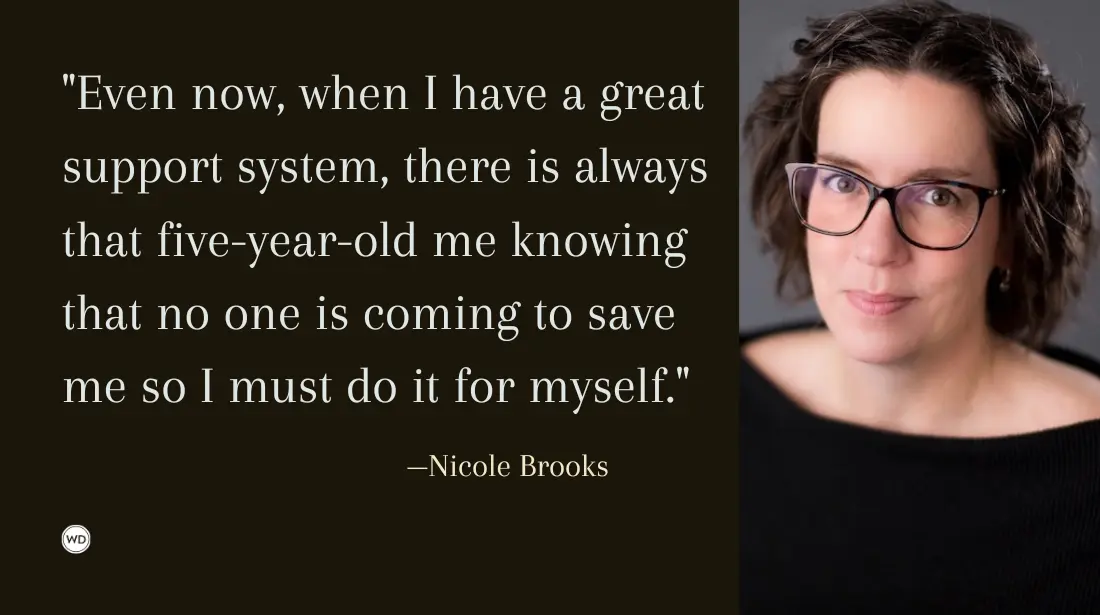
- Radical Self-Reliance: Operating under the core belief that no one is coming to save you—that the only person you can truly trust is yourself.
The Statistics of Silence
According to child welfare and psychological research, childhood abuse that occurs behind closed doors and is accompanied by a veneer of public respectability is among the most underreported and psychologically damaging. Children subjected to this environment frequently develop intense self-gaslighting techniques—wondering if they are "being dramatic," questioning their own memories, or blaming themselves to make the abuse palatable.
Brooks’s literary translation of these metrics into her protagonist, Raven, provides readers with an authentic psychological roadmap that clinical textbooks often fail to capture with emotional resonance.
Official Statements and Author Insights
In reflections detailing the creation of No Higher Ground, Brooks has been remarkably candid about the cathartic, albeit terrifying, process of translating her internal life onto the page. Her insights shed light on the ethics and emotional labor of writing trauma.
"I thought everyone walked through life so hypervigilant that they cannot be snuck up on no matter how quiet the other person thought they were being… I thought everyone had trouble connecting to others or always felt at odds with the world," Brooks notes, highlighting the profound isolation of undiagnosed childhood trauma.
Reflecting on why she never disclosed the abuse during her childhood or youth, Brooks offers a poignant psychological revelation:
"I suspect the real reason I never told anyone was I believed that if anyone loved me they would have seen it without me having to say a word and the fact that no one saw it said more about me than it did about them."
This sentiment strikes at the heart of CPTSD: the erroneous, yet deeply protective, belief that the child is fundamentally unlovable or unworthy of protection.
Brooks argues that true authenticity in fiction cannot be faked through mere observation or academic research. It requires a willingness to excavate the darkest, most closely guarded parts of the psyche.
"So maybe the best stories emerge when we as writers dig into the deepest part of ourselves to tell something we are scared to tell… That is how we make a narrative authentic, that is how we show the reader to trust us, that is how we let people know they are not alone in those deep, dark thoughts and secrets."
Future Outlook: The Evolution of Trauma-Informed Fiction
The success of No Higher Ground and the public vulnerability of Nicole Brooks signal a broader, transformative shift in contemporary literature and publishing. For generations, stories involving childhood trauma tended to rely on sensationalized tropes, melodrama, or tidy, resolved narrative arcs where a caring mentor swoops in at the eleventh hour to rescue the protagonist.
Real life, as Brooks demonstrates, is rarely so neat.
The Rise of Trauma-Informed Narratives
As readers become more psychologically literate and attuned to mental health nuances, the demand for authentic, unvarnished portrayals of conditions like CPTSD is skyrocketing. Audiences are no longer satisfied with flat characters who simply "get over" their pasts. They seek out narratives that honor the long, non-linear, and often messy reality of healing.
Authors are increasingly recognizing that mining their own difficult histories—while maintaining healthy psychological boundaries—creates a profound bridge of empathy with readers. When a writer has walked through the fire of CPTSD, their prose carries an unmistakable resonance. It acts as a beacon for survivors who, like the five-year-old Nicole, are still waiting for someone to understand the invisible wars they fight every day.
Writing as an Act of Radical Reclamation
For Nicole Brooks, the publication of No Higher Ground was more than a professional milestone; it was a psychological milestone. By taking the architecture of her abuse, handing its pieces to Raven, and forcing the world to look at it unflinchingly, she reclaimed the narrative that had been stolen from her in childhood.
In doing so, she offers a blueprint for both aspiring authors and trauma survivors alike: by refusing to let our secrets remain in the dark, we not only demystify our pain—we transform it into art that has the power to save others.



Comments
Facebook App ID not configured. Please add it in the Customizer.