
Executive Overview
The intersection of the Civil Rights Movement and the Asian American social justice struggle remains one of the most vital, yet under-documented, chapters of 20th-century American history. At the epicenter of this cross-cultural solidarity stood Yuri Kochiyama, a Japanese American activist whose lifelong dedication to human rights was forged through personal trauma, systemic persecution, and an extraordinary, transformative friendship with Malcolm X.
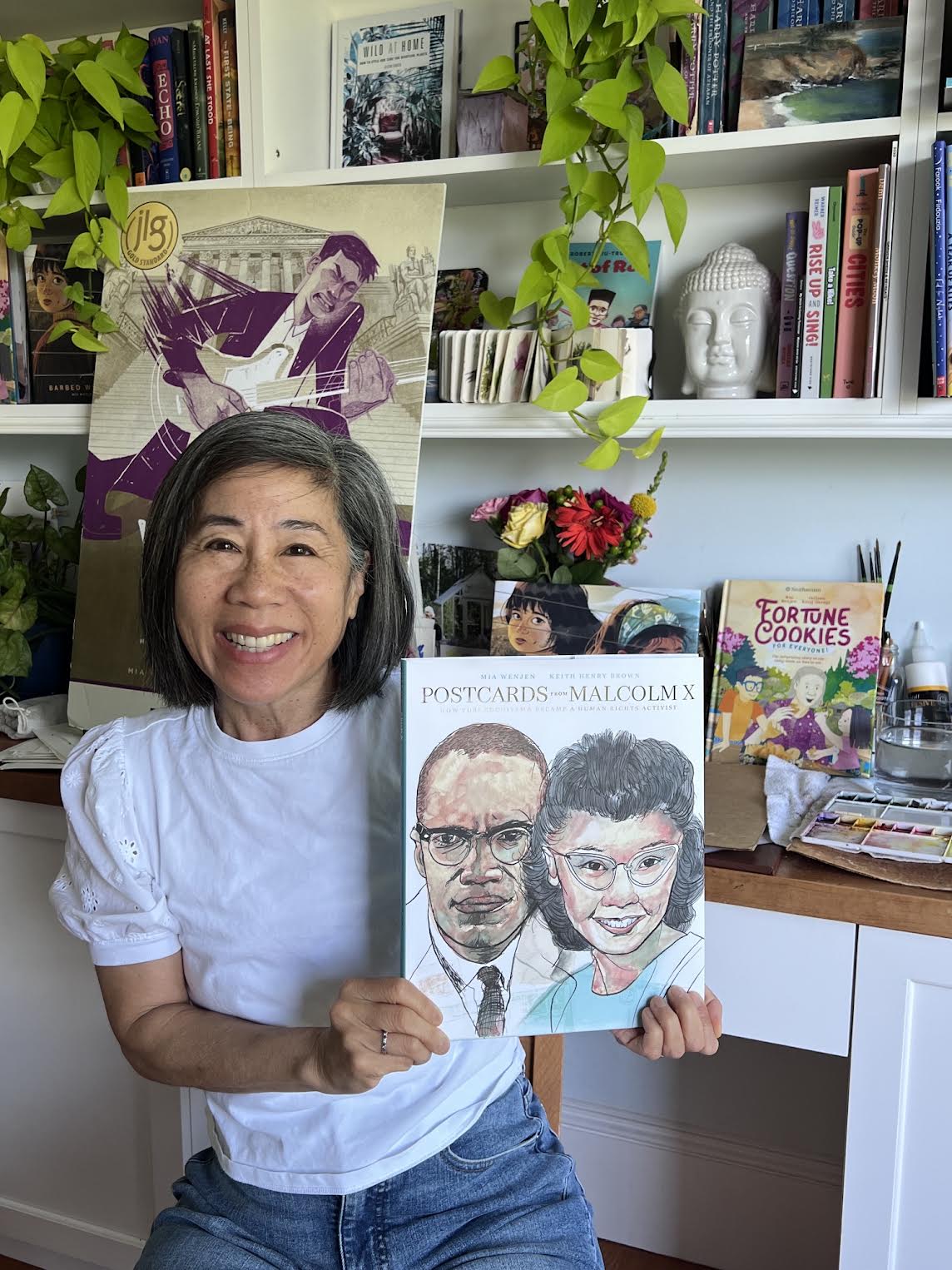
Arriving just ahead of its official release date on October 13, 2026, author Mia Wenjen’s upcoming picture book biography, Postcards from Malcolm X: How Yuri Kochiyama Became a Human Rights Activist—brilliantly illustrated by Keith Henry Brown—brings this profound narrative to young readers aged 7 and up. Featuring original archival postcards from Malcolm X, a detailed historical timeline, and rich back matter, the book serves not only as a poignant biographical portrait of an unsung American hero, but also as an urgent, timeless call to action for the next generation of social justice advocates.
This feature explores the historical catalysts behind Kochiyama’s activism, the structural significance of Wenjen’s new literary contribution, and the broader context of multicultural children’s literature designed to foster civic consciousness.
Read Also
Detailed Chronology: From Internment to Harlem’s Front Lines
To understand the magnitude of Yuri Kochiyama’s legacy, one must trace the harrowing trajectory of her early life—a series of historical injustices that systematically catalyzed her evolution from a small-town Californian into a fearless human rights champion.

Early Life and World War II Internment
Born in San Pedro, California, Kochiyama’s early life was upended by the geopolitical shockwaves of World War II. Following the Imperial Japanese Navy’s attack on Pearl Harbor, the United States government enacted Executive Order 9066, leading to the forced removal and incarceration of over 120,000 Japanese Americans.
Kochiyama and her family were torn from their home and forced into desert concentration camps, specifically the Jerome Relocation Center in Arkansas. This state-sanctioned violation of civil liberties instilled in her a lifelong distrust of systemic oppression and state overreach. Compounding this trauma, her father was arrested by the FBI immediately following the outbreak of the war due to baseless suspicions. Subjected to intense interrogation and denied proper medical care, he passed away just hours after returning home—a tragic loss that left an indelible mark on Kochiyama’s worldview.

The Catalyst in New York and the Courthouse Meeting
Following her marriage to Bill Kochiyama, a Nisei soldier who served in the legendary, highly decorated 442nd Regimental Combat Team, Yuri eventually settled in Harlem, New York. Living in a predominantly Black and Puerto Rican community, Kochiyama immersed herself in the local grassroots struggles for civil rights, education reform, and economic justice.
The defining moment of her public life occurred in October 1963 at a New York courthouse. There, she approached Malcolm X to shake his hand and express her admiration for his fierce advocacy. That single handshake bridged two distinct communities—Asian Americans and African Americans—and blossomed into a profound, intellectually rigorous friendship anchored in a mutual vision for global human rights and anti-imperialist solidarity.

Kochiyama’s commitment to this alliance was so steadfast that she was present at the Audubon Ballroom in Harlem on February 21, 1965, when Malcolm X was assassinated, famously cradling the dying leader in her arms. Rather than retreating out of fear, Kochiyama spent the remaining decades of her life fighting for political prisoners, protesting the Vietnam War, and demanding reparations for Japanese American internment survivors.
Supporting Context & Metrics: The Evolution of Activism in Children’s Literature
Mia Wenjen’s Postcards from Malcolm X arrives at a pivotal juncture in contemporary publishing. Over the past decade, the landscape of children’s literature has undergone a significant democratization, shifting toward historical narratives that center intersectionality, cross-cultural alliances, and grassroots resistance.

| Publication Metric / Context | Overview & Industry Significance |
|---|---|
| Target Demographic | Children aged 7 and up, introducing complex historical themes through accessible narrative nonfiction. |
| Primary Historical Sources | Integration of original, authentic postcards from Malcolm X, offering tangible primary-source engagement for young minds. |
| Thematic Focus | Cross-cultural solidarity, intersectional civil rights, systemic racism, and the enduring legacy of Japanese American activism. |
| Complementary Works | Part of a robust wave of multicultural titles, including Wenjen’s companion release Barbed Wire Between Us and Fortune Cookies for Everyone!. |
The inclusion of primary-source artifacts—such as the actual postcards exchanged between Malcolm X and Kochiyama—elevates the work from a standard picture book biography to an archival-grade educational tool. Educators and librarians increasingly rely on literature that bridges historical divides, proving that systemic struggles against racism, war, and inequality are interconnected globally.
Official Statements and Authorial Insights
In celebration of the arrival of her advance author copies, Mia Wenjen shared an exclusive unboxing video showcasing the physical edition of Postcards from Malcolm X. The visual presentation highlights Keith Henry Brown’s striking, evocative illustrations, which capture the emotional weight, historical gravity, and vibrant community spirit of Harlem and wartime America.

While detailing the book’s creation, literary advocates and publishing analysts have emphasized the urgency of teaching children about adult-level historical concepts through age-appropriate, empowering frameworks. Wenjen’s extensive back matter and chronological timelines provide teachers with ready-to-use pedagogical structures, empowering students to contextualize mid-century civil rights within modern human rights movements.
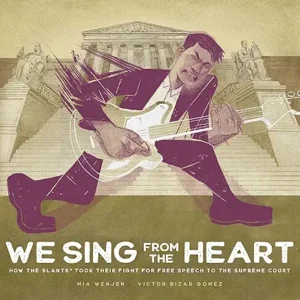
Furthermore, Postcards from Malcolm X aligns with Wenjen’s broader literary mission. Known for amplifying diverse historical narratives and Pacific American resilience—seen in works such as Barbed Wire Between Us, illustrated by Violeta Encarnación, and We Sing from the Heart: How the Slants® Took Their Fight for Free Speech to the Supreme Court—Wenjen consistently challenges young readers to question injustice and champion free expression.
Future Outlook: Legacy, Availability, and Impact
As the official publication date of October 13, 2026 approaches, anticipation for Postcards from Malcolm X: How Yuri Kochiyama Became a Human Rights Activist continues to accelerate across educational networks, libraries, and literary communities.
The book is currently available for pre-order through major platforms, independent bookstores via Bookshop.org, and directly through the author’s official portal for signed or inscribed copies.
Looking forward, the long-term impact of Wenjen and Brown’s collaboration is expected to reverberate across classrooms nationwide. By immortalizing the bond between Yuri Kochiyama and Malcolm X, the book offers a masterclass in coalition-building. It reminds contemporary readers that lasting social change is never achieved in isolation; rather, it requires empathy, shared struggle, and the courage to stand shoulder-to-shoulder across cultural lines in the relentless pursuit of justice.

Comments
Facebook App ID not configured. Please add it in the Customizer.