
Executive Overview
In the sprawling, high-stakes ecosystem of professional basketball, June serves as a seasonal crucible. It begins in Manhattan with a celebratory parade honoring the ultimate victors of the Larry O’Brien Championship Trophy, and ends in the outer boroughs with a quieter, more complex ritual: an inventory of loss, aspiration, and corporate pageantry at the NBA Draft. Held under the vaulted, security-bussed gates of the Barclays Center in Brooklyn, the draft is ostensibly an operational event where teams acquire the rights to sign elite rookie talents. Yet, beneath its glittering surface, it functions as a hyper-commercialized microcosm of modern sports culture—a strange hybrid of reality television, contract law, digital-age access journalism, and raw, unfiltered capitalism.
For years, the architecture of the NBA draft has been governed by a weighted lottery system designed to provide a mathematical lifeline to the league’s most unsuccessful franchises. By rewarding poor regular-season records with higher statistical probabilities of landing top-tier collegiate and international phenoms, the league inadvertently institutionalized a practice known as "tanking"—the intentional sidelining of competitive ambition in pursuit of draft-board supremacy.
However, the 2025–2026 iteration of the draft marks the end of an era. With sweeping league-wide reforms slated to take effect next year to eliminate intentional losing, this year’s lottery winners—including the Washington Wizards and the Utah Jazz—represent the last generation of beneficiaries who successfully weaponized failure into generational talent. Conversely, franchises like the Brooklyn Nets and the Indiana Pacers serve as cautionary tales of cyclical futility, illustrating how quickly the line between strategic maneuvering and institutional despair can blur.
Read Also
As fans navigate a concourse saturated with corporate activations, branded Funko Pops, and roving social media content creators, the event exposes a deeper truth about contemporary sports fandom: the game on the hardwood is increasingly competing with—and occasionally losing to—the relentless, 24-hour soap opera of insider trading, smartphone notifications, and psychological psychodrama that defines the modern NBA.
Detailed Chronology: Anatomy of Draft Night
The journey to the draft floor is a protracted saga that begins months before the first commissioner steps to the podium. To understand the room’s electric, anxious energy, one must retrace the chronological missteps and fortunes that delivered each franchise to its specific seating arrangement in Brooklyn.
The Lottery Winners and the Last "Tanks"
The 2025–2026 season was defined by a stark divergence in strategy across the league. While contenders traded future assets for immediate championship windows, teams like the Washington Wizards and the Utah Jazz executed calculated, patient descents down the standings. Through strategic injuries, youth-heavy rotations, and a steady accumulation of high-value lottery combinations, both organizations converted their regular-season struggles into prime draft real estate. Joining them via statistical fortune were the Chicago Bulls and the Memphis Grizzlies, who beat the mathematical odds to vault upward in the selection order. In a draft class universally heralded by scouts as historically deep and talented, these four franchises emerged as the undisputed lottery champions.
The Brooklyn Descent and the Pacers’ Paradox
At the opposite end of the spectrum lay the Brooklyn Nets, whose night encapsulated a cascading series of failures. Coming off a disastrous campaign that yielded the league’s third-worst record, the Nets suffered a brutal blow when the lottery balls dropped, plummeting them from tied-best odds at the first overall pick down to sixth. This compounded the stinging memory of the previous year’s draft, where they squandered an unprecedented five first-round selections on an uninspired cohort of players incapable of halting the franchise’s post-super-team bleeding. Culturally and competitively eclipsed by their crosstown rivals, the New York Knicks, the Nets stood as a monument to systemic erosion.
The Indiana Pacers endured a parallel tragedy. Following a miraculous 2025 run that saw them dismantle the Knicks in the Eastern Conference Finals and push the Oklahoma City Thunder to a grueling seven-game NBA Finals, tragedy struck: star guard Tyreese Haliburton suffered a torn Achilles tendon. Deprived of their offensive engine, the Pacers collapsed, tumbling down the standings into a lottery tie. Compounding the injury, a mid-season trade clause stripped them of their protected pick, which defaulted to the Los Angeles Clippers when Indiana slipped past the top-four threshold. The Pacers exited the first round empty-handed, a cruel descent for a team knocking on the door of a championship just two years prior.
The On-Stage Ritual and the Fall of the Board
As the evening commenced at the Barclays Center, the rhythmic cascade of smartphone notifications routinely outpaced the arena’s public address system. Long before NBA Commissioner Adam Silver—greeted by the customary, ritualistic chorus of boos—announced the selections, digital ecosystems had already leaked the choices.
The Washington Wizards ignited the room by securing elite prospect AJ Dybantsa with the first overall pick. As the draft wound its way through the lottery and into the late first round, the collective mood in the arena shifted from hyper-attentive anticipation to an ambient, exhausting restlessness. The contrast between the elation of the top-four selections and the visible anxiety of prospects sliding down the board was stark. For the young men waiting at their designated tables, posture and body language spoke volumes, transforming a high-profile career launch into a public exhibition of professional evaluation.
Supporting Context & Metrics: The Financial and Structural Labyrinth
The modern NBA draft cannot be divorced from the Byzantine legal and financial architecture that governs it. Far from a simple athletic showcase, the draft is the primary administrative valve of a multi-billion-dollar enterprise regulated by the Collective Bargaining Agreement (CBA) negotiated between the NBA and the National Basketball Players Association (NBPA).
The CBA and the Salary-Cap Complex
To follow the NBA today requires an ad-hoc fluency in contract law, labor negotiations, and corporate accounting. Modern fans must contend with an alphabet soup of mechanisms:
- Salary Aprons: Strict financial ceilings that penalize high-spending teams with roster-building restrictions.
- Bird Rights: Provisions allowing teams to exceed the salary cap to re-sign their own veterans.
- Exceptions: A dizzying array of taxpayer, non-taxpayer mid-level, traded-player, disabled-player, and biannual exceptions used to manipulate rosters.
This administrative complexity has transformed basketball commentary. Some of the league’s most respected analysts and commentators are former lawyers or financial analysts who decode the CBA with the precision of tax attorneys. Into this complex framework steps the rookie contract: when a team drafts a player, they acquire exclusive rights to negotiate and sign him to a standardized, scale-based rookie deal. While players retain the theoretical right to refuse—or utilize leverage through private workouts and media posturing—actual holdouts have vanished from the modern game, cementing the draft as an ironclad corporate pipeline.
The Rise of Information Mercenaries
Parallel to the financialization of the league is the evolution of sports journalism into an industry of instantaneous information peddling. The era of long-form, analytical sports writing has been largely eclipsed by scoop-hunting "insiders" whose currency is speed, access, and digital engagement.
The prototype for this model was Adrian Wojnarowski ("Woj"), whose "Woj bombs" on Twitter defined an era of transaction-obsessed reporting. Following Wojnarowski’s retirement in 2024—prompted by a disillusionment with an industry increasingly detached from human connection and genuine athletic appreciation—his mantle was largely assumed by Shams Charania. Operating within an ecosystem dominated by social media and corporate partnerships, figures like Charania have turned insider leaking into high-stakes enterprise, occasionally intersecting with sports gambling markets and raising critical ethical questions about information latency and market manipulation in the age of widespread legal wagering.
Official Statements and Industry Perspectives
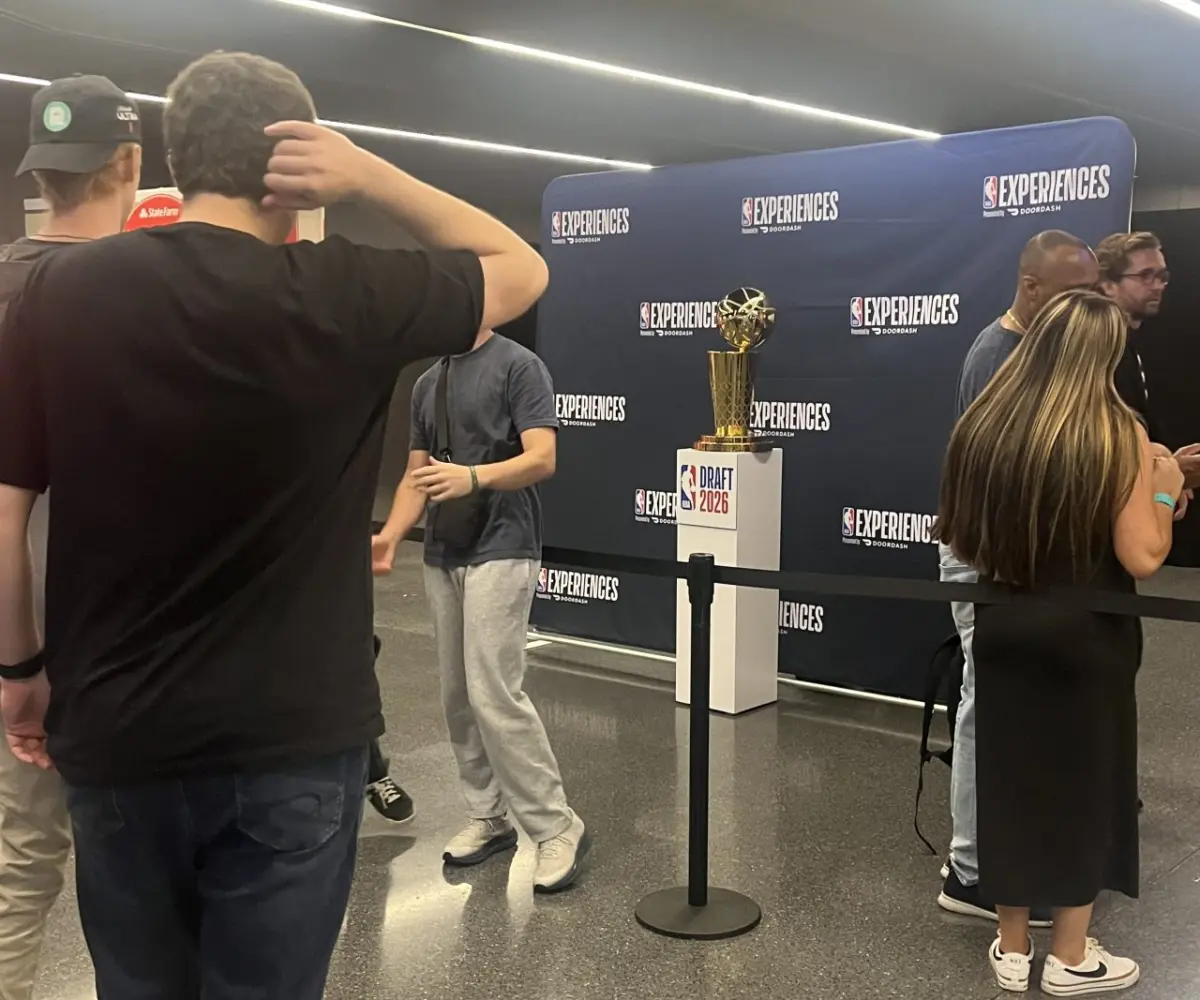
The commercialization of the draft was laid bare on the concourse of the Barclays Center, where corporate partnerships dictated nearly every square foot of fan interaction.
The Corporate Midway
Walking through the CLEAR-branded security gates, attendees were immediately greeted not by basketball heritage, but by a series of sponsored activation zones designed exclusively for digital content generation:
- The Rookie Trophy Experience: Fans waited in lines managed by security guards to pose with a glass-enclosed, replica Rookie of the Year trophy, presented by DoorDash.
- The Larry O’Brien Display: Unclear as to whether it was on loan or custom-built for the evening, a championship trophy sat on a taped-off plinth, serving as a backdrop for impromptu selfies and looping video clips.
- The Funko Pop Phenomenon: Distributed in limited quantities—though with universal photo-op potential—was the "Jake From State Farm" Funko Pop figurine, perfectly encapsulating the omnipresence of corporate branding in modern sports.
The Social Divide
The demographic split within the arena offered a sociological snapshot of the league’s audience. Team owners, front-office executives, and high-powered sports agents populated the lower tiers in tailored suits, their expressions alternating between corporate triumph and calculated stoicism. Media members and league employees populated the middle tiers, identifiable by standardized lanyards and business-casual attire.
Meanwhile, the true pulse of the building resided in the upper concourses and nosebleed sections. Groups of young, deeply knowledgeable fans—such as a row of middle-school-aged Philadelphia 76ers supporters armed with personal "Big Boards"—demonstrated a granular, almost academic passion for the draft. Their exuberant reactions to second-tier selections like Yaxel Lendeborg contrasted sharply with the jaded, transactional indifference of the adult spectators who treated the actual athletic talent as mere portfolio assets.
Future Outlook: The Post-Tanking Era and the Soap Opera Horizon
As the 2025 NBA Draft concluded and the crowds spilled out onto the Brooklyn concourses, the overarching mood was one of cautious, speculative transition.
The End of Intentional Losing
The impending implementation of the NBA’s restructured lottery rules next year signals the death knell for the traditional "tanking" strategy. By flattening lottery odds and penalizing systemic underperformance, the league is attempting to compel every franchise to field competitive rosters year-round. For teams like the Wizards, Jazz, Nets, and Bulls, the calculus changes overnight. The era of quietly resting healthy players in March to secure ping-pong balls is drawing to a close, forcing front offices to rely on analytical scouting, player development, and precise cap management rather than structural failure.
The Soap Opera Imperative
Yet, structural reforms to the draft will do little to alter the cultural trajectory of the NBA itself. As regular-season games increasingly struggle to capture the collective imagination of a younger, chronically online fan base, the league’s primary product has permanently bifurcated. The actual athletic competition on the court now shares billing with the ceaseless psychodrama of trade demands, podcast gossip, and real-time social media speculation.
When fans care more about Giannis Antetokounmpo’s rumored frustrations in Milwaukee than they do about a meaningless mid-winter matchup between bottom-tier opponents, the NBA proves that it is no longer just a sports league—it is an all-consuming cultural soap opera.
As the lights dimmed at the Barclays Center and the digital avatars on the jumbotron faded to black, the fans streamed toward the exits with a shared, eternal hope: that this year, the losing might finally end. Whether the new regulatory framework can redeem the league’s competitive soul remains to be seen, but the machinery of ambition, speculation, and corporate spectacle will march relentlessly on, waiting for the next ping-pong ball to drop.





Comments
Facebook App ID not configured. Please add it in the Customizer.