
Executive Overview
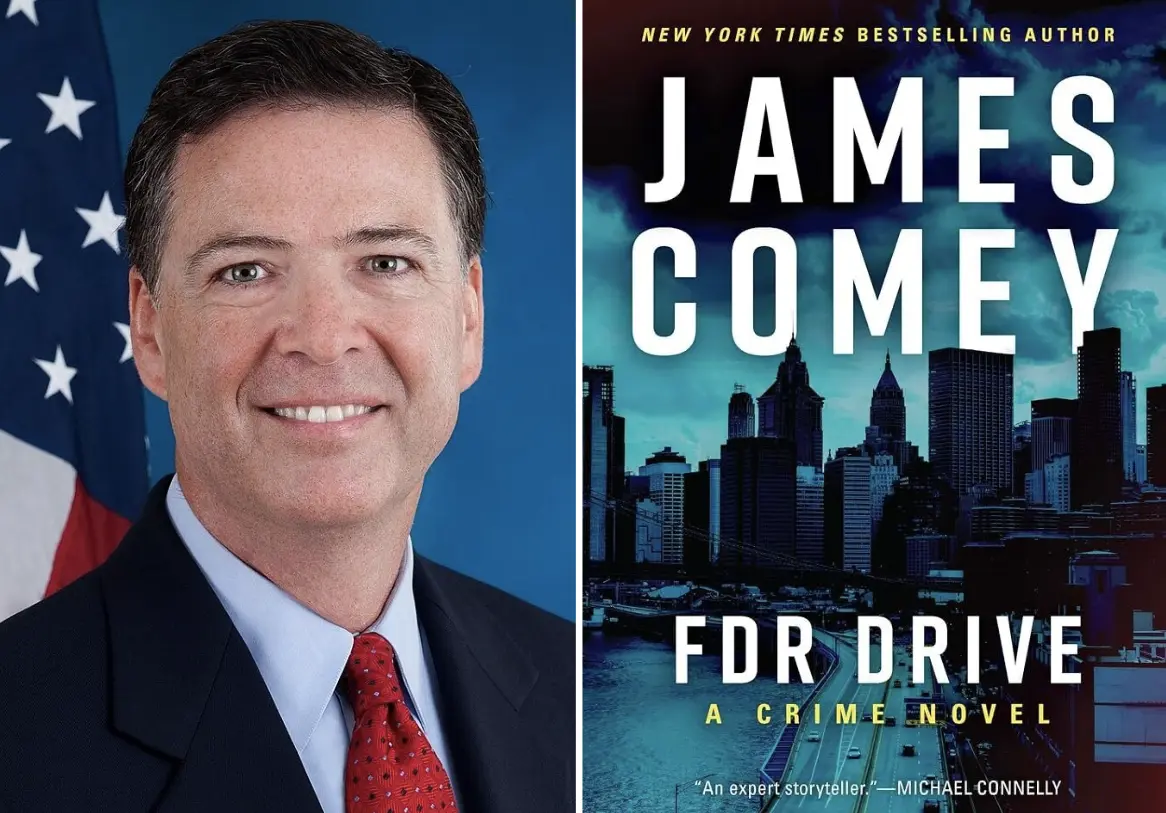
In a legal maneuver that has stunned constitutional scholars, literary critics, and defense attorneys alike, federal prosecutors have introduced a work of fiction into a federal criminal proceeding to substantiate charges against former FBI Director James Comey. The Department of Justice (DOJ), fighting desperately to prevent the dismissal of a controversial indictment, is pointing to Comey’s 2025 legal thriller, FDR Drive, as proof that the former top law enforcement official allegedly communicated coded assassination directives against President Donald Trump.
The crux of the government’s argument centers on a social media post in which Comey shared a photograph of seashells arranged on a beach to spell the alphanumeric code "86-47." Prosecutors contend that this imagery was not merely a political statement, but an explicit call to violence modeled after plot points in Comey’s own novel. In an extraordinary inclusion, the government’s recent court filing even references a starred review of the book from Publishers Weekly to support its interpretation of the author’s narrative methodologies.
Legal experts have reacted with profound alarm, characterizing the government’s reliance on fiction as a dangerous escalation that threatens core First Amendment protections. Free expression advocacy groups, most notably PEN America, have condemned the prosecution’s tactics as a constitutionally dubious "Hail Mary." The case sits at an unprecedented intersection of executive power, political animus, free speech jurisprudence, and the criminalization of creative writing—a realm where prosecutors are increasingly attempting to blur the lines between an author’s imagination and alleged criminal intent.
Read Also
Detailed Chronology
The Catalyst: The "86-47" Seashell Post
The genesis of the current legal battle dates back to an online post published by James Comey that quickly drew the ire of the Trump administration. Seeking to ramp up pressure on the former FBI director, administration loyalists within the Department of Justice pursued a theory that Comey had crossed the legal threshold from political dissent into the realm of making direct threats against the sitting president.
The object of scrutiny was a photograph shared by Comey depicting seashells carefully arranged on a sandy beach to spell out "86-47." In slang and political parlance, "86" is frequently used to mean to get rid of, eject, or eliminate someone, while "47" referred to Donald Trump as the 47th President of the United States.
To federal prosecutors, the post was an unambiguous threat of physical harm. To Comey’s defense team, however, the phrase represented standard, protected political speech—a commentary advocating for the political or electoral removal of the president. Faced with what they argue is a baseless and politically motivated prosecution, Comey’s attorneys formally moved to have the entire indictment thrown out of court, citing a complete lack of a "true threat" under established First Amendment jurisprudence.
The DOJ Counter-Filings and Literary Forensics
Cornered by the defense’s motion to dismiss, the DOJ submitted a sweeping opposition brief designed to keep the indictment alive. Rather than relying solely on traditional threat-analysis frameworks, prosecutors pivoted toward a novel line of argumentation: literary forensics.
In the filing, the government claims that Comey utilized a playbook lifted straight from his own fiction. Prosecutors maintain that Comey mirrored a narrative device employed by a right-wing podcaster character in FDR Drive. According to the government’s theory, just as the fictional podcaster allegedly transmitted coded instructions to followers to eliminate a target, Comey used the seashell photograph to signal his own followers to act against President Trump.
To bolster this unconventional thesis, the DOJ’s legal team incorporated unusual evidentiary citations into a federal court document. Alongside their legal arguments, prosecutors included a reference to a starred review of FDR Drive published by Publishers Weekly. The brief quotes the review’s concluding observation—that the novel "proves that Comey the crime novelist is here to stay"—not as a literary critique, but as a bizarre form of corroboration for the author’s capacity to orchestrate complex, coded messaging campaigns through his creative outputs.
Furthermore, the government’s filing introduces a financial motive to reinforce its criminal narrative. Prosecutors asserted that Comey had an "apparent financial incentive to stir up controversy," arguing that the seashell photograph was intentionally engineered as a marketing stunt designed to juice book sales for what the DOJ termed an "eerily on-the-nose novel."
Supporting Context & Metrics
The Anatomy of FDR Drive
Published in 2025, FDR Drive represents the latest installment in James Comey’s post-government career as a crime novelist. Released through Otto Penzler’s renowned Mysterious Press, the book follows in the footsteps of Comey’s previous fictional works, which frequently draw upon his extensive background in high-stakes federal investigations, counterintelligence, and prosecutorial maneuvering.
While legal thrillers written by former public officials are a well-established genre—dating back through decades of books penned by former prosecutors, judges, and intelligence officers—Comey’s work has found itself uniquely weaponized by the very legal apparatus he once helped lead.
The Dangerous Rise of "Prosecuting Fiction"
The DOJ’s reliance on FDR Drive is not happening in a vacuum; rather, it reflects a troubling and accelerating trend within the American legal system: the prosecution of creative expression. Over the past decade, prosecutors across federal and state jurisdictions have increasingly attempted to use lyrics, screenplays, poetry, and fiction as direct evidence of criminal intent, gang affiliation, or active conspiracy.
- The Chilling Effect on Authors: Legal scholars note that using an author’s fictional creations to establish the mens rea (guilty mind) of a real-world crime creates an untenable dilemma. If writers of crime, horror, or political thrillers know that their fictional plots, character motivations, and narrative devices can be unspooled by prosecutors and presented to juries as blueprints for actual illegal acts, the foundational freedom to imagine and explore dark or transgressive themes will inevitably wither.
- The "True Threat" Doctrine: Under foundational Supreme Court precedent—such as Virginia v. Black and Elonis v. United States—a statement constitutes a "true threat" only if the speaker means to communicate a serious expression of an intent to commit an act of unlawful violence to a particular individual or group. Courts have historically demanded a high bar of objective menace, separating hyperbole, political rhetoric, and artistic expression from actionable criminality. By reaching into a novel to bridge the evidentiary gap, legal critics argue the DOJ is attempting to lower this constitutional threshold.
Official Statements
The inclusion of a commercial fiction novel in a federal indictment has triggered fierce pushback from civil liberties organizations and legal watchdogs.
PEN America Condemns the Indictment
In a blistering public statement, PEN America’s legal director, Mara Gassmann, dismantled the government’s legal strategy and warned of the broader implications for free expression in the United States.
"Citing a novel to save an indictment that is constitutionally dubious is a desperate Hail Mary and should be rejected," Gassmann stated. "A political message, expressed through a photo of seashells, is no true threat; now, the government’s use of Comey’s work of fiction to support this prosecution compounds the First Amendment concerns. Extreme caution should be taken any time creative works are used to support criminal charges to protect the free expression rights of us all."
Publisher Silence and Defense Posture
Representatives for Otto Penzler’s Mysterious Press declined to comment on the unprecedented inclusion of FDR Drive within a federal criminal docket, leaving the literary world to grapple with the awkward intersection of commercial publishing and criminal prosecution.
Meanwhile, James Comey’s defense team is preparing a rigorous response to dismantle the government’s literary comparisons. Legal analysts anticipate that the defense will argue the prosecution’s reliance on a novel demonstrates the fundamental weakness and speculative nature of the government’s case, proving that the indictment rests on creative imagination rather than hard evidence of a federal crime.
Future Outlook
As this high-profile legal battle heads toward critical hearings, several key questions loom over the federal judiciary:
- Judicial Reception of Literary Evidence: Will the presiding federal judge permit the government to introduce FDR Drive and literary reviews into the evidentiary record during trial, or will the court rule that such materials are prejudicial, irrelevant, and constitutionally impermissible under the First Amendment?
- The Fate of the Indictment: If the defense successfully demonstrates that the "86-47" seashell post falls squarely within the bounds of protected political speech—and that the government’s literary narrative is a legally insufficient scaffolding—the court could grant the motion to dismiss, bringing a swift and humiliating end to the DOJ’s case.
- A Precedent for Future Prosecutions: Should the government’s tactic survive judicial scrutiny, it could open a Pandora’s box for authors, artists, and political commentators across the political spectrum. The normalization of using fictional narratives to infer real-world criminal conspiracies would fundamentally alter the landscape of American authorship, transforming the imaginative mind into a perennial target for prosecutorial scrutiny.
For now, James Comey’s FDR Drive occupies a surreal dual reality: sitting on bookstore shelves as a work of commercial crime fiction, while simultaneously being dissected in federal court as an alleged manual for presidential assassination. As the case proceeds, the judiciary’s handling of this literary-legal experiment will establish a monumental precedent regarding where the boundaries of state power end and the freedoms of imagination begin.





Comments
Facebook App ID not configured. Please add it in the Customizer.