
The landscape of modern franchise television is defined by an insatiable appetite for high-concept, cross-genre experimentation. From musical deep-dives into repressed trauma to animated intergalactic crossovers, contemporary showrunners frequently weaponize tonal whiplash to test the elasticity of their foundational mythologies. Few series, however, have embraced this philosophy with the audacity of Paramount+’s Star Trek: Strange New Worlds.
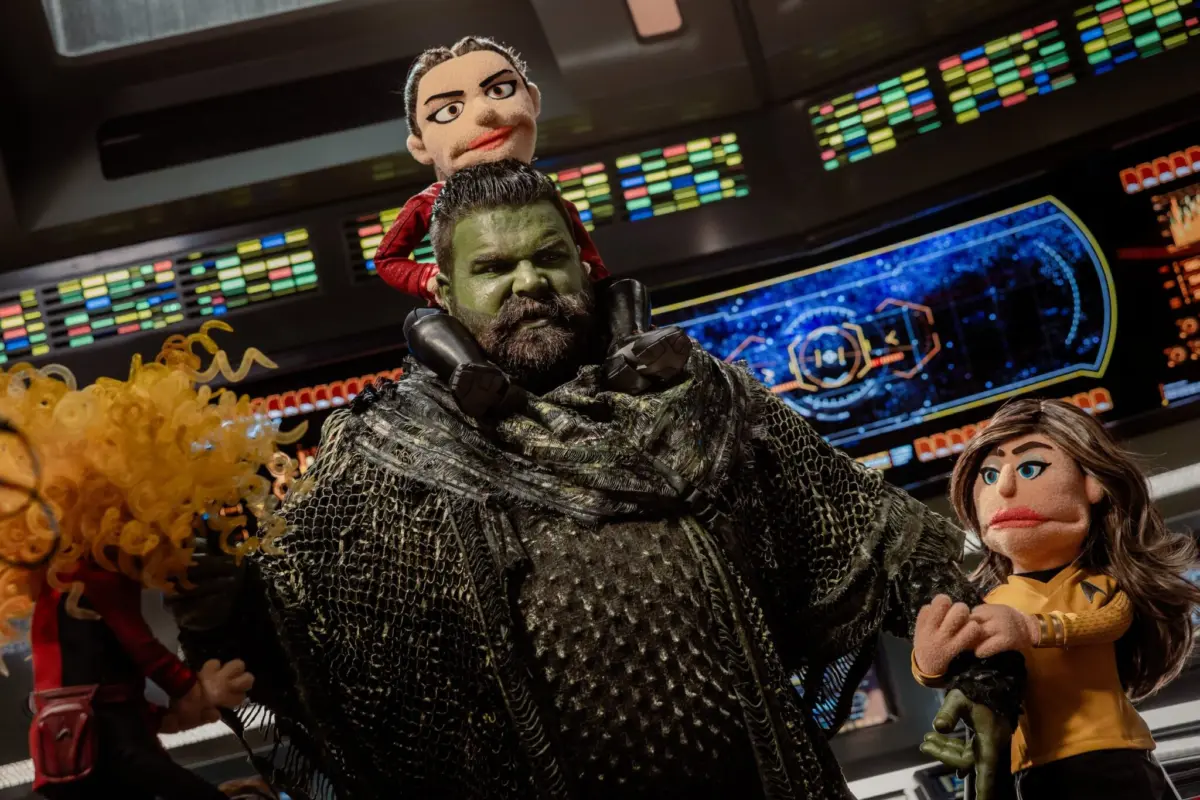
In Season 4, Episode 5—titled "Level-Five Transporter Accident"—the creative team ventured into territory previously deemed unreachable by the franchise’s purists: transforming the crew of the U.S.S. Enterprise into physical puppets. While the episode immediately ignited fiery discourse across digital fandoms, it serves as a fascinating case study in how franchise television negotiates legacy, character development, and narrative risk.
For a generation raised on the optimistic, humanistic templates laid down by Jim Henson’s Muppets and Gene Roddenberry’s Star Trek, the episode represents a poetic, if contentious, convergence of formative influences. Yet, beneath the novelty of felt hulls and polyfill anatomies lies a deeply polarizing narrative choice—culminating in a classic "it was all a dream" resolution that has sharply divided critics and audiences alike. This review explores the technical mechanics, the thematic triumphs, and the ultimate structural missteps of an episode destined to be remembered as one of the most polarizing hours in modern Star Trek history.
Read Also
Detailed Chronology: The Anatomy of a "Puppetized" Enterprise
The Inciting Incident: Transporter Physics and Trivial Test Subjects
The narrative engine of "Level-Five Transporter Accident" kicks into motion as the U.S.S. Enterprise sets a course for Vulcan. First Officer Spock, perpetually wrestling with the turbulent tides of his human heritage and emotional volatility, seeks refuge in rigorous logic studies. To aid in his emotional equilibrium, he coordinates a rendezvous with T’Pring, who happens to be stationed on a world situated conveniently between the starship’s current coordinates and the Vulcan home world.

Simultaneously, Chief Engineer Montgomery Scott is pushing the boundaries of Starfleet engineering. Eager to expand the safe operating range of the ship’s transporter systems—currently capped at a standard benchmark of 20,000 kilometers, with a personal record of 27,000 kilometers—Scotty believes he can achieve an unprecedented 29,000 kilometers. For this high-stakes test, Scotty selects an unorthodox payload: a puppet named "Little Ricky," an artifact from his childhood famously weaponized by his brothers to torment him.
As Spock departs the ship via shuttlecraft to maintain his detachment, Scotty initiates the test. The resulting level-five transporter accident is catastrophic. The unique material composition of the puppet interacts with the quantum matrix of the transporter stream, generating a localized spatial anomaly that instantly transforms every organic lifeform aboard the Enterprise into a felt-and-fabric puppet.
Logistical Nightmares and Orion Incursions
The immediate aftermath of the transformation introduces a cascading series of absurd logistical challenges. Starfleet hardware, notoriously calibrated for biometric scanning and multi-digit dexterity, refuses to recognize or respond to the physical properties of felt appendages. With the crew reduced to diminutive, fabric-based avatars, Spock—who remains un-transformed while piloting his shuttle—finds himself thrust into a frantic, high-stress rescue mission upon returning to the ship. He is the sole registered lifeform capable of operating the ship’s vital systems, sending his carefully cultivated emotional equilibrium spiraling into absolute chaos.
Compounding the crisis, an Orion pirate vessel intercepts the crippled Enterprise. Capitalizing on the crew’s newfound physical limitations, the Orion boarding party easily breaches the ship. The puppetized Starfleet officers find themselves utterly incapable of operating heavy weaponry or physically resisting their captors, who can casually pick them up and toss them aside like children’s toys.

The Illusion of Invulnerability and the Climax
When the Orion captain—portrayed with magnetic villainy by guest star Rachael Harris—demands the ship’s command codes, the crew refuses to yield. To demonstrate the gravity of her threats, the Orion captain executes a chilling homage to Star Trek II: The Wrath of Khan, hurling Captain Pike out of an airlock complete with a dramatic glass-touching farewell alongside Spock.
However, the laws of physics that govern biological humanoids do not apply to polyfill. Devoid of a cardiovascular system, lungs, or a circulatory network, Captain Pike experiences no asphyxiation or decompression trauma. This physiological immunity is further underscored earlier in the episode when Chief Engineer Pelia is literally sliced in half by an Orion blade. Thanks to the steady hands of Dr. M’Benga and Nurse Chapel—assisted by Spock’s five-fingered dexterity—Pelia is simply sewn back together with needle and thread, making a full, instantaneous recovery.
Realizing their unique physiological advantages, the crew hatches a counter-offensive. Leveraging their diminutive size, lack of mass, and sheer invulnerability, they stage an insurgency against the pirates. The decisive blow comes when the crew deactivates the ship’s life support systems. While the oxygen-dependent Orions rapidly lose consciousness, the resilient puppets endure just long enough to reclaim their vessel.
Supporting Context & Metrics: A History of Franchise Absurdism
Deconstructing the "Purity" Backlash
The announcement of a puppet-centric episode predictably unleashed a wave of online fulminating from corners of the fandom convinced that such whimsical experiments contaminate the sacred purity of Star Trek. This hand-wringing ignores the franchise’s rich, unbroken tradition of high-concept camp and narrative absurdity dating back to the 1960s.

To claim that puppets violate the dignity of Star Trek is to conveniently forget a staggering catalog of bizarre canonical precedents:
- The Original Series (TOS): Captain Kirk literally riding his first officer like a horse (Plato’s Stepchildren); encounters with Abraham Lincoln floating in deep space (The Savage Curtain); a cosmic doomsday machine resembling a stone cornucopia that lost a bar fight (The Doomsday Machine); and hundreds of multiplying Tribbles raining down upon the captain’s head (The Trouble with Tribbles).
- The Next Generation (TNG): Dr. Beverly Crusher engaging in romantic trysts with a Scottish ghost inside a candle (Subrosa); the crew undergoing spontaneous "de-evolution" into aquatic and reptilian forms (Genesis); and Security Chief Tasha Yar being lethally vanquished by a sadistic, sentient oil slick (Skin of Evil).
- Later Iterations: Voyager introducing a warp-drive mutation that transforms humanoids into hyper-fertile salamanders (Threshold); Captain Archer’s beagle contaminating an alien biosphere (Strange New World); and Deep Space Nine featuring a board game structurally inferior to Jenga (Move Along Home).
Strange New Worlds has consistently leaned into this theatrical heritage, most notably in its Season 2 musical episode, "Subspace Rhapsody," proving that stylistic detours can yield profound emotional and character-driven dividends.
Technical continuity and world-building
Beyond the stylistic flair, "Level-Five Transporter Accident" offers subtle winks to established franchise lore. Scotty’s ambition to push the transporter range to 29,000 kilometers directly references dialogue from Star Trek: The Next Generation (specifically the Season 2 episode "A Matter of Honor"), where a safe transporter range of 40,000 kilometers is established as a standard benchmark a century later. This meticulous attention to chronological scaling demonstrates that the writers’ room remains deeply conversant with the broader Star Trek tapestry.
Official Statements and Creative Vision
The thematic heart of the episode resonates deeply with the philosophies of two legendary creators: Gene Roddenberry and Jim Henson. Speaking on the convergence of these two iconic universes, veteran cast members and creators have frequently highlighted the shared ethos of optimism, tolerance, and relentless perseverance.

Actively channeling the spirit of The Muppet Show, the episode champions an unyielding artistic philosophy: the mandate to pursue one’s passions wholeheartedly, regardless of inherent limitations. Just as Gonzo remains an unapologetically disastrous stuntman, Fozzie Bear a notoriously unfunny comic, and Miss Piggy a tumultuous diva, the crew of the Enterprise achieves victory precisely when they stop trying to act like infallible humans and fully embrace their "puppetude."
Ethan Peck’s performance as Spock anchors this thematic exploration. Peck captures the excruciating tension of a Vulcan struggling to maintain emotional equanimity amidst escalating chaos. This narrative thread builds directly upon his acclaimed performance in the Short Treks entry "Q & A," tracing a deliberate, heartbreaking trajectory from the expressive, occasionally smiling cadet seen in early franchise history to the rigidly stoic science officer immortalized by Leonard Nimoy.
Future Outlook: The Fallout of the "Dream" Resolution
The Cop-Out Controversy
For all its imaginative world-building, kinetic action sequences, and thematic resonance, "Level-Five Transporter Accident" stumbles at the finish line in a manner that threatens to derail its own accomplishments. In its final minutes, the narrative delivers a devastating twist: the entire sequence was nothing more than a dream.
The revelation that the crew’s transformation into felt-based avatars never physically occurred is a textbook example of the hoariest cliché in television writing. While this cop-out will undoubtedly appease vocal purists who viewed the premise as sacrilege, it represents a profound structural failure for the audience. It absolves the writers of the responsibility to construct a plausible scientific or techno-babble explanation for the anomaly—ironic, given the franchise’s long history of inventing pseudoscientific justifications for far more outlandish phenomena.

Furthermore, the dream logic collapses under basic scrutiny. Major events occur entirely outside of Spock’s direct awareness—such as T’Pring informing him of Pike’s survival—exposing a glaring internal contradiction within what is ostensibly supposed to be Spock’s subconscious mind.
Legacy and Franchise Impact
Ultimately, the dream twist feels like a defensive maneuver designed to preemptively shield the production team from toxic fan backlash. For this critic, it successfully spoils an otherwise delightful hour of television.
Yet, to dismiss the episode entirely would be short-sighted. Much like Deep Space Nine introduced the terrifying Dominion within the framework of a lighthearted Ferengi comedy, or how Strange New Worlds used musical theater to unpack profound psychological trauma, "Level-Five Transporter Accident" leaves a permanent mark on its protagonist. Even within the confines of a subconscious dreamscape, the emotional and psychological toll experienced by Spock is entirely real. The chaos he navigated cements his resolve, serving as a critical stepping stone on his long, arduous journey toward the iconic persona defined by Leonard Nimoy six decades ago.
As Strange New Worlds looks toward future seasons, this episode will undoubtedly be remembered as a bold, if flawed, testament to the power of creative risk-taking. It proves that while franchise television must honor its past, it must also retain the courage to tear up the rulebook—even if it sometimes leaves us wishing the dream had actually been real.




Comments
Facebook App ID not configured. Please add it in the Customizer.