
Executive Overview
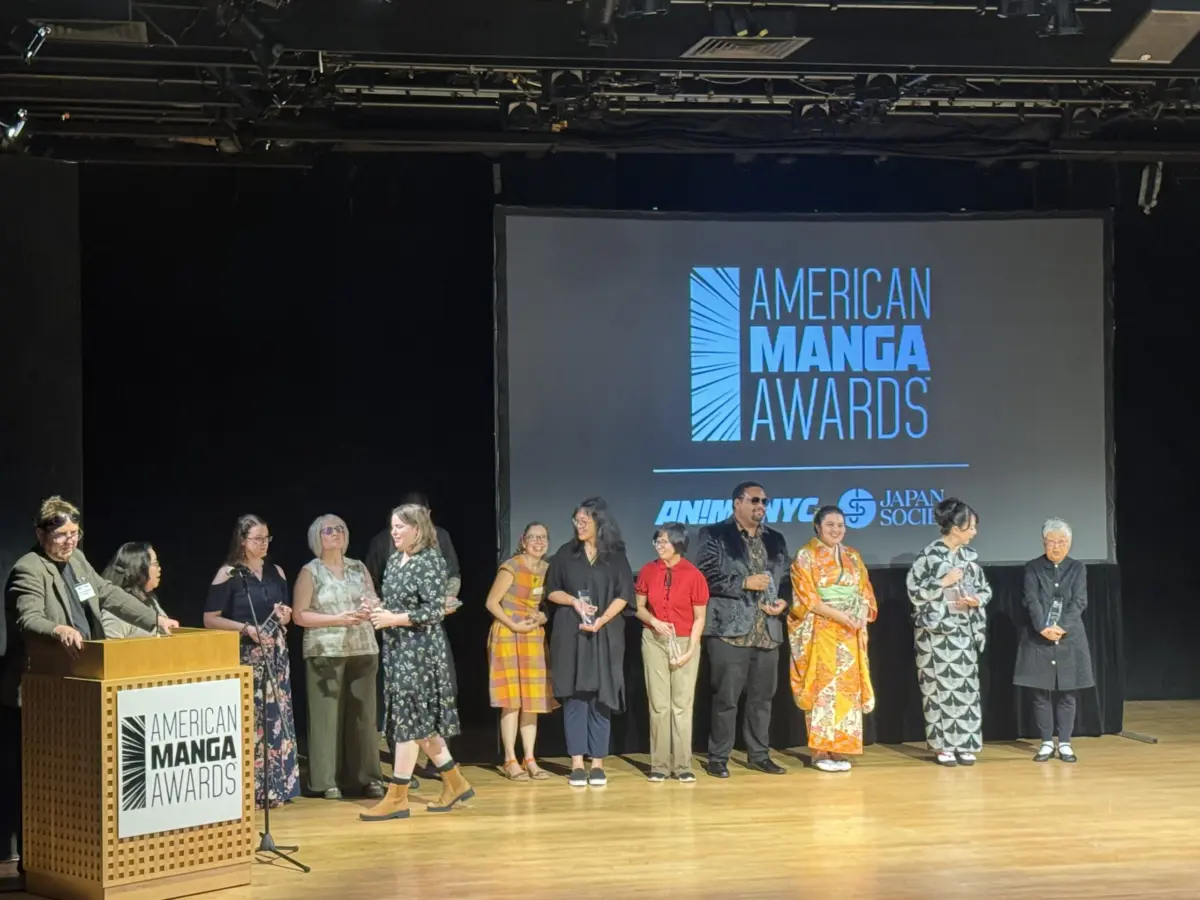
Midtown Manhattan bore the brunt of a ferocious, apocalyptic rainstorm on Thursday, August 20, drenching attendees as they sought refuge inside the storied Japan Society. Yet, inside the auditorium, the dampness of the New York weather was quickly forgotten. The occasion was the third annual American Manga Awards, a high-profile ceremony celebrating the rich history, explosive contemporary success, and unwritten future of Japanese comics and their cross-cultural adaptation into the U.S. market.
What began as an informal gathering to honor localized comic art has rapidly matured into a bellwether event for the global entertainment landscape. Hosted by Eisner Award–winning manga translator Zack Davisson, the evening bridged continents, languages, and mediums. From recognizing century-long publishing powerhouses like Shueisha to confronting the precarious labor realities of the freelance translators who serve as the industry’s lifeblood, the ceremony proved that the American manga community is grappling with both its staggering commercial growth and its structural responsibilities.
As the night unfolded through bilingual acceptance speeches, virtual presenters, and standing ovations, it became abundantly clear: manga is no longer a localized subculture in the United States. It is a dominant cultural force, and the infrastructure supporting it is undergoing a profound reckoning.
Read Also
Detailed Chronology: A Night of Milestones, Translation, and Reckoning
Weathering the Elements and Kicking Off the Celebration
The evening commenced under the lingering atmospheric pressure of a sudden cloudburst. Despite umbrellas being rendered largely useless by the driving wind and rain, the crowd packed into the Japan Society was visibly electrified. Davisson took the stage to open the proceedings, immediately grounding the evening in a historical context. He acknowledged the arduous, years-long industry-wide efforts required to establish formal, prestigious U.S. honors dedicated exclusively to manga publications—a milestone long overdue given the medium’s multi-million-dollar footprint in North America.
Centering a Titan: Shueisha’s Centennial
The first honor of the night set a reverent tone, celebrating a century of storytelling excellence. Shueisha, the Tokyo-based publishing giant behind legendary magazines like Shonen Jump, was awarded a special centennial trophy.
Hiroyuki Kojima, director general of the Japan Foundation, took the stage and drew chuckles from the audience as he attempted to rapidly rattle off the staggering roster of iconic properties born from Shueisha’s presses: Dragon Ball, One Piece, Naruto, Yu Yu Hakusho, Death Note, and Jujutsu Kaisen, among countless others.
"Many of you here in this room may be here because of Shueisha manga," Kojima remarked during his presentation. "For many Americans, I believe, the anime adaptations of those works were their first encounter with Japan, and the beginning of a lifelong appreciation of Japanese culture."
Accepting the Shueisha Centennial Award was editorial director Shuhei Hosono. Fittingly, Hosono’s address highlighted the binational nature of the industry: he opened in accented English before seamlessly transitioning to energetic Japanese with the aid of a translator. Hosono expressed deep gratitude to the manga creators who have partnered with Shueisha and to the fiercely loyal American readership that has embraced their work.
He used the platform to spotlight the publisher’s ambitious Manga Million initiative, a global campaign dedicated to translating 1 million pages of manga into 100 languages worldwide, expanding access to English-language readers for titles that previously lacked international distribution.
Akiko Higashimura and the Bridge of Comedy
The honorary American Manga Award of Distinction was presented by committee member Debra Aoki to prolific manga artist Akiko Higashimura. Widely celebrated in the U.S. for her hit series Princess Jellyfish and Tokyo Tarareba Girls, Higashimura is also among the creators whose deeper cuts—such as Gintaro-san, Much Obliged and My Mom Is Easily Flustered—are slated for English translation under Shueisha’s Manga Million project.
Speaking via translator, Higashimura reflected on her creative roots and the surprising loops of international cultural exchange. "I work on a lot of comedy series, and I’m influenced by American comedies," she noted. Pointing to Tokyo Tarareba Girls, she described it as a Japanese spiritual successor to Sex and the City. "I was influenced by New York entertainment, and to have New Yorkers read my title that was influenced by it is really nice."
The Professional Awards: Craft, Technical Excellence, and Labor Advocacy
Shifting from honorary accolades to competitive categories, the ceremony honored the technical and artistic crafts essential to bringing manga across the Pacific. The professional awards highlighted the unsung heroes of localization:
- Best Publication Design: Awarded to Wendy Chan for her exquisite work on the recent boxed set of Fruits Basket.
- Best Lettering: Awarded to Madeleine Jose for Maid To Skate.
- Best Translation: Awarded to Jan Mitsuko Cash for volume 1 of Magica.
While most acceptance speeches praised the harmonious cultural exchange of international publishing, Cash used her time at the microphone to "politely stir up the pot," delivering what would become the emotional turning point of the evening.
Directing her comments squarely at major publishing executives, Cash issued a blunt and urgent call to action: "Please double your rates [for translators]."
She laid bare the grim economic realities facing freelance translators, noting that compensation packages have remained stagnant for a decade despite rampant inflation. "Your most prolific freelancers," Cash continued, "suffer from online harassment for the things they work on, work 80-hour weeks, have no health insurance or retirement, but have developed long-term occupational illnesses and live paycheck-to-paycheck. At some point, something has to give. Freelancers are the bedrock of the industry, and the foundation your companies stand on is sagging."
The speech was met with a prolonged standing ovation from the audience, signaling that the American Manga Awards were not merely a night of mutual back-patting, but a crucial forum for defining the moral and economic future of the trade.
Artistic Vulnerability: Cocoon and World War II Memory
The gravity of the evening continued with the presentation of Best One-Shot, awarded to Machiko Kyo for Cocoon. Because Kyo was not in attendance, the book’s English-language editor, Pancha Diaz, read a translated statement from the author.
Cocoon, published originally in Japan in 2010, is a daring and somber work that follows Japanese schoolgirls mobilized to support their nation’s military against American invaders during World War II. Kyo admitted to harboring deep anxieties prior to its Western release. "When Cocoon was published in Japan in 2010, I remember asking my editor, ‘Will this story ever be read in America?’"
That his work ultimately found a resonant international audience before its formal U.S. publication underscored the maturity of the Western readership. "I hope that receiving this award will give rise to new questions for me," Kyo’s statement concluded, "and those in turn will inspire me to continue moving forward through my work."
A Virtual Presence and the Future of Storytelling
In a nod to the digital-first evolution of modern fandom, one of the night’s final honors—Best Continuing Series—was presented by IRyS, a prominent streamer who operates using an anime-style virtual avatar, or "VTuber." Davisson introduced her with characteristic flair, reading her official bio describing her as "a Nephilim who was once the embodiment of hope in Paradise."
IRyS announced that the award went to volume six of Mokumokuren’s The Summer Hikaru Died, an uncanny, critically acclaimed supernatural horror series exploring the fragile bond between a teenager and an entity that has usurped the body of his deceased best friend.
Accepting the award on behalf of the author, Yen Press editor Jacquelyn Li took the stage beneath the towering, digital anime avatar. Surveying the scene—accepting a prize for a queer-coded supernatural horror manga via a virtual reality influencer in midtown Manhattan—Li encapsulated the zeitgeist of the evening:
"These are incredible times we live in."
Supporting Context & Metrics: The Expansion of the North American Manga Market
To fully appreciate the gravity of the 3rd Annual American Manga Awards, one must examine the staggering macroeconomic context driving the industry. Over the past decade, manga sales in North America have experienced an unprecedented renaissance. Driven in equal parts by the explosion of legal digital subscription services (such as Shonen Jump and Manga Plus), the mainstream accessibility of streaming platforms like Crunchyroll and Netflix, and the visual literacy of younger demographics, the North American comic book market has fundamentally shifted.
| Metric / Indicator | Historical Context (Pre-2018) | Current Industry Standing (2024–2025) |
|---|---|---|
| Market Share | Niche pop-culture category; relegated to specialty comic book shops. | Dominant segment of overall graphic novel and bookstore sales nationwide. |
| Publisher Reach | Limited physical distribution; sporadic licensing agreements. | Global, synchronized digital-and-print releases (e.g., Shueisha’s Manga Million initiative). |
| Localization Infrastructure | Over-reliance on underpaid, overworked freelancers operating in institutional silos. | Increasingly organized, vocal labor advocacy demanding structural reform (living wages, healthcare, fair rates). |
| Media Intersection | Siloed print medium; anime adaptations as secondary marketing tools. | Fully integrated multi-media ecosystem spanning traditional publishing, streaming, VTuber culture, and high art. |
The launch of initiatives like Shueisha’s Manga Million—pledging to translate 1 million pages into 100 languages—illustrates that supply is scaling to meet unprecedented global demand. However, as industry analysts note, this rapid corporate expansion risks collapsing under its own weight if foundational contributors—such as translators, letterers, and production designers—are not compensated equitably to match inflation and workload.
Official Statements: Voices from the Floor
The dichotomy between corporate celebration and grassroots labor advocacy defined the rhetoric of the evening. Key stakeholders offered poignant perspectives on the state of the art:
- Hiroyuki Kojima (Director General, Japan Foundation): Emphasizing the soft-power bridge forged by Japanese comics, Kojima noted that manga serves as the primary gateway for cross-cultural appreciation in the West. "For many Americans, I believe, the anime adaptations of those works were their first encounter with Japan, and the beginning of a lifelong appreciation of Japanese culture."
- Akiko Higashimura (Manga Artist & Award of Distinction Recipient): Reflecting on the circular nature of global media influence, Higashimura highlighted how Western entertainment traditions often cross back over the Pacific, only to return home transformed. "I was influenced by New York entertainment, and to have New Yorkers read my title that was influenced by it is really nice."
- Jan Mitsuko Cash (Best Translation Winner): Delivering a sobering reality check to publishing executives, Cash spotlighted the human cost behind cultural exchange. "Your most prolific freelancers suffer from online harassment for the things they work on, work 80-hour weeks, have no health insurance or retirement… Freelancers are the bedrock of the industry, and the foundation your companies stand on is sagging."
- Machiko Kyo (Cocoon Creator, via Editor Pancha Diaz): Speaking to the universal resonance of localized historical narratives, Kyo expressed optimism regarding the sophistication of Western readers. "I hope that receiving this award will give rise to new questions for me, and those in turn will inspire me to continue moving forward through my work."
Future Outlook: Challenges and Horizons for American Manga
As the third annual American Manga Awards drew to a close beneath the glow of screens and virtual avatars, the event left attendees with a dual narrative: one of triumphant artistic achievement, and another of urgent systemic reform.
On the horizon, the outlook for manga consumption in North America is overwhelmingly bright. Initiatives like Shueisha’s Manga Million promise to unlock vast archives of Japanese literature that have historically remained inaccessible to English speakers. Furthermore, the diversification of genres—ranging from mainstream battle shonen to psychological horror (The Summer Hikaru Died) and historical trauma (Cocoon)—proves that the American audience has graduated past casual fandom into deep, critical appreciation.
Yet, the resounding applause that greeted Jan Mitsuko Cash’s speech regarding translator compensation serves as a warning shot to major publishers. The romanticized era of passion-project localization, where translators and letterers absorbed personal financial and physical tolls to satisfy global demand, is rapidly drawing to a close. For the manga industry to sustain its explosive multi-billion-dollar trajectory in the United States, corporate stakeholders must invest not only in digital distribution pipelines and marketing initiatives, but in the human infrastructure that makes translation possible.
If the Japan Society events proved anything, it is that the community surrounding American manga—creators, translators, publishers, and fans alike—possesses the passion, courage, and intelligence to weather any storm, literal or figurative. How the industry responds to the labor and creative challenges laid bare on Thursday night will ultimately dictate whether its glittering future stands on solid ground or a sagging foundation.


Comments
Facebook App ID not configured. Please add it in the Customizer.