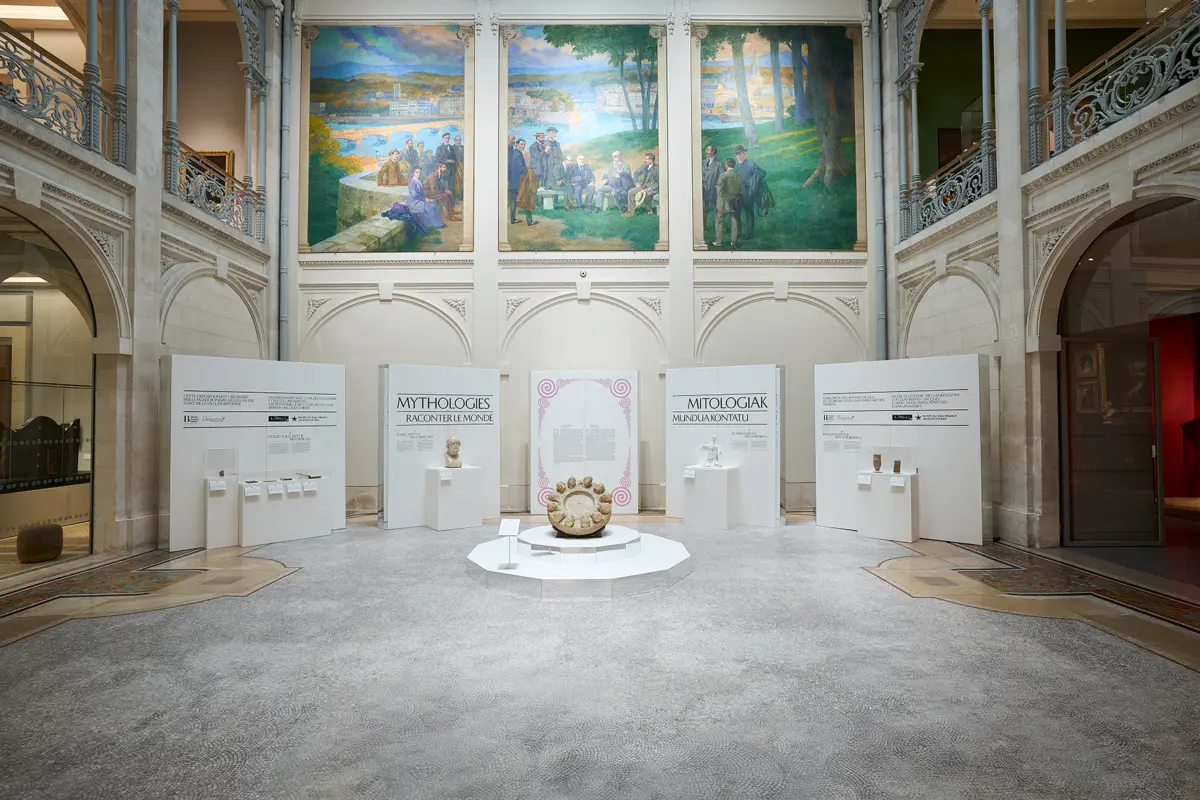
Nicknamed the “Little Louvre,” the Musée Bonnat-Helleu in Bayonne, France, stands at a fascinating crossroads of art history, regional identity, and international cultural politics. Founded in 1891, this hidden gem in the French Basque Country reopened its doors following a massive, 14-year renovation project that successfully doubled its exhibition space. Yet, its physical rebirth is only part of the story. Under the leadership of its 33-year-old director, Barthélémy Etchegoyen Glama—who took the helm ten months prior to its reopening—the institution has debuted its first major temporary exhibition, “Mythologies: To Tell the Story of the World.”
Far from being a routine regional showcase, the exhibition acts as a vibrant manifesto for a new era of museum curation, one that deliberately collapses traditional chronological and geographical boundaries. By placing ancient masterpieces from the Louvre alongside contemporary folk artifacts and global regional works, the museum challenges rigid Eurocentric boundaries of art history.
However, this innovative, inclusive approach does not exist in a vacuum. The cultural philosophy championed by Etchegoyen Glama—one that views the museum not merely as a secure vault for cultural heritage, but as a dynamic public forum rooted in shared humanity—is running headfirst into a conservative, nationalist backlash across Western institutions. As right-leaning political tides shift from the United States to Italy and reverberate through the highest echelons of French cultural administration, museum professionals find themselves navigating a precarious landscape of self-censorship, shifting political appointments, and ideological re-evaluations.
This article explores the triumphant revitalization of the Musée Bonnat-Helleu, the curatorial philosophy driving its new programming, and the broader, high-stakes culture wars threatening to undo a decade of progressive museology in Europe and beyond.
Detailed Chronology
To fully understand the current trajectory of the Musée Bonnat-Helleu and its place within the broader European art ecosystem, it is vital to trace the institutional milestones, leadership transitions, and policy shifts that have defined the past decade.
1891: The Musée Bonnat-Helleu is founded in Bayonne, built upon a foundational collection of approximately 7,000 artworks spanning from antiquity to the early 20th century.
2011–2012: The museum closes its doors to the public to embark on an ambitious, long-term infrastructure overhaul aimed at modernizing its facilities and expanding its curatorial footprint.
2017: French President Emmanuel Macron delivers his landmark speech in Ouagadougou, Burkina Faso, signaling a historic shift toward the restitution of African cultural heritage and opening the door for critical reckonings with colonial histories in French museums.
2019: The Musée d’Orsay, then under the leadership of Laurence des Cars, stages the watershed exhibition “Le Modèle Noir” (Black Models: From Géricault to Matisse). Co-curated by Denise Murrell, the show breaks new ground by examining the representation of Black figures, slavery, and French imperialism throughout art history.
Fall 2025: After a prolonged 14-year closure, the Musée Bonnat-Helleu officially reopens its doors, boasting doubled exhibition space and a radically redesigned permanent collection hang that discards traditional national school divisions in favor of thematic, cross-historical galleries like the "Gallery of the Bodies."
Late 2025 (Approximately 10 months prior to reopening): Barthélémy Etchegoyen Glama, a 33-year-old native of the Basque Country and former advisor to Laurence des Cars, is appointed as the director of the Musée Bonnat-Helleu.
June 2025: The International Council of Museums (ICOM) adopts a modernized code of ethics explicitly stating that museums serve society by embracing diverse perspectives, championing human rights, upholding social justice, and acting as spaces for open dialogue. This guideline immediately draws sharp criticism from conservative French art critics who decry the "politicization" of cultural institutions.
Early 2025 (US Context): The incoming Trump administration issues executive orders targeting public cultural institutions like the Smithsonian Institution, alleging they have fallen under the sway of a "divisive, race-centered ideology."
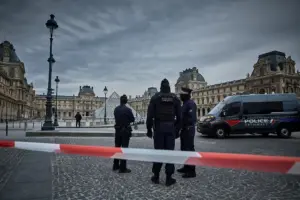
February 2026: Laurence des Cars resigns from her post as president of the Louvre following the high-profile theft of $102 million in historical jewels from the museum. Her departure is widely interpreted by cultural insiders as the end of an era defined by social justice-oriented programming.
May 2026: Christophe Leribault is appointed as the new president of the Louvre. In an interview with Le Monde, Leribault signals a strategic shift away from the robust contemporary art initiatives championed by des Cars, favoring a return to core Western-centric and historical foundations.
Summer 2026: The Musée Bonnat-Helleu unveils its first temporary exhibition since reopening, “Mythologies: To Tell the Story of the World,” featuring rare loans from institutional partners including the Louvre and the Quai Branly museum. The exhibition immediately garners critical acclaim across France while highlighting the deepening ideological divide in modern museology.
Supporting Context & Metrics
The transformation of the Musée Bonnat-Helleu is anchored in impressive logistical and spatial metrics. The institution’s 14-year renovation cycle successfully expanded its physical footprint, doubling its exhibition square footage to house its collection of roughly 7,000 works. This expansion enabled the curatorial team to pioneer a new installation methodology, replacing isolated, compartmentalized national school galleries with thematic spaces.
At the heart of this permanent installation is the “Gallery of the Bodies,” a sweeping spatial arrangement that bridges historical divides. By grouping artistic representations of the human form from ancient Egypt, Greco-Roman antiquity, 17th-century Italy, and 19th-century France—alongside works by the museum’s namesake benefactor, Léon Bonnat—the institution presents art history as a continuous, interconnected human conversation rather than a fractured timeline of isolated civilizations.
This thematic fluidity is mirrored in the museum’s inaugural post-renovation temporary exhibition, “Mythologies: To Tell the Story of the World.” Running through November 9, the exhibition creates startling, cross-cultural dialogues through unexpected juxtapositions:
A traditional Basque lamina (a part-goose, part-woman mask) crafted by the contemporary Owantshoozi studio stands directly opposite a celebrated bust of Homer on loan from the Louvre.
Raphael’s classic Renaissance masterpiece Saint George and the Dragon (1503–05) hangs directly beside mid-17th-century Syrian icon paintings of the identical subject matter, created by Ne’meh al-Musawwir in 1666.
Thomas Loyatho’s 2025 iteration of the Basque "Hartza" (a mythical "man-bear" used in regional spring carnivals) looms large, establishing a direct line between ancient folklore and living contemporary traditions.
However, these curatorial victories contrast sharply with the broader geopolitical and institutional climate in Europe and the United States. According to a 2024 report by the Network of European Museum Organizations (NEMO), European cultural institutions are increasingly vulnerable to political interference, particularly concerning public budget allocations. This financial leverage has cultivated a troubling environment of self-censorship among museum workers who must appease conservative regional and national governments.
Furthermore, high-profile administrative shifts—such as the restructuring of Italy’s cultural ministry under Prime Minister Giorgia Meloni and the leadership transition at the Louvre from Laurence des Cars to Christophe Leribault—illustrate a concerted pushback against the progressive, decolonial frameworks that dominated museum studies over the last decade.
Official Statements & Diverse Perspectives
The ideological battle lines drawn across the museum world have sparked fierce debate among directors, historians, and curators.
Barthélémy Etchegoyen Glama, Director of the Musée Bonnat-Helleu:
“Mythologies serves as a kind of manifesto for the museum we want… It is a vision of the museum that is worth fighting for, because here, the public is at the center. What’s going on in the museum field is a reflection of what is going on in society at large. It’s true that there’s a form of reaction that is visible in all Western societies, in the US as well as in France.”
Glama emphasizes that placing disparate objects together allows visitors to bypass intimidating academic barriers:
“If you understand the relationship between an artist who was also a collector… inspired by art that was much older than what he practiced himself, [then] you understand that the whole history of art is about connection through time and space. Visitors can enter the collection and the history of art first through their feelings and senses.”
Anne Lafont, Art Historian and Member of the Louvre’s Scientific Council:
Reflecting on the shifting institutional landscape following the watershed 2019 “Modèle Noir” exhibition at the Musée d’Orsay, Lafont notes a palpable regression in how museums address racial and imperial history:
“We had the feeling that a window was opening in France. Perhaps it will be difficult to open it wider, or even to leave it open at all. While the inclusion of more women artists will likely continue to hold ground in museums, that is not necessarily the case for questions about the history of colonialism, imperial, and racial history within art history studies.”
Anne Dressen, Curator at the Musée d’Art Moderne de Paris:
Offering a more nuanced perspective based on extensive surveys of European and American museum wall texts, Dressen argues that foundational institutional practices have permanently evolved despite political pressures:
“I see museums asking questions of themselves, and trying to rethink their existing terminologies, in an effort to open up to larger audiences. If you just look back 10 to 15 years [at wall labels mentioning tainted provenance], there’s just no comparison.”
Jean-Christophe Castelain, Writing in Le Journal des Arts:
Criticizing the International Council of Museums’ (ICOM) updated code of ethics for embedding social justice and human rights into professional guidelines, Castelain argued that the organization:
“…is not content to update professional regulations applicable to museums; it politicizes them. Social justice, the battle against discrimination, reparational practices, participation of communities, sustainability—the museum is called upon to respond to the contemporary world’s divisions.”
Future Outlook
As the cultural landscape enters the latter half of the 2020s, the future of museum curation hangs in a delicate balance. On one hand, regional institutions like the Musée Bonnat-Helleu prove that a bold, imaginative approach to exhibition-making can successfully draw diverse publics, revitalize historical collections, and democratize art history. By breaking down the barriers between high art and folk tradition, ancient artifact and contemporary design, directors like Barthélémy Etchegoyen Glama are demonstrating that museums can remain vital, community-centered forums.
On the other hand, the chilling effects of political polarization, executive oversight, and conservative pushback against inclusive, decolonial narratives pose a formidable threat. With major national institutions like the Louvre signaling a retreat from robust contemporary programming under newly appointed leadership, and with international guidelines like those of ICOM facing fierce domestic opposition in France, the hard-fought gains of the 2010s are far from secure.
Ultimately, the museum of the future will be defined by its resilience. Whether institutions will be permitted to act as brave, open-ended mirrors of our shared global humanity—or whether they will be forced to retreat into safe, nationalistic, and academic silos—will depend entirely on the willingness of cultural workers, directors, and publics to defend the museum as a space for civic discourse. In Bayonne, at least, the "Little Louvre" has chosen its side, proving that even the most historic institutions can boldly rewrite the rules of engagement for a changing world.




Comments
Facebook App ID not configured. Please add it in the Customizer.