
Executive Overview
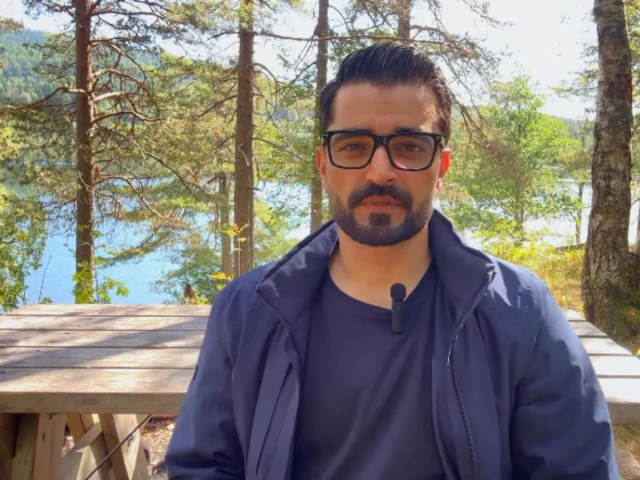
Pakistani actor and public figure Hamza Ali Abbasi has once again stepped into the cultural discourse, leveraging his platform to challenge deeply entrenched societal stigmas. Following insights gathered from consultations behind Marriage4Life—the intentional matchmaking platform he launched alongside his wife, actor Naimal Khawar Khan—Abbasi has brought to light two major cultural roadblocks that continue to plague contemporary South Asian society: the societal prejudice faced by divorced and widowed women seeking to remarry, and the rigid traditional taboo surrounding families of brides taking the initiative in proposing.
In an era where modern technology intersects with conservative cultural expectations, platforms like Marriage4Life are uniquely positioned to act as a mirror for society. Abbasi’s recent video message, shared widely across Instagram, did not merely market an app; it served as a sociological critique of the unwritten rules governing courtship, marriage, and female autonomy in Pakistan. By addressing the double standards that penalize women for exercising their Islamic and moral rights to seek companionship, and by deconstructing the patriarchal premise that the man’s family must always make the first move, Abbasi has ignited a much-needed national conversation.
This report delves into the mechanics of these cultural stigmas, examines the foundational ethos of Marriage4Life, explores historical and religious precedents cited by the actor, and evaluates the broader implications of shifting these rigid behavioral paradigms within Pakistani households.
Read Also
Detailed Chronology: From Concept to Cultural Critique
To understand the weight of Abbasi’s recent statements, it is essential to trace the trajectory of Marriage4Life and the evolution of public discourse surrounding it since its inception in early 2026.
March 2026: The Inception of Marriage4Life
Recognizing a gap in the market for a culturally sensitive, security-focused, and intention-driven matchmaking medium, Hamza Ali Abbasi and Naimal Khawar Khan officially launched Marriage4Life in March 2026. Unlike Western-style swiping applications that often prioritize superficial interactions and casual dating, the couple envisioned an ecosystem explicitly designed for individuals seeking serious, lifelong matrimony. The platform was marketed as a safer alternative to unregulated social media groups and predatory platforms, emphasizing privacy, verified profiles, and family-oriented matchmaking.
July 2026: Rapid Growth and Scaling Realities
Within a mere three months of its rollout, the platform experienced exponential growth. By July 2026, Marriage4Life officially surpassed 20,000 registered members. During this milestone, Naimal Khawar Khan noted that the development team was continuously refining the infrastructure by actively incorporating user feedback. However, as the user base expanded into the tens of thousands, the human resources and consultancy teams behind the platform began processing thousands of real-world narratives, struggles, and systemic bottlenecks. It was through this massive influx of consultations that the platform’s administrators identified the deep-seated psychological and social barriers confronting modern Pakistani singles and their families.
Late 2026: The "Big Discoveries" Unveiled
Synthesizing months of qualitative feedback from the platform’s matchmaking consultants, Abbasi took to Instagram to share what he termed "two big discoveries." Rather than keeping these findings internal, he utilized his considerable reach to dismantle the silence surrounding single mothers, widows, and proposal protocol. His commentary struck a nerve, generating thousands of engagements, debates, and supportive remarks across digital media channels, validating that the platform was touching upon pain points largely ignored by mainstream matrimonial processes.
Supporting Context & Metrics: The Sociological Realities of South Asian Matrimony
The observations shared by Abbasi are not isolated anomalies; they reflect structural vulnerabilities within the South Asian socio-cultural fabric. To contextualize his remarks, one must examine the statistical and cultural landscape of marriage in Pakistan.
The Stigmatization of Single Mothers and Remarriage
In patriarchal societies, divorce and widowhood carry an asymmetrical social penalty. While divorced or widowed men face minimal cultural friction when seeking a subsequent spouse, women—particularly those with children from a previous union—frequently encounter systemic ostracization.
- The "Burden" Narrative: Cultural conditioning often frames children from previous marriages as "baggage," placing an unfair psychological burden on women who wish to rebuild their lives.
- Moral Policing: Divorced women are often subjected to unsolicited moral scrutiny, where their desire for emotional and physical companionship is viewed through a hyper-sexualized or cynical lens, rather than as a fundamental human need.
- Religious vs. Cultural Hypocrisy: As Abbasi pointed out, Islamic jurisprudence explicitly grants women—including divorcees and widows—the moral and legal right to remarry. Yet, cultural orthodoxy often supersedes religious allowance, trapping women in involuntary solitude due to familial and societal judgment.
Challenging the One-Sided Proposal Paradigm
The second discovery highlights the unyielding protocol of the marriage proposal (rishta). Traditionally, South Asian matchmaking operates on a strictly unidirectional axis:
- The prospective groom’s family evaluates multiple prospective brides, often likened to an inspection process.
- The prospective bride’s family waits passively, conditioned to believe that making the first move exhibits desperation or compromises their dignity.
- Rejection by the male’s family inflicts profound psychological damage on the female and her relatives, reinforcing an asymmetrical power dynamic.
By challenging the notion that a bride’s family cannot initiate a proposal, Abbasi directly confronts the classism and institutionalized humility forced upon women in the matrimonial market.
Official Statements and Philosophical Arguments
Hamza Ali Abbasi’s public commentary was marked by a blend of moral appeal, historical reverence, and pragmatic counseling. Below is a detailed breakdown of his core arguments.
On the Rights of Divorced and Widowed Women
Addressing the consultants’ reports regarding how people view women seeking remarriage, Abbasi was unequivocal in his defense of individual autonomy:
"Whether someone wants to marry again or not is their own individual choice. I just request that the women who do want to remarry, we should not view them in a negative light. Our religion has given these women this right; it is their moral right."
He emphasized that altering this perspective would yield immediate humanitarian benefits: "If we change these attitudes, it can ease a lot of lives." By framing the issue through a lens of empathy and religious legitimacy, Abbasi attempts to strip away the cultural shame historically tied to second marriages.
On Reconsidering Proposal Protocols via Historical Precedent
To dismantle the stigma of the bride’s family initiating contact, Abbasi turned to Islamic history, citing the profound example of Prophet Muhammad (PBUH) and Hazrat Khadija (RA):
"Please don’t restrain yourself from wanting to initiate the process. We should not look down upon it; we should actually appreciate and encourage such steps being taken."
By highlighting that Hazrat Khadija (RA) herself approached the Prophet (PBUH) for marriage, Abbasi effectively neutralizes the cultural argument that female-initiated proposals are ungraceful or un-Islamic. He notes that while Pakistani society has modernized in various commercial and technological spheres, deep-seated archaic mindsets regarding courtship remain stubbornly unchanged.
Amplifying the Consultants’ Consensus
Abbasi noted that the issues raised are not isolated personal grievances but systemic dilemmas echoing across households throughout Pakistan and the broader South Asian diaspora:
"Our consultants tell us these are among the biggest issues faced by parents everywhere."
By bringing these private struggles into the public eye, the actor hopes to de-stigmatize the matchmaking process itself, transforming it from a source of anxiety and social humiliation into a transparent, dignified, and mutually respectful endeavor.
Future Outlook: Transforming the Matrimonial Landscape
The intervention by Hamza Ali Abbasi and Naimal Khawar Khan through Marriage4Life points toward a broader transformation in how South Asian societies approach marital unions. As digital platforms gradually replace or supplement traditional matchmakers (mirasis and aunties), the nature of matrimonial data collection is shifting.
1. Shift from Secrecy to Transparency
Historically, past marriages, divorces, and children were facts often obfuscated or whispered about behind closed doors out of fear of social rejection. Platforms that mandate verified profiles and honest disclosures compel families to confront these realities upfront. As more individuals utilize structured platforms, the normalization of remarriage is expected to accelerate.
2. Empowerment Through Female Agency
Encouraging women and their families to take the initiative in proposing represents a fundamental paradigm shift away from passive endurance toward active agency. If cultural leaders and digital platforms continue to validate this approach, future generations may view proposals as a bilateral dialogue rather than a unilateral selection process.
3. The Role of Digital Infrastructure in Social Reform
Marriage4Life demonstrates that tech startups in Pakistan can serve double duty as social enterprises. By utilizing aggregated user data and consultant feedback, platform founders possess a unique vantage point to diagnose societal ailments and use their public profiles to prescribe progressive cultural adjustments.
Conclusion
Hamza Ali Abbasi’s candid revelations regarding the trials faced by divorced women and the rigid protocols of the traditional proposal system underscore a critical truth: technological innovation in matchmaking is futile if it operates within regressive cultural paradigms. By confronting these stigmas head-on, Abbasi and his contemporaries are laying the groundwork for a more empathetic, egalitarian, and spiritually grounded approach to marriage in Pakistan—one where individual dignity supersedes antiquated social pressures.





Comments
Facebook App ID not configured. Please add it in the Customizer.