
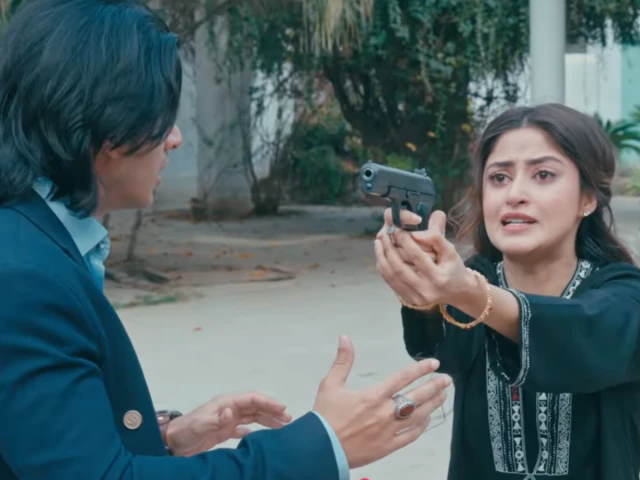
The landscape of contemporary Pakistani television drama is defined by its ability to elicit profound visceral responses from its viewing public, turning serialized fiction into a national cultural dialogue. Recently, the landscape reached a fever pitch during the broadcast of Episode 37 of the hit television serial Zanjeerein. Marking a watershed moment in the series’ narrative arc, the episode featured the long-awaited, deeply explosive face-off between the protagonist, Rabiya, and her antagonist, Torsam.
The sequence was not merely a plot device designed to advance the storyline, but an emotional masterclass that captivated audiences across terrestrial broadcasts and digital streaming platforms alike. Viewers took to social media en masse to dissect the intricacies of the scene, with particular emphasis placed on the mesmerizing performances of leading lady Sajal Aly and veteran actor Usman Javed.
As Zanjeerein races toward its thrilling conclusion—with the penultimate episode scheduled to air next Wednesday—the cultural footprint of Episode 37 offers a compelling case study in the power of sustained narrative tension, psychological realism, and tour-de-force acting. This report provides an exhaustive examination of the dramatic confrontation, the critical and audience reception, the thematic resonance of the storyline, and the broader trajectory of the series as it nears its final curtain.
Read Also
Detailed Chronology: The Anatomy of a Climax
The Build-Up: A Boiling Point Reached
For weeks, the narrative of Zanjeerein has methodically laid the groundwork for a catastrophic collision between Rabiya (portrayed by Sajal Aly) and Torsam (portrayed by Usman Javed). The conflict was never pitched simply as a battle between good and evil; rather, it was layered with the heavy, suffocating baggage of sustained psychological trauma, profound grief, and a burning sense of injustice.
Rabiya’s trajectory throughout the series has been one of systematic erosion. Stripped of her agency, subjected to emotional and situational devastation, and burdened by monumental losses, her character’s descent into a state of furious desperation was meticulously paced by the writers. Torsam, meanwhile, embodied a chilling, calculated malevolence—a villain whose arrogance and lack of remorse served as the ultimate foil to Rabiya’s suffering.
By the time Episode 37 arrived, the narrative spring had been wound as tightly as possible. Viewers had invested dozens of hours into watching Rabiya absorb blow after blow, making the promise of a reckoning not just desirable, but psychologically imperative.
The High-Stakes Sequence
The climax itself played out over several minutes of intense, unyielding drama. When Rabiya finally stood face-to-face with Torsam, the air in the room—and across living rooms nationwide—seemed to vanish. The sequence escalated rapidly from icy, silent fury to an open, volcanic eruption of raw emotion.
The tension was ratcheted up exponentially when Rabiya pulled a gun on Torsam. The firearm served as a physical manifestation of her ultimate power over her tormentor, but also as a ticking time bomb for the audience: Would a lifetime of accumulated grief and a desperate desire for revenge push Rabiya across an irreversible moral threshold?
As Rabiya cornered Torsam, one of the scene’s most devastating emotional beats arrived when she pleaded for her life to be returned to her. This single, agonizing line cut through the noise of the physical confrontation, laying bare the tragic truth that revenge would not resurrect what she had truly lost. It was a moment that underscored how profoundly the events of the narrative had warped, scarred, and fundamentally changed her character.
Supporting Context & Metrics: Cultural Impact and Audience Reception
The Digital Echo Chamber
The immediate aftermath of Episode 37 transformed social media platforms—particularly X (formerly Twitter), Instagram, and TikTok—into virtual amphitheaters of analysis and praise. Within hours of the broadcast, hashtags associated with Zanjeerein, Sajal Aly, and Usman Javed trended nationally.
Audience fragmentation in the modern television landscape often makes it difficult for a single show to capture the collective imagination, but Zanjeerein achieved precisely that. User-generated clips of the confrontation garnered millions of views, accompanied by fervent commentary praising the direction, script, and, above all, the performances.
Fan Testimonials and Critical Tributes
The qualitative data gathered from fan responses highlights a level of engagement rarely seen in contemporary television:
- Praise for Narrative Payoff: "Waited the whole drama for this plot twist and confrontation," wrote one prominent fan reviewer, capturing the sentiment of an audience that had endured weeks of agonizing narrative suspense.
- Global Resonance: The cross-border and international appeal of the series was underscored by calls for wider digital distribution. One viral comment pleaded: "Put this on Netflix, she acted so damn well," reflecting the high production values and universal thematic appeal of the project.
- Appreciation for Physicality and Micro-Expressions: Viewers were particularly articulate about the physical language of the scene. One fan noted: "Her eyes when she was strangling him… Oh my God, those were the eyes of pure hatred and revenge. How can someone be so goated in acting even with eyes?"
- Cathartic Release: Numerous viewers reported shedding tears in real-time as they watched Aly’s character break down, tremble, and articulate the sheer unfairness of her subjugation.
Character Analysis & Thematic Resonance
Sajal Aly’s Masterclass in Emotional Range
Sajal Aly’s reputation as one of South Asia’s most formidable dramatic actors was cemented further by her work in Episode 37. The sequence required her to transition seamlessly through a dizzying array of high-stakes psychological states: shock, profound disbelief, paralyzing sorrow, white-hot rage, and helpless vulnerability.
What distinguished Aly’s performance was her avoidance of melodrama for its own sake. Even when screaming in anguish or holding a lethal weapon, her portrayal retained an anchor of psychological truth. The subtlety with which she conveyed multiple conflicting emotions simultaneously—the desire to kill juxtaposed with the agonizing grief of a victim—demonstrated a rare mastery of the craft. Industry observers and fans alike were quick to dub it "the best scene of the whole drama."
Usman Javed: The Underrated Antagonist
While the lion’s share of digital real estate was understandably dedicated to Aly, critical discourse quickly pivoted to ensure that Usman Javed received his due credit for portraying Torsam.
Villain roles in television serials frequently devolve into caricature, but Javed managed to infuse Torsam with a chilling dimension of realism. In the face-off sequence, Javed’s micro-expressions were crucial to the scene’s success. As Rabiya turned the tables on him, his face flickered through shock, creeping embarrassment, and a deeply unsettling undercurrent of guilt—all while maintaining the residual pride of a man unaccustomed to being subjugated.
Fan forums were quick to champion his contribution:
"Usman Javed is so underrated. I truly wish him more success, recognition, and appreciation for his work. He deserves so much more."
Without Javed’s grounded, menacing, yet psychologically vulnerable portrayal of Torsam, Aly’s performance would have lacked the necessary resistance to spark such theatrical fireworks.
Future Outlook: The Countdown to the Finale
As the dust settles on the cultural phenomenon that was Episode 37, attention turns inevitably to the horizon. Zanjeerein is rapidly approaching its climax, with the second-last episode scheduled to air next Wednesday.
Narrative Stakes Moving Forward
The cliffhanger left by the confrontation—with Rabiya holding a gun to Torsam—poses profound structural questions for the final hours of the narrative:
- The Moral Horizon: Will Rabiya pull the trigger, sacrificing her soul and her future to the gods of vengeance, or will an external intervention or internal grace pull her back from the precipice?
- Resolution of Trauma: Can a character as deeply fractured as Rabiya find a path toward healing, or is the tragedy of Zanjeerein destined to be an unmitigated Greek tragedy?
- The Fate of the Antagonist: How will Torsam’s arc conclude? Will justice be meted out through institutional channels, or will the private war between these two characters consume them both?
Industry Implications
The success of Zanjeerein—and specifically the viral resonance of Episode 37—signals a shift in what contemporary audiences demand from prime-time television. Viewers are no longer satisfied with passive storytelling; they crave emotional authenticity, high production complexity, and fearless performances that explore the darkest corners of the human psyche.
As broadcasters and producers look toward the post-Zanjeerein era, the benchmark has been set exceptionally high. For Sajal Aly and Usman Javed, the acclaim garnered from this sequence further solidifies their status as heavyweights of the medium, leaving fans eagerly anticipating their next creative endeavors while steeling themselves for an unforgettable series finale next week.


Comments
Facebook App ID not configured. Please add it in the Customizer.