
Executive Overview
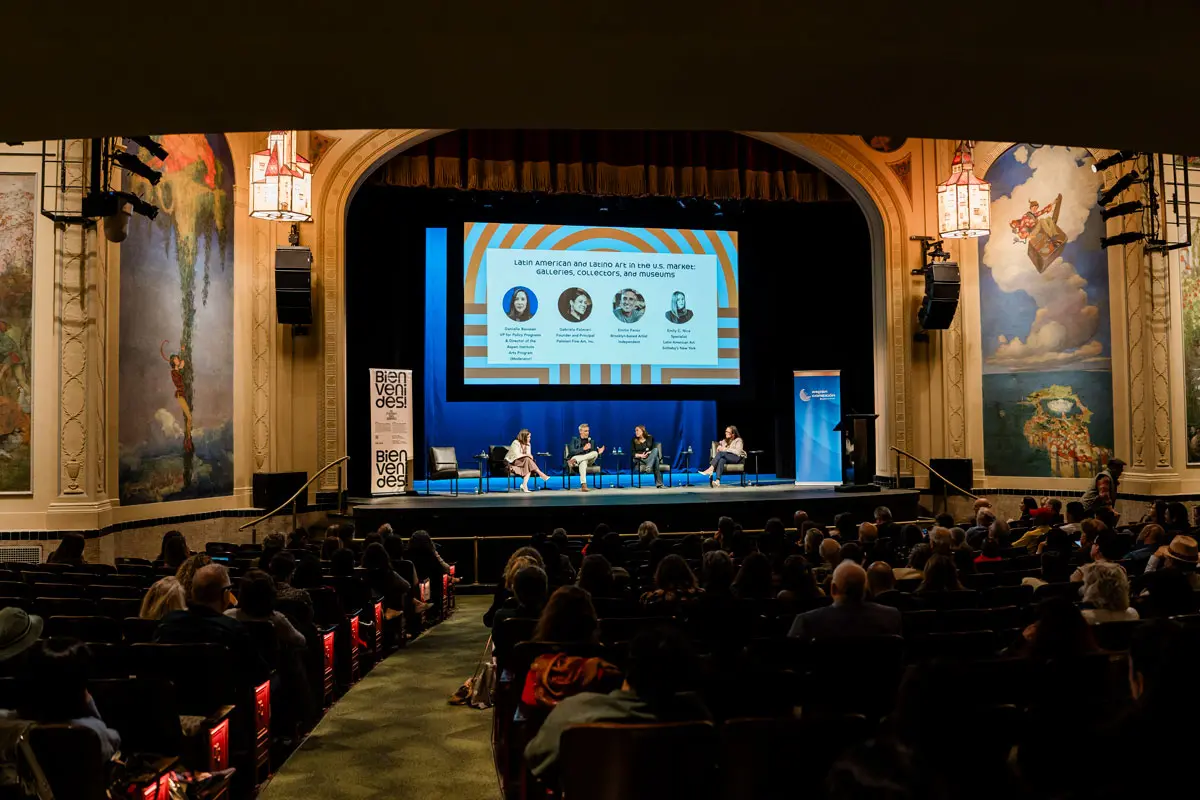
This spring, the historic Teatro space at New York’s El Museo del Barrio served as the epicenter for a critical and long-overdue dialogue regarding the economic and institutional standing of U.S. Latinx visual culture. Titled “The Rise of the U.S. Latino Art Market: Lessons from Latin America,” a half-day symposium brought together a distinguished roster of artists, curators, museum directors, market insiders, and philanthropic leaders. Co-hosted by El Museo del Barrio and Aspen Conexión—a division of the Aspen Institute formerly known as Latinos & Society—the convening arrived at a watershed moment. While contemporary culture is increasingly being shaped and driven by Latinx creative power across music, fashion, and film, the visual arts sector continues to lag behind in institutional support, equitable market investment, and robust commercial infrastructure.
The core thesis of the gathering was as provocative as it was pragmatic: Can the unprecedented market surge of Latin American art over the past two decades serve as a viable blueprint for accelerating the fortunes of U.S. Latinx art?
While speakers acknowledged the remarkable secondary market milestones achieved by historical Latin American icons—such as Leonora Carrington and Frida Kahlo fetching historic multimillion-dollar auction sums—they also confronted the sobering realities facing contemporary Latinx artists living and working within the United States. Underrepresented in major museum collections, routinely pigeonholed by rigid categorizations, and historically overlooked by commercial gallerists, Latinx art is operating in what market leaders describe as an “earlier chapter” of a developing story.
Read Also
Throughout the day, panel discussions and keynote addresses dissected the mechanics of institutional visibility, the pitfalls of drawing direct comparisons between continental Latin America and the domestic U.S. market, and the absolute necessity of moving past fleeting cultural moments to secure permanent structural change.
Detailed Chronology of the Convening
Setting the Stage: The Institutional Imperative
The symposium opened with remarks from Karla Harwich, board chair of El Museo del Barrio, who framed the growing visibility of U.S. Latinx artists as “a profound cultural shift.” However, Harwich immediately tempered the optimism with a call to action, noting that this newfound visibility must be matched by sustained, equitable financial investment and long-term institutional backing.
“The questions we are exploring feel both urgent and long overdue,” Harwich told the packed auditorium. “This is precisely why today matters.”
Pilar Frank O’Leary, executive director of Aspen Conexión, expanded on this sentiment by placing the conversation within a broader socioeconomic framework. Tracing the evolution of her organization’s mission, she emphasized that the impact of the Latino community in the United States is fundamentally a hemispheric phenomenon spanning business, finance, sports, and culture.
“We are gathering at a moment when Latino culture is increasingly redefining the American and the global mainstream,” Frank O’Leary stated, famously categorizing the current zeitgeist as “the Bad Bunny era.”
Patrick Charpenel, executive director of El Museo del Barrio, sharpened the day’s focus by presenting a guiding question for the attendees: “At El Museo del Barrio, we think deeply about how to translate cultural moments into structural change. What does it take to move from moments of visibility to lasting recognition?”
Panel One: Galleries, Collectors, and the Mechanics of the Market
The morning’s first panel, titled “Latin American and Latino Art in the U.S. Market: Galleries, Collectors, and Museums,” was moderated by Danielle Baussan of the Aspen Institute. It featured art adviser Gabriela Palmieri, artist Emilio Perez, and Emily C. Nice, a Latin American art specialist at Sotheby’s.
The discussion quickly turned to the staggering economic velocity of Latin American art on the secondary market. Gabriela Palmieri pointed to the phenomenal trajectory of Leonora Carrington, whose auction record was reset twice within a brief two-year window—climbing from $3.3 million in 2022 to an astonishing $25.8 million in 2024. Palmieri also highlighted a major institutional milestone: Wifredo Lam’s modernist masterpiece The Jungle (1942–43), which for decades hung quietly near the elevators at the Museum of Modern Art (MoMA), finally received prime placement during the artist’s major retrospective last fall.
Emily C. Nice provided historical context from the auction house perspective, noting that Sotheby’s initiated dedicated Latin American art auctions following a formative specialist trip to Mexico in 1977. She pointed out that while Carrington’s records were achieved at Sotheby’s, the house also brokered the sale of Frida Kahlo’s El Sueño (La cama), which shattered the record for the most expensive Latin American artwork ever sold at auction when it realized $54.7 million in November 2025.
“Context is key, placement is seminal, and excitement is real,” Palmieri summarized.
Yet, artist Emilio Perez—whose vibrant, gestural abstractions are currently featured in Let Us Gather in a Flourishing Way, a major survey of contemporary Latinx painting at the Buffalo AKG Art Museum—offered a vital counterpoint from the creator’s perspective. Perez admitted that he initially hesitated to join convenings centered strictly on identity-based markets, fearing the limitations of categorical labels.

“Given my background, of course, I’m always going to be Latino—that’s who I see when I look in the mirror in the morning,” Perez reflected. “But when it comes to how the work is perceived, it really has so much to do with nuance. As an artist, my interest focuses on being able to connect with a much broader audience, and sometimes I find labels to be somewhat of a constraint.” He concluded with pragmatic advice for emerging practitioners: “For any artist, the important thing is showing up every day, and when those opportunities happen, when those doors open, you have to walk through them.”
Panel Two: Decolonizing the System and the Danger of False Equivalencies
Serving as a thematic rebuttal to the first panel, the afternoon session—“Decolonizing the Art System: Visibility and Invisibility in Latin American and Latino Art”—tackled the structural mechanics of exposure. Moderated by the event’s organizers, the panel featured Silvia Cubiñá, executive director and chief curator of the Bass Museum of Art in Miami; Irene Gelfman, global curator for the Pinta Group; Patricia Hanna, director of the Jorge M. Pérez Collection and El Espacio 23; and Susanna V. Temkin, interim chief curator at El Museo del Barrio.
Patricia Hanna redirected the conversation from pure market metrics to physical and institutional access. “We talk a lot about the market, sales, record sales, and these works entering collections, but these works need to be seen, so how do people even know they exist if they don’t go to institutions and museums?” Hanna asked. She detailed how El Espacio 23, established by prominent collectors Darlene and Jorge M. Pérez, mounts ambitious annual exhibitions timed to coincide with Art Basel Miami Beach, deliberately inserting marginalized artists into a global discourse.
Susanna V. Temkin highlighted the institutional framework built by El Museo del Barrio, notably the successful relaunch of its signature La Trienal exhibition series in 2021. Drawing on her previous tenure as a curator at the Americas Society, Temkin noted that El Museo serves as a unique launchpad. “Shortly after the first Trienal, we witnessed [some featured artists’] work finally being acquired by major institutions,” she observed.
However, Silvia Cubiñá offered a necessary reality check regarding the impulse to mirror the success of Latin American art onto the U.S. Latinx demographic. She cautioned that comparing the two ecosystems is “a little bit of an unfair comparison.” Cubiñá pointed out a massive demographic disparity: the population of Latin America and the Caribbean stands at approximately 673 million, supported by sprawling, localized infrastructures of museums, galleries, and private foundations across dozens of nations. By contrast, the U.S. Latinx population totals roughly 68 million, operating within a historically rigid, Eurocentric American art establishment.
“Creating that infrastructure—which El Museo del Barrio does so well, and I think all of us try a little bit to do—is really important and the way forward,” Cubiñá argued.
The Keynote Address: Responsibility, Collaboration, and Long-Term Vision
The day’s proceedings culminated in a powerful keynote address delivered by E. Carmen Ramos, chief curatorial and conservation officer of the National Gallery of Art in Washington, D.C. Drawing on decades of institutional experience, Ramos rooted her address in a philosophy of proactive optimism.
“I bring lived experience grounded in the belief that equal opportunity, curiosity, pride, and joy can help advance Latinx art in the present and future,” Ramos told the audience.
At the same time, she did not shy away from confronting systemic shortcomings. “Our field, while undoubtedly better than in the not-too-distant past, still fails to fully recognize the realities facing many Latinx artists and institutions—their profound underrepresentation and their trailblazing leadership remain widely overlooked and underknown.”
Ramos positioned commercial galleries, private collectors, and critical voices as “essential partners” alongside public museums in the ongoing work of equity. In her closing remarks, she issued a rallying cry for sustained institutional commitment: “The stories we revisited, the artists we uplifted, the institutions we recognized—all reminders that progress is never incidental. It is built over the long haul through conviction, collaboration, and the courage to imagine something better.”
Supporting Context & Metrics: Latin America vs. U.S. Latinx Art
To fully grasp the core debate of the El Museo symposium, one must examine the stark economic and structural disparities separating the international Latin American art market from the domestic U.S. Latinx art market.
The Latin American Art Surge
Over the past twenty years, Latin American modern and contemporary art has transitioned from a specialized collecting category into a powerhouse sector of the global blue-chip art market. This growth was not accidental; it was the result of a coordinated, multi-decade ecosystem-building effort spearheaded by international auction houses, specialized galleries, major institutional retrospectives, and dedicated art fairs.
- Auction Milestones: The secondary market for Latin American surrealism and modernism has achieved historic heights. Leonora Carrington’s auction benchmark vaulted from $3.3 million in 2022 to an astounding $25.8 million in 2024. Shortly thereafter, Frida Kahlo’s 1939 painting El Sueño (La cama) realized $54.7 million at Sotheby’s, setting a new all-time high for any Latin American artwork sold at auction.
- Institutional Anchoring: Museums such as the Museum of Modern Art (MoMA), the Tate Modern, and the Reina Sofía have increasingly integrated foundational Latin American figures into their permanent collection displays and prime exhibition real estate, shifting artists like Wifredo Lam and Remedios Varo from the margins to the center of art-historical narratives.
- Fair Infrastructure: Platforms like the Pinta Group, founded by Diego Costa Peuser, have meticulously cultivated regional and international art weeks across Latin America, the Caribbean, and the United States, fostering regional collector bases and institutional networks.
The U.S. Latinx Realities
Conversely, U.S. Latinx art—encompassing the visual production of artists of Latin American and Caribbean descent living and working in the United States—occupies a more precarious developmental stage.
- Demographics vs. Representation: While U.S. Latinos represent a demographic force of approximately 68 million people—driving consumer trends, economic growth, and cultural innovation—their representation within major U.S. museum permanent collections, boardrooms, and commercial gallery rosters remains disproportionately low.
- The Danger of False Equivalency: As expert panelists noted during the symposium, comparing the U.S. Latinx market to continental Latin America ignores structural realities. Latin America comprises dozens of sovereign nations with their own entrenched museum systems and state-supported cultural policies. U.S. Latinx artists, by contrast, must navigate a predominantly Anglo-American institutional apparatus that has historically treated multicultural art through episodic, siloed programming rather than permanent integration.
Official Statements and Perspectives
-
Pilar Frank O’Leary (Executive Director, Aspen Conexión):

"Latino impact in the United States is not only a domestic story but a hemispheric one across business, culture, finance, sports, and the arts. Latino communities are shaping markets, influencing global demand and redefining how we think about economic growth and cultural power across the Americas and beyond."
-
Karla Harwich (Board Chair, El Museo del Barrio):
"The increased visibility that U.S. Latinx artists are receiving is a profound cultural shift, but there is still significant work to be done to ensure that this influence is matched by sustained institutional, equitable market investment, and long-term infrastructure."
-
Patrick Charpenel (Executive Director, El Museo del Barrio):
"At El Museo del Barrio, we think deeply about how to translate cultural moments into structural change. What does it take to move from moments of visibility to lasting recognition?"
-
Diego Deleersnyder (Managing Director, Aspen Conexión):
"The rise of Latin American art over the past two decades did not happen by accident. It was built intentionally, through institutions, collectors, galleries, fairs, and sustained investment over time… Latinx art is still in an earlier chapter of that story."
-
E. Carmen Ramos (Chief Curatorial and Conservation Officer, National Gallery of Art):
"Our field, while undoubtedly better than in the not-too-distant past, still fails to fully recognize the realities facing many Latinx artists and institutions—their profound underrepresentation and their trailblazing leadership remain widely overlooked and underknown."
Future Outlook: Building a Lasting Infrastructure
As the symposium concluded, the consensus among artists, curators, and market leaders was clear: capitalizing on the current cultural visibility of Latinos requires moving past ephemeral trends and constructing durable institutional scaffolding.
The lessons learned from the maturation of the Latin American art market offer a clear roadmap, albeit one that must be tailored to the unique sociopolitical and economic realities of the United States. Translating the "Bad Bunny era" of mainstream cultural dominance into permanent art-historical weight will demand coordinated action across multiple fronts:
- Sustained Institutional Acquisitions: Major U.S. museums must move beyond periodic, identity-driven group exhibitions and commit to long-term, structural acquisitions of contemporary Latinx art for their permanent collections.
- Commercial Gallery Support: Commercial galleries must continue to nurture and champion Latinx artists, providing them with the primary market backing, international art fair placement, and critical monograph production necessary for long-term career viability.
- Philanthropic and Collector Engagement: Private collectors and philanthropic foundations—following models like El Espacio 23 and El Museo del Barrio—must expand patronage networks specifically dedicated to supporting U.S. Latinx visual culture.
- Cross-Border Collaboration: Fostering deeper ties between domestic U.S. institutions and Latin American art ecosystems will allow for a more fluid exchange of ideas, scholarship, and market opportunities.
In his closing remarks, Aspen Conexión managing director Diego Deleersnyder captured the ultimate aspiration of the gathering: "The talent is here, the cultural influence is undeniable, the demographic and economic momentum is significant… We hope today is not the end of a conversation, but the beginning of many more—across institutions, across markets, and across borders."


Comments
Facebook App ID not configured. Please add it in the Customizer.