
Executive Overview
The tragic loss and systematic violation of society’s most vulnerable members have triggered an unprecedented wave of fury and collective activism across Pakistan’s cultural and social landscape. At the forefront of this mobilization is prominent actor Sarah Khan, whose impassioned public pleas via social media have amplified a national conversation long overdue for structural legislative reform. In a series of unvarnished, deeply emotional statements shared across digital platforms, Khan gave voice to a terror shared by millions of parents: the escalating, nightmarish reality of child sexual abuse and violence sweeping the nation.
This outcry is not an isolated emotional response; it is a critical tipping point in a society reeling from a succession of high-profile, devastating crimes against children. From the horrific abduction and murder of five-year-old Ayat Noor in Haripur to the brutal assault and killing of a toddler in Karachi, the collective conscience of the nation has been pushed past its breaking point. Artists, intellectuals, and citizens alike are no longer willing to accept cyclical statements of condemnation from political leadership. Instead, they are demanding systemic transparency, uncompromising legal enforcement, preventive safeguarding frameworks, and the strict implementation of maximum penalties—including the death penalty—for offenders.
This comprehensive report examines the catalyst behind Sarah Khan’s poignant appeals, contextualizes the broader systemic failures enabling these atrocities, reviews the specific horrifying incidents driving public panic, and outlines the urgent path forward required of Pakistan’s federal and provincial governing bodies to restore public trust and protect future generations.
Read Also
Detailed Chronology: The Escalating Crisis and Celebrity Mobilization
The current wave of public indignation did not emerge in a vacuum. It is the direct consequence of a horrifying sequence of events that laid bare the systemic vulnerabilities plaguing child protection infrastructure across Pakistan.
The Immediate Catalyst: Social Media Advocacy by Sarah Khan
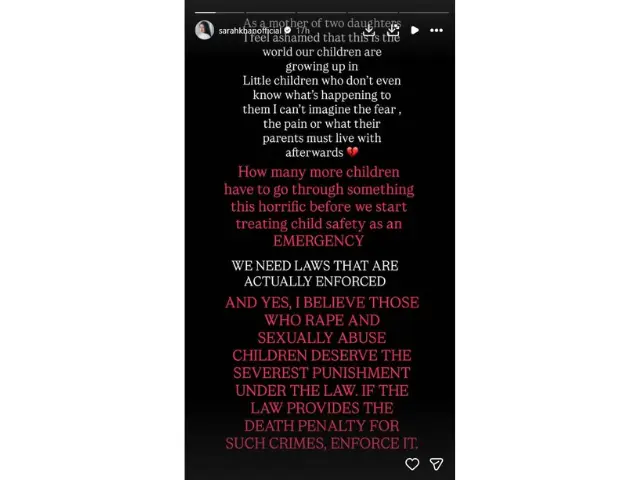
Taking to her official Instagram account, actor Sarah Khan—speaking explicitly through the lens of a mother of two young daughters—drew back the curtain on the profound psychological toll these crimes take on parents. Her digital statements served as a piercing indictment of the current socio-legal environment:
"As a mother of two daughters, I feel ashamed that this is the world our children are growing up in. Little children who don’t even know what’s happening to them. I can’t imagine the fear, the pain, or what their parents must live with afterwards."
Khan challenged the reactive nature of the state apparatus, questioning how many more children must suffer before child safety is declared an absolute national emergency. Directing her outrage at the highest echelons of power, she tagged Prime Minister Shehbaz Sharif, the Government of Pakistan, and Federal Law Minister Azam Nazeer Tarar.

Rather than settling for generic condemnations, Khan outlined specific demands:
- Uncompromising Penalties: Immediate enforcement of the death penalty or the maximum legal punishment available under the law for child rapists and abusers.
- Preventive Action over Reactive Condemnation: Shifting state focus from post-tragedy rhetoric to proactive policing, community surveillance, and institutional safeguards that prevent offenses before they occur.
- Institutional Transparency: Clear, public-facing accountability regarding how investigative agencies handle cases, track down predators, prosecute offenders, and protect traumatized families from secondary victimization.
The Broader Industry Backlash
Sarah Khan’s digital campaign is part of a unified front within Pakistan’s entertainment sector. A coalition of leading artists—including Mahira Khan, Naimal Khawar, and Sonya Hussyn—has leveraged their massive public platforms to demand systemic accountability. This cross-industry solidarity signals a departure from traditional celebrity neutrality. Recognizing their reach, these cultural figures are forcing mainstream media and political stakeholders to confront uncomfortable truths about institutional apathy, slow-moving justice systems, and the pervasive culture of impunity that protects perpetrators of gender-based and child violence.
The Ground Reality: Recent Heinous Incidents
The urgency behind these demands is anchored in a series of deeply disturbing recent criminal investigations that shocked the nation:
- The Haripur Tragedy: Five-year-old Ayat Noor was abducted, sexually assaulted, and brutally murdered. Her lifeless body was later discovered in a well, plunging her community into mourning and exposing glaring gaps in local law enforcement response times and missing-child protocols.
- The Karachi Tragedy: A mere year-and-a-half-old toddler fell victim to a heinous crime in Qayyumabad, Karachi. Local police subsequently arrested a 17-year-old relative linked to the brutal sexual assault and murder—underscoring the terrifying reality that a significant proportion of child abuse occurs within the immediate domestic or extended family circle, where children are meant to be safest.
These cases, compounded by dozens of underreported atrocities across rural and urban centers, transformed isolated tragedies into a unified national movement demanding structural overhaul.
Supporting Context & Metrics: The Anatomy of Child Abuse in Pakistan
To understand the ferocious urgency of Sarah Khan’s appeal, one must examine the broader statistical and structural landscape of child abuse in Pakistan. Civil society organizations, child rights advocates, and independent watchdogs have repeatedly warned that the nation faces a hidden pandemic of child sexual abuse, exploitation, and violence.
Statistical Realities and Reporting Barriers
According to annual data compiled by organizations such as Sahil, a leading non-governmental organization dedicated to the protection of children’s rights in Pakistan, thousands of child abuse cases are reported across the country annually. However, experts emphasize that these reported figures represent merely the tip of the iceberg.
- The Dark Figure of Crime: Social stigma, fear of familial dishonor, victim-blaming, and profound distrust in the criminal justice system mean that a staggering percentage of child abuse cases go entirely unreported.
- Demographic Vulnerability: Data consistently reveals that younger children—particularly toddlers and pre-teens—are disproportionately targeted. Furthermore, a disturbing percentage of perpetrators are known to the victims, including neighbors, trusted family acquaintances, and extended relatives, complicating traditional community-safety paradigms.
- Geographic Spread: While urban centers like Karachi, Lahore, and Islamabad receive concentrated media attention due to the presence of national news outlets, rural areas—where policing infrastructure is thin, forensic capabilities are primitive, and local power dynamics often suppress justice—suffer disproportionately from unpunished crimes against minors.
Systemic Bottlenecks in the Justice System
The frustration voiced by public figures like Sarah Khan stems from structural dysfunctions deeply embedded within Pakistan’s investigative and judicial pipelines:
- Forensic Deficiencies: First-responder protocols frequently fail to secure vital forensic evidence at crime scenes. Delays in DNA collection, lack of specialized child-friendly interview rooms, and overloaded forensic laboratories often compromise cases before they reach a courtroom.
- Protractedly Slow Trials: Judicial backlogs mean that trials for heinous crimes can drag on for years. This erosion of swift, definitive justice diminishes the deterrent effect of the law and inflicts enduring psychological trauma on grieving families forced to relive their nightmares through endless court adjournments.
- Implementation Gaps: While legislative frameworks—such as the Zainab Murder Case (Protection and Rehabilitation of Children) Act and various provincial child protection laws—exist on paper, their enforcement remains inconsistent. Bureaucratic inertia and a lack of inter-agency coordination between provincial police departments and federal oversight bodies often render protective laws toothless in practice.
Official Statements and Institutional Response
As public pressure mounts, federal and provincial governments face intense scrutiny over their handling of child safety issues. Historically, the state’s response to such crises has followed a predictable cycle: initial shock, emotional public statements from political leaders promising swift justice, the formation of high-level joint investigation teams (JITs), followed by a gradual lapse into institutional complacency once public media attention wanes.
The Demand for Structural Accountability
The poignant interventions by cultural icons have rejected this cycle of political amnesia. By directly tagging Prime Minister Shehbaz Sharif and Federal Law Minister Azam Nazeer Tarar, the artistic community has forced federal policymakers into a corner where generic press releases and token condemnations are no longer politically viable.
- The Call for Legislative Transparency: Legal experts echoing Sarah Khan’s sentiments argue that the Ministry of Law and Justice must publish periodic, verifiable transparency reports detailing:
- The exact number of registered child abuse and exploitation cases nationwide.
- The conviction rates achieved within specialized anti-terror or fast-track gender/child courts.
- The status of pending investigations where perpetrators remain at large.
- Institutional Overhaul Proposals: Child rights activists are pressing the government to move beyond punitive measures and invest heavily in institutional preventative infrastructure. This includes:
- Mandating comprehensive background checks for individuals working in educational, recreational, and domestic sectors.
- Establishing nationwide, toll-free emergency helplines integrated with rapid-response child protection units.
- Implementing mandatory child-safety and body-autonomy education curricula within primary schools to empower children to recognize and report inappropriate behavior.
Future Outlook: A Critical Crossroads for Child Protection in Pakistan
The emotional outcry led by Sarah Khan and supported by Pakistan’s wider cultural fraternity represents a critical diagnostic moment for the nation. It highlights a profound disconnect between the lived realities of ordinary citizens and the protective efficacy of state institutions.
The Choice Ahead
Pakistan stands at a definitive crossroads. The state can choose to treat this moment as a temporary public relations crisis, offering superficial assurances while structural failures persist behind closed doors. Alternatively, the government can seize this momentum to forge a transformative partnership with civil society, legal experts, and child rights advocates.
Roadmap for Sustainable Reform
To honor the memory of victims like Ayat Noor and protect the millions of children currently growing up in fear, structural reforms must be implemented with unyielding political will:
- Fast-Tracking Judicial Proceedings: Establish dedicated, fast-track juvenile and child protection courts across all provinces, mandating that trials involving the abuse, abduction, or murder of minors reach a definitive legal verdict within 90 days.
- Standardizing Investigative Protocols: Upgrade provincial police forces with modern forensic tools, mandatory sensitivity training for investigating officers dealing with traumatized minors, and specialized child-interviewing units to eliminate secondary trauma during investigations.
- Transparent State Reporting: Institutionalize a transparent national registry for convicted sex offenders, coupled with regular public briefings by law enforcement agencies regarding the protection status and prosecution metrics of child-related crimes.
- Holistic Prevention and Education: Deploy nationwide public awareness campaigns and mandatory school-based education programs aimed at dismantling the stigma of reporting abuse, empowering children, and educating parents and guardians on early warning signs.
As Sarah Khan powerfully articulated, vulnerable children cannot fight for themselves; society and the state must shoulder that heavy burden. The current wave of celebrity activism has cracked open the door to uncomfortable truths. It now falls squarely upon the shoulders of Prime Minister Shehbaz Sharif, Law Minister Azam Nazeer Tarar, and provincial legislators to ensure that this collective outcry translates into permanent, unyielding, and life-saving legislative protection.





Comments
Facebook App ID not configured. Please add it in the Customizer.